the Sanskriti experience and my buddies – posted 12/21/14 in Boulder

72 Sanskriti_DSC5465 copy

above image: Sanskriti Kendra, Delhi, India

Happy winter solstice and to my friends in the South happy summer solstice! It is a month now since I left India and the residency at Sanskriti. Most of my blog posts have been about my research and my process with Nasreen Mohamedi and I have not written much about the social and physical experience of the residency – which was great. The physical circumstances of Sanskriti; of living in the outskirts of Delhi (about a hour walk and metro ride into Delhi,) in a beautiful compound with lovely gardens and three small museums on site created a very special kind of atmosphere.

While I was at Sanskriti there were about 12 -14 visual artists in residence, though they welcome writers and academics as well. I was there for the shortest period (three and a half weeks,) there were artists there for 4 weeks, 2 months, and the longest was for four months. Many of the artists were there on fellowships through different sponsors. I was one of the few artists paying the full rate for my studio apartment and three meals a day – which was still quite reasonable at $55 a day.

During the day there is a Sanskriti staff member available, Ravindar, to help all the artists set up whatever activities they need help with; trips to museums and galleries, help with printing and supplies, whatever. There are also many staff people at Sanskriti who are running the museums and all the various events that take place there. Mr. O.P. Jain is the man who built the place. He is in his 80’s and comes almost everyday to Sanskriti to oversee things. He is a wealthy Jain businessman with a big commitment to culture and he has created a beautiful cultural institution.

For me though, my most intimate and memorable interactions were with the other artists. Eating together is of course an important activity. We ate breakfast, lunch and dinner together in the dining room and on the tables in the garden. All the vegetarian food was prepared by a wonderful staff and was very good: breakfast was very minimal, lunch was the main meal of the day and there was always a delicious dal and some kind of rice and several mild vegetable curries and a paneer dish and homemade chapattis and dessert. Then tea was served late afternoon and dinner was lighter than lunch but delicious.

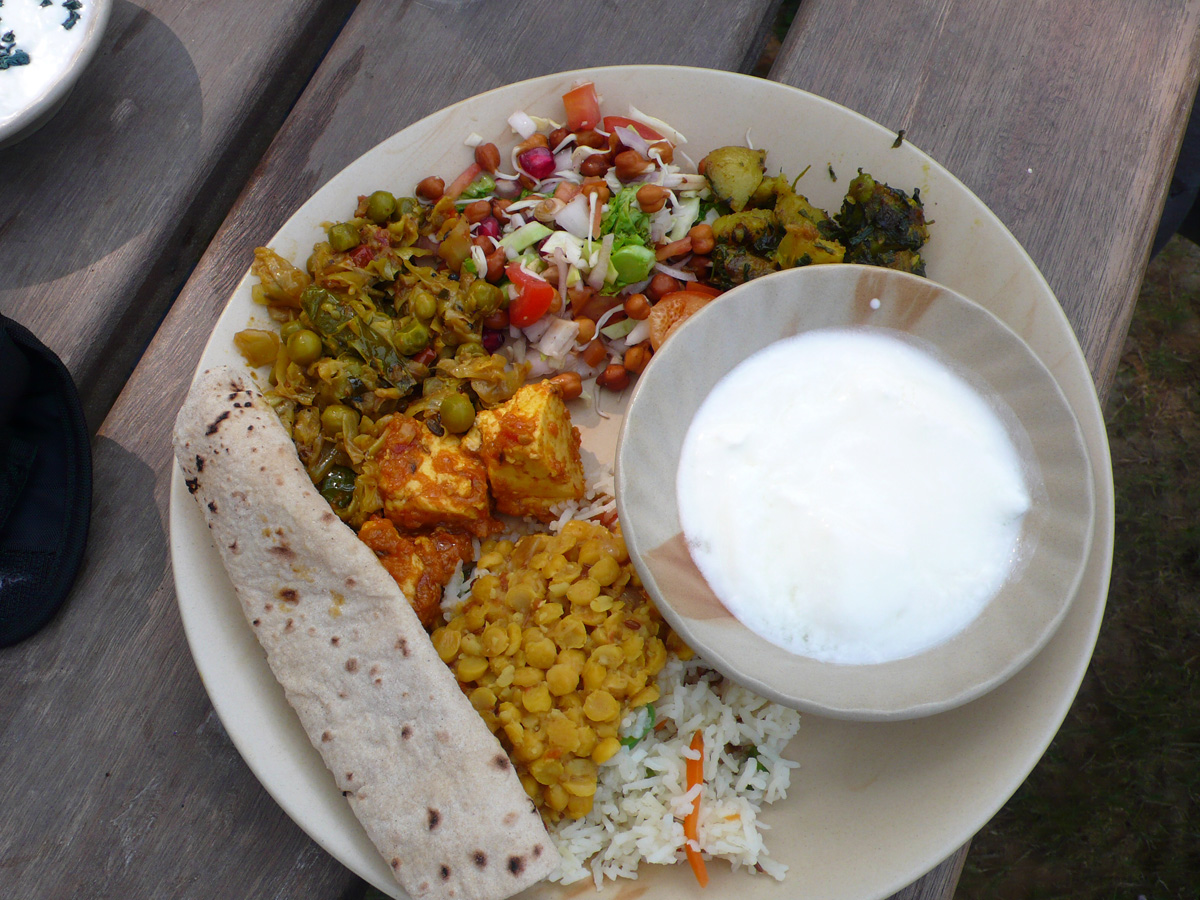
72 Lunch P1020598 copy 72 Lunch P1020599 copy

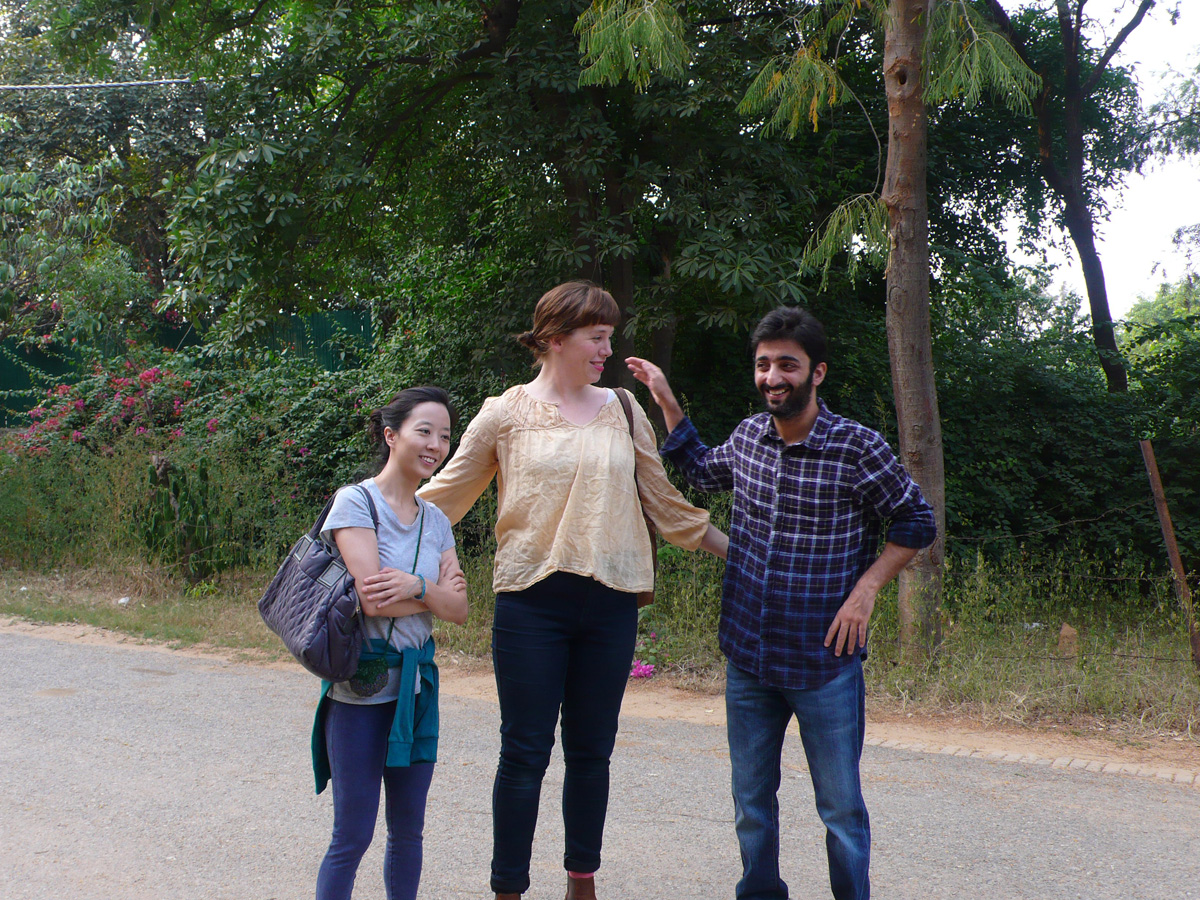
But it is really art that brought us together. I got to be quite close with several of the artists and as a whole it was a very congenial and talented group of artists. There were three young Indian artists there on a special program for a month. I became close with Ankush quickly, partly because he spoke such good English and was so kind and helpful, but mostly because he is such a bright and passionate artist. He is Punjabi and Kashmiri (Northern) by birth but has been living in Delhi for the last several years. The images below show Ankush working on his large pastel drawings in the garden at Sanskriti.

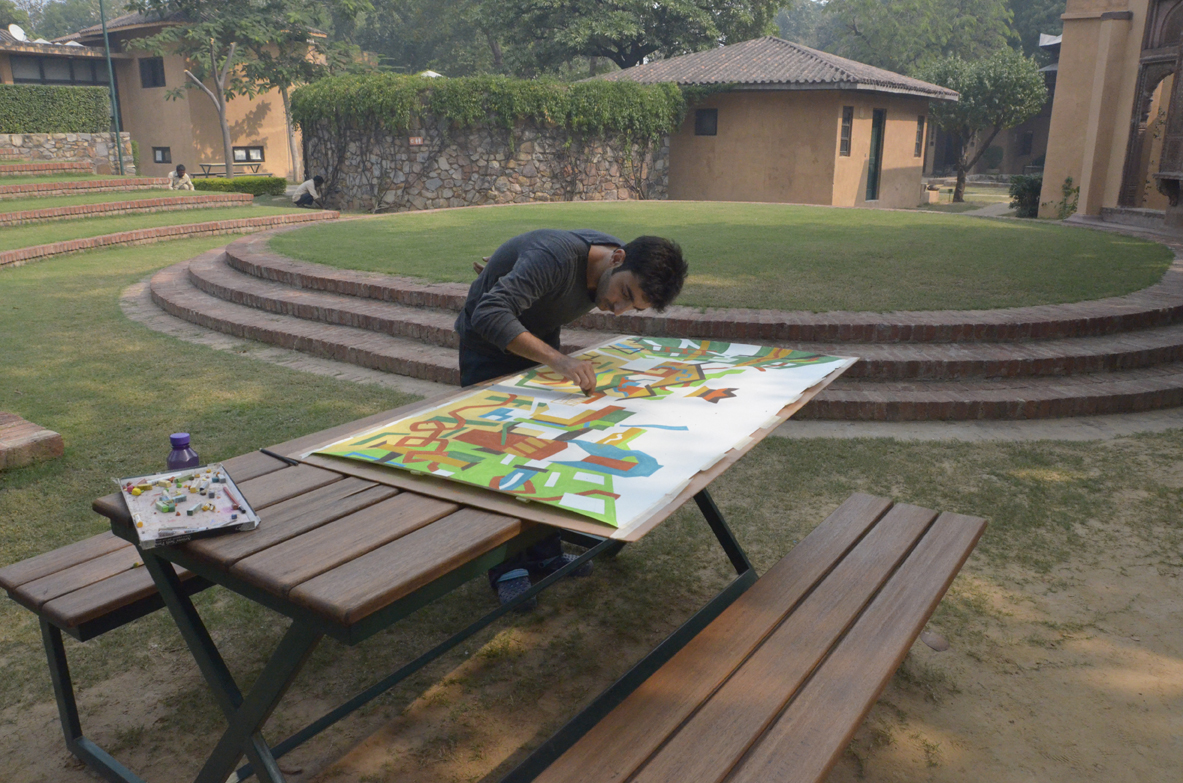
72 Ankush _DSC5469 copy 72 Ankush _DSC5471 copy

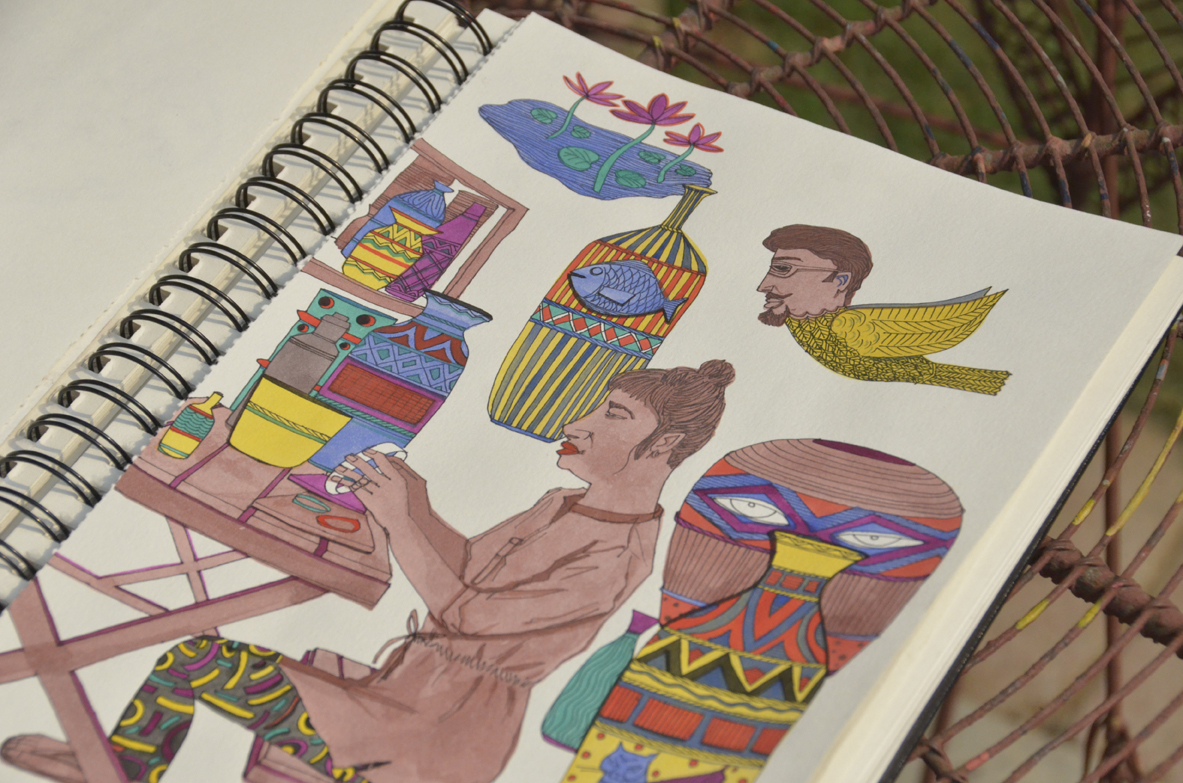
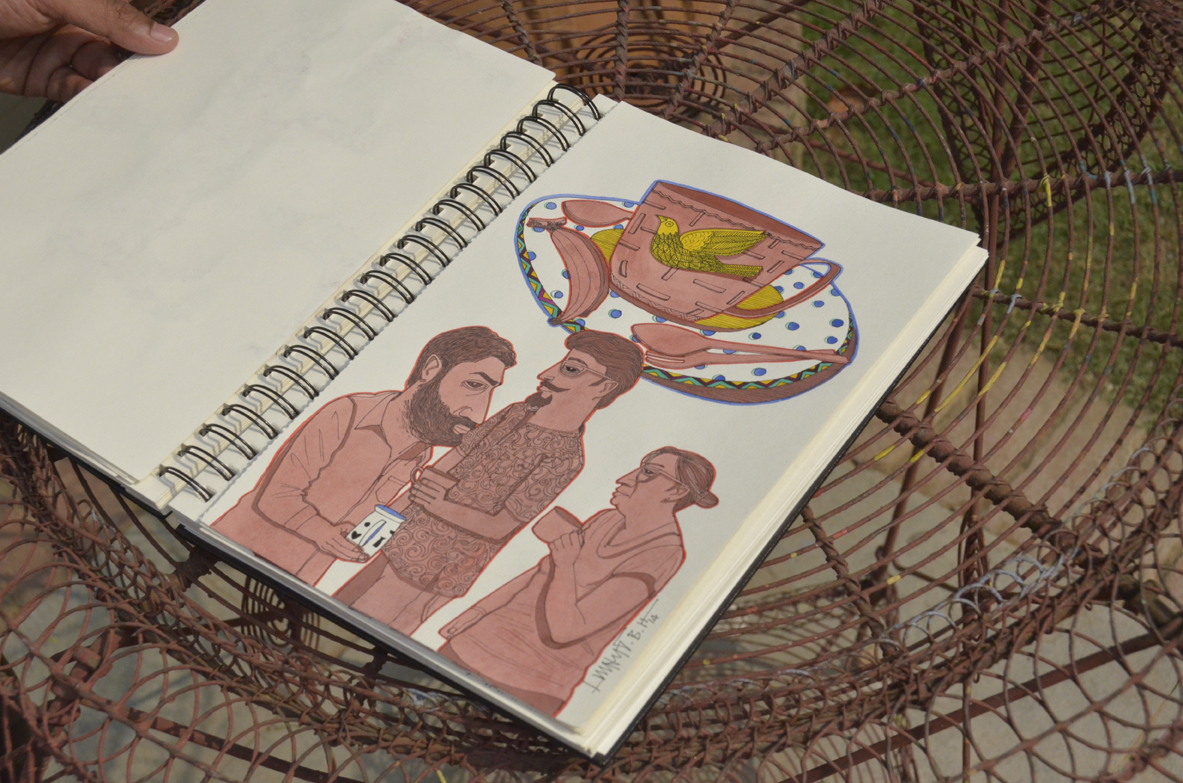
Lokesh is from Bangalore in the south and is one of those artists who just has “the hand and the eye,” his drawings and paintings are fanciful and joyous. I really enjoyed him, we communicated as he said through the “international language of art.” Below are images of Lokesh with his sketch book. The bottom image shows Ankush and I and Lokesh having our morning coffee.

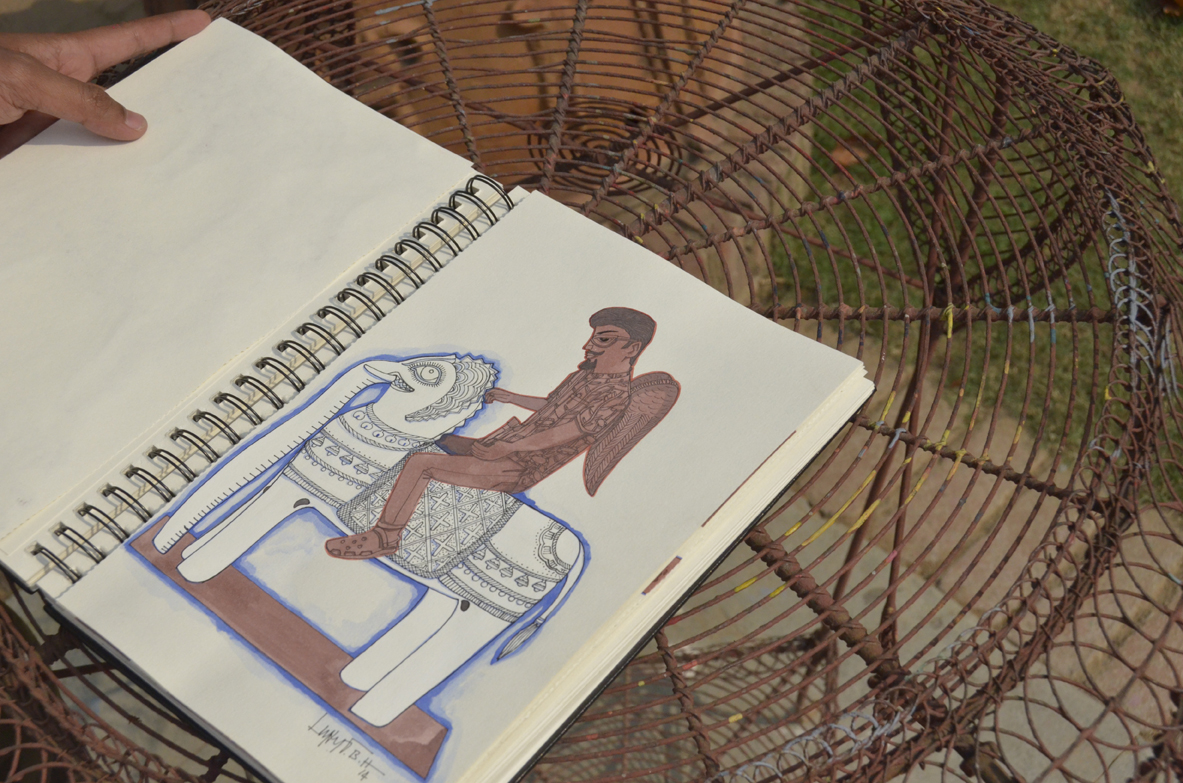
72 Lokesh_DSC5494 copy 72 Lokesh_DSC5499 copy

72 Lokesh_DSC5503 copy 72 Lokesh_DSC5502 copy

The other young artist from India was Sikan, who is a very talented conceptual artist from Orissa. All three of the Indian artists were very interested in my project with Nasreen Mohamedi and I think they learned quite a bit about Nasreen as well.

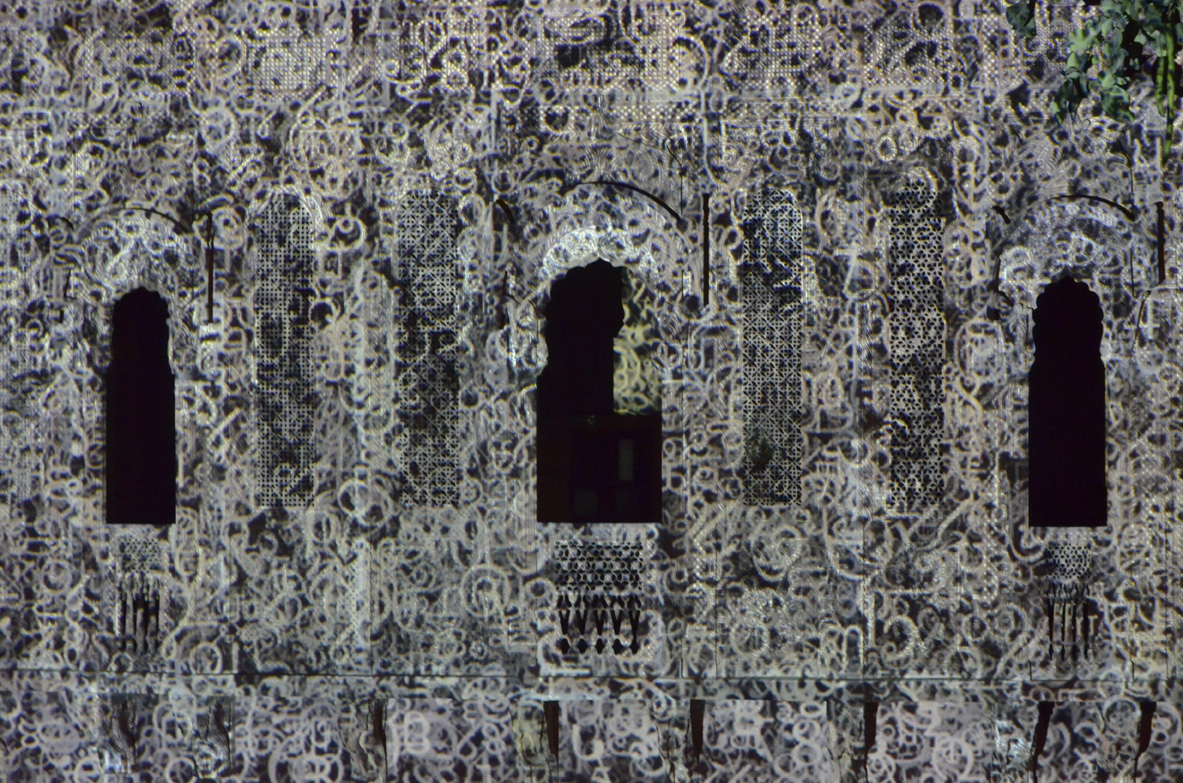
Then there was Yuni, who is a very talented artist from South Korea. She got her masters at Rhode Island School of Design a few years ago. Somehow we “found” each other very quickly. We figured out we both have a very similar conceptual and aesthetic viewpoint, and truthfully I just love her. She was at Sanskriti on a UNESCO fellowship. She created a video titled “Between These Breaths” with a computer program in which she inputted the numbers 1 to 9 in several of the many languages of India – Sanskrit, Hindi, Urdu, Tibetan and some other ones. The video is a beautiful layering and expansion of all these numbers. Below you see pictures of the projection of her video on the carved wooden screen in the amphitheater during our group exhibition, also a picture of Yuni and I.

72 Yuni w comp_DSC5872 copy 72 Yuni large proj_DSC5883 copy

72 Yuni projection _DSC5887 copy 72 Yuni and Me DSC_0156 copy

Vicki is a wonderful artist and person from Melbourne who was at Sanskriti on a major fellowship while finishing her PHD in studio arts. This was Vicki’s fourth tour at Sanskriti and in India and she was remarkably generous with her knowledge of all things Indian. Below are pictures of Vicki and part of the installation she made for our group exhibition.

72 Vicki Installation 1. SK SHOW VM 1 72 Vicki _DSC5894 copy

Then there were the young Australian artists from Adelaide – Genevieve, Lucy, Nick and Jarred. They were all there on a special program; studying various Indian art and craft forms. They are all very talented artists and very FUN people.

I developed a special relationship with Genevieve from the start as well. I love one of her projects that she started while in India. She and her comrades were very game and walked and rode the metro all over Delhi. At one point she ended up in one of the “complaint” offices in the metro and in some kind of shuffle walked out of the office with one of the “complaint books.” She then took this book and made beautiful drawings on the complaints, she called the drawings “little prayers for the complainers.”
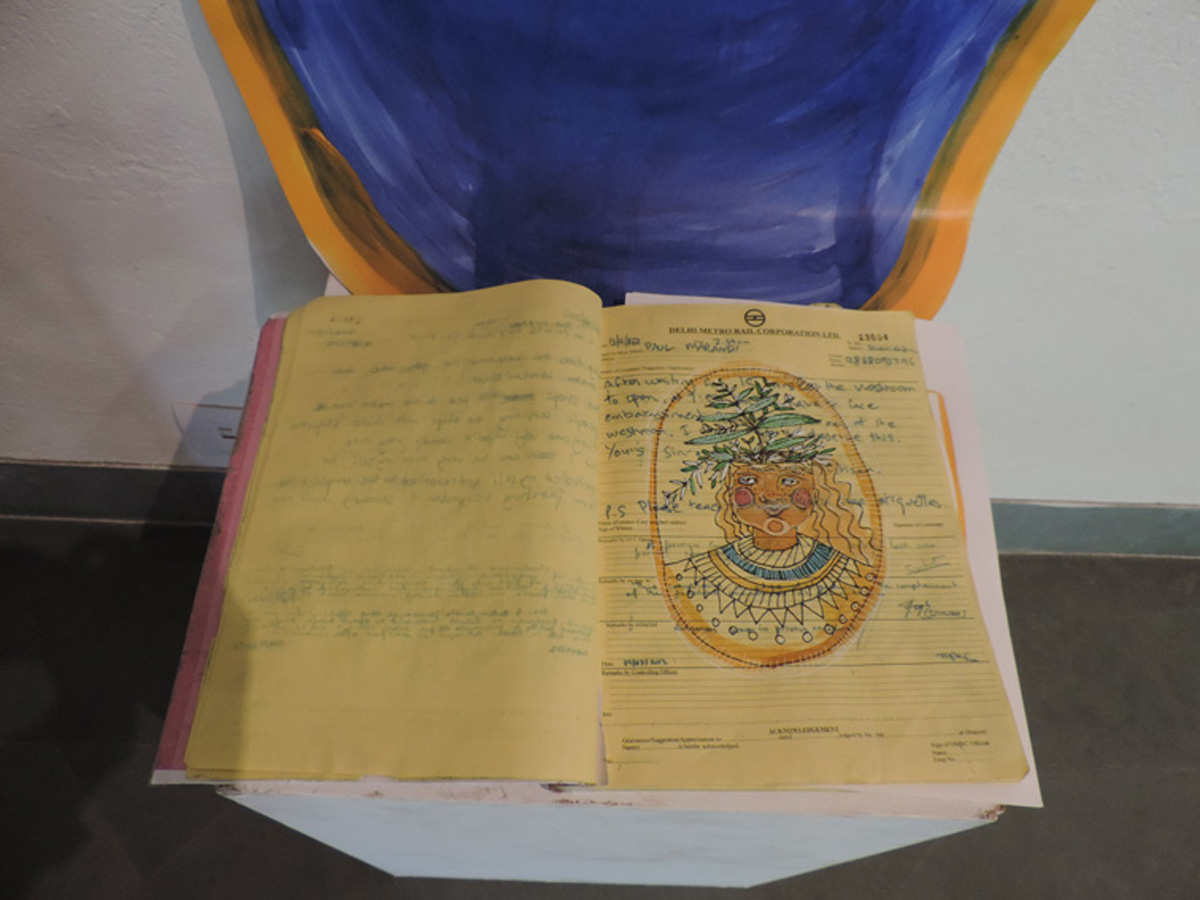
72 Complaint Book 8. SK show GDS

Anyway the comradery, the trips all over Delhi, the late night Kama Sutra Tarot readings, the great dance party after our exhibition, the inspiration and support that I found while at Sanskriti with this group of artists was truly wonderful. I have not mentioned some of the other artists I met; Emily, Mirjam, Lee and Miranda – all talented artists and good people whom I was happy to meet.

This was my first bonafide artist residency, though my work and travels in Palestine had some similar aspects- of meeting wonderful artists doing great work and forming bonds through art. I chose this residency in India, partially because my relationship with Nasreen is so strong, and partially because I thought I should go to India again before I am too old. India is rough, and it is a very long distance to travel. However my belief in this concept of the artist residency is confirmed. I am going to try and continue to participate in the artist residency model for the next few years with my various projects with these remarkable women artists of the 20th Century. I still have much work to do with Nasreen at home in my studio, but I am looking forward to my next project which I think will be with artist Helena Almeida as my inspiration in Portugal sometime in 2015. I will keep you posted.
72 Y G A P1020590 copy 72 Metro P1020595 copy

72 Taxi P1020603 copy

moving back into my studio in Boulder, Colorado – posted 12/3/14 in Boulder

72 dpi studio boulder_DSC5930 copy copy

72 dpi studio sankriti_DSC5898 copy copy

above: my “recreated” studio in Boulder

below: my studio at Sanskriti in Delhi at the end of my 3 ½ weeks there

I have not posted since I came home from India. In the last several months I have found the discipline of writing regularly (and posting on the blog) to be a real aid in my artistic process, so I figure I better get back to it. I really appreciate the response I have gotten from all of you at home and those in India as well to my “treasure hunt” for Nasreen, as my friend Genevieve calls my ongoing search and research for and on Mohamedi.

I came home excited and fulfilled from a wonderful and productive residency and also pretty exhausted from the intensity of traveling to India. Nether the less it was a great first residency experience for me and the Nasreen project is in no way over. In some ways it is just beginning with the next stage of drawing and painting and further research here at home in my studio.

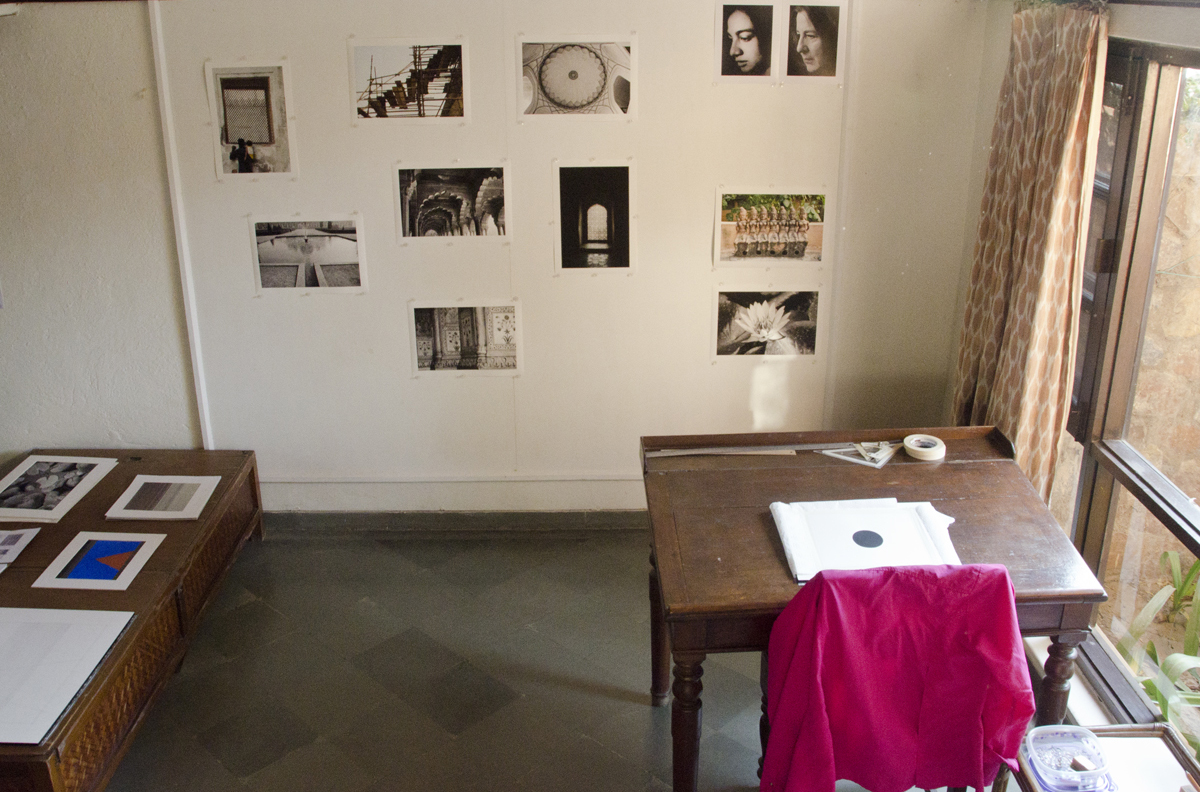
Last week, in addition to having a wonderful Thanksgiving vacation with part of my family (Dana, Will, Jamie, Bruce,) I went into my studio and decided it needed a major clean up and reorganization. My studio was so pristine in India – I thought to begin working again I should recreate the environment that I had made there. Jamie gave me a great Thanksgiving gift and patched and painted the most beat up part of my studio. I switched my drawing/painting workspace to the south window space, as my studio was configured that way in India. I really like this connection and the arrangement. My entire studio space is not totally put back together yet but I have this corner “recreated” and ready to get to work in again, except that my new drawing board with sliding parallel ruler has not arrived yet.  I have posted below more about my continuing research and thoughts about Nasreen and my studio practices.

studio practice for Nasreen and for me – posted 12/3/14 in Boulder

72 DPI BETTER NASREEN studioCCI12032014_00000

72 dpi best of books _DSC5948

above: Nasreen’s studio in Baroda, photograph by Prakash Rao

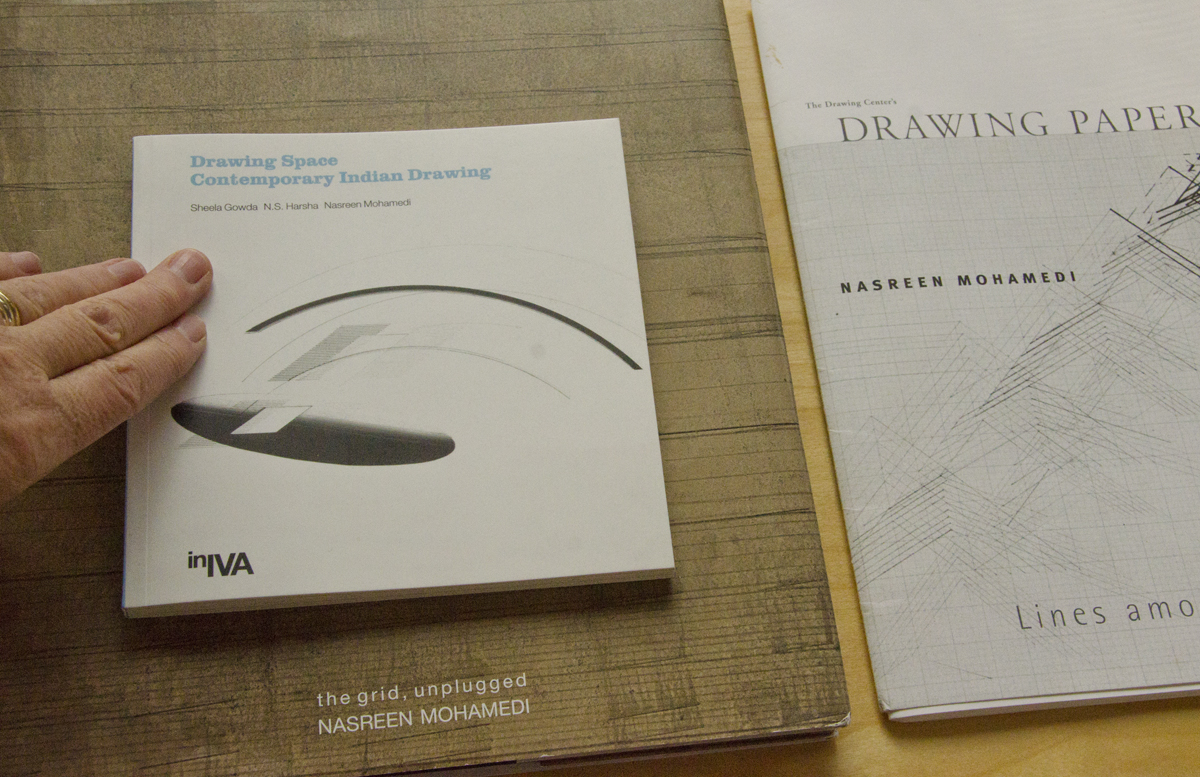
below: catalogues/books with Nasreen’s work, including Drawing Space Contemporary Indian Drawing The above image of Nasreen’s studio is taken from the essay “Memories of Nasreen, A Conversation with Jeram Patel” by Grant Watson.

This essay is in the catalogue Drawing Space Contemporary Indian Drawing, published by the Institute of International Visual Arts in 2000. This exhibit was curated by Grant Watson and Suman Gopinath. The long excerpt below is from the same essay by Grant Watson. It is very interesting to me because in Watson’s conversation with artist Jeram Patel (who was a close friend of Mohamedi’s as well as a colleague) many of the same subjects arose that came up in my conversation with curator Roobina Karode. I am now particularly interested in thinking more about Nasreen’s studio and drawing practice in relationship to my own as well as her photographic practice. As I reread this essay I continue to compare the similarities and differences in my interests and practice to Mohamedi’s. Watson writes: “During her time at Baroda, Nasreen’s work took a radical shift in direction. She lost all traces of figuration, became increasingly concerned with line drawing and during the 1970’s and 1980’s distilled her practice down to the economical abstractions that typify her best-known works today. Jeram Patel described how, to make these later drawings, she sat at a tilted desk with adjustable arms, which looked like it could have been used by an architect or designer. Her tools included rulers, set squares, pencils, brushes, pens, ink and a compass that she had specially designed for her use. The whole operation was performed with a meticulous and exacting attention to detail. As in her earlier works, she would dilute the ink to different tonal levels and apply this to her pen with a brush. She mixed the ink lines with lighter, tightly controlled pencil ones. These drawings were an exercise in concentration and could take four or five days to complete, during which time Nasreen would often sit at her desk late into the night. Sometimes ink would spill on the paper undoing hours of work; always a perfectionist, she would place the unfinished drawing in a cabinet and begin again. Nasreen’s preoccupation was always with space, space as a metaphor, but also as a formal concern in her compositions. For her, physical space occupied by the body was a point of departure or a measuring referent. Beyond the body was the urban fabric of the city, the spaces created by walls, windows and intervals in architectural structures, through which people pass. Her drawings not only described this lived, physical environment but also an internal/mental space; for Nasreen, paper was only a surface on which to picture these different levels and dimensions. At the same time, her almost mathematical spacing of lines indicates a sophisticated handling of formal/aesthetic relations on the picture plane. She carefully weighed the intervals between the lines and released them on to the page with a rhythmic flow that alludes to musical notations. Next we looked at Nareen’s photographs. Jeram Patel described how, even without any formal training, she quickly adapted the medium to her own uses. Her photography stands as a sort of research project in itself, through which Nasreen was able to follow her spatial investigations. Central to this, according to Jeram Patel, was the investigation of light –light as the illuminating component which makes space available to visual perception, but also as a material in the photographic process. Light is captured both in its natural form – the brilliant Indian sun bleaching city walls to a flat whiteness – and artificially – spectacular dreamlike stadium lights at night. Then there is the trace left by a mechanical projector light, which burns into the photographic paper in her abstract compositions reminiscent of Man Ray.” Nasreen’s studio practice was highly disciplined and very rigorous. Nasreen essentially lived, worked, practiced meditation and as I learned from Roobina Karode even exhibited her work in her small spare home studio in Baroda. She also taught at the University and had many friendships and family relationships so she was no shut in. She also traveled extensively and I think she must have been inspired by her travels. I did not see any of her photographic work in person in India. However when I think of the photographs of Mohamedi’s I have seen in books many are from her travels: the street markings in Japan, the water towers in Kuwait, as well as the pictures in India from Fatehpur Sikri and Chandragargh. However her studio practice was paramount and sacrosanct as Roobina Karode and Jeram Patel and others have described it. She had a very simple environment she worked in as well as very refined tools for those perfected drawings she was creating in the last 20 years of her life. I do have this tremendous attraction and urge to the studio and drawing practice at this point in my life. I am excited to be moving back into my fresh clean studio with many of my photographs and discoveries from Delhi and still with Nasreen’s inspiration. I am also reorganizing my meditation space in my studio as this has been an integrated part of my life and art practice for some time. My studio is not as pared down as Nasreen’s and my studio practice is not as diligent but I am working on both these attributes of Mohamedi’s in my life and work. I will continue posting about this project on this blog, perhaps less frequently as this work in the studio is slow. I have future projects with other women artists and residencies in mind as well but want to continue to focus on this practice with Mohamedi for several months. One post I want to write soon will describe more about the residency at Sanskriti itself – the setup, the artists I met there etc.. I think this whole subject of residencies is an important one for many artists, writers, academics and cultural workers alike.

Nasreen the person, the teacher, the artist – posted 11/14/14 in Delhi

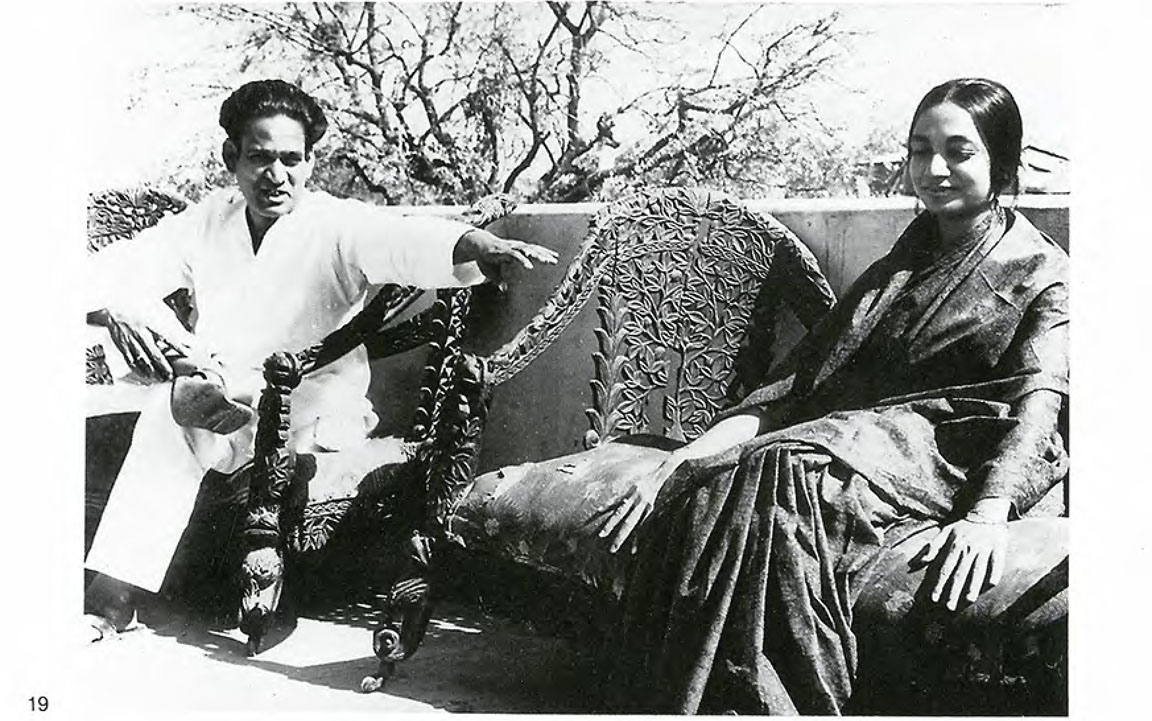
19 72 dpi Nasreen in Retrospect LC000130-136_pdf copy-5

image above: Nasreen with artist friend Jeram Patel, appx. 1974 from “Nasreen in Retrospect” published in 1996 after her death

I feel much closer to Nasreen and my reasons for coming to India today! I met Roobina Karode this afternoon. She is the Director and Chief Curator at the Kiran Nadar Museum of Art. KNMA is a highly regarded private contemporary art museum in Delhi. Roobina was also a student of Nasreen’s at the M.S. University in Baroda, and a friend and neighbor of hers as well. Roobina was studying to be an artist and for various reasons later turned to art history. She curated the exhibit in 2013 of Nasreen Mohamedi’s work, “ A View to Infinity,” at the KNMA that was the largest exhibit of Mohamedi’s work to date. There were more than 100 photographs and drawings and paintings in the exhibit. The exhibit at the Tate Liverpool this last summer only had about 50 of Nasreen’s works. Ms. Karode was remarkably generous with her time and very engaging, just lovely. She had 8 of Nasreen’s drawings and paintings from the collection (they have 40 of Mohamedi’s works in their permanent collection but many are out on loan now) brought out to show me. I was able to handle the framed works and look at them closely. She also asked the associate curator, Saumya Bhatt to show me the documentation of the exhibit at KNMA which looked absolutely beautiful. Roobina concurred the information that I had heard at the Talwar Gallery in New York that a major exhibition of Mohamedi’s work (the largest yet) will be shown “somewhere in Europe” (it has not been announced yet where) in 2015 and this exhibit will travel to “somewhere in the U.S.” in 2016. Roobina Karode is currently involved with producing a book about Mohamedi that will be published in conjunction with the international exhibition. She said she is writing three chapters from her different personal perspectives on Mohamedi: one chapter will be about her relationship with Nasreen as a student, another as a curator and the third chapter from her perspective as a critic. We looked at the different works together – from Nareens’s early works from the late 50’s and early 60’s with color and brush strokes to the later works of the 70’s and 80’s drawn with a rapidograph and graphite pencil. She obviously loves and is amazed by Mohamedi’s work. It is very fresh with her. I love the work too. I have posted these works that I actually saw with Roobina in one post below titled “seeing Mohamedi’s works at Kiran Nadar Museum of Art.” But a lot of our discussion was really about Nasreen Mohamedi the person: the teacher, the artist, and the human being. She had such descriptive stories to tell of her student days in Baroda and of Nasreen. She said that Nareen was a lovely generous person. Everyone liked her also people who had no connection to art. They lived in the same neighborhood in Baroda and often went to the University together in the morning. She said that Nasreen knew every tuk-tuk (the bicycle taxies) driver’s name and always asked about their family. It sounds like she was very engaged with people in general and very present. Roobina also said she was a very good teacher, very giving, very different than the other teachers, not as traditional at all. She was interested in teaching the conceptual and the experiential aspects of art. Roobina said that this was unheard of at the time and even today her style of teaching art would be unusual. At that time in Indian Art (the 60’s and 70’s) the figurative and narrative art predominated. Abstraction was very unusual. There was a very traditional and and formal approach by the other mostly male teachers. But Nasreen asked her students to be aware of their environment: the sounds, the smells, the forms, and the movement. She would take everyone outside to draw and give them exercises like to draw the tones of the colors of the tree, or draw the movement of the wheel that you observe. Roobina said that she treated all her students and their work with great respect and attention. Ms. Karode also talked about Nasreen’s own work process as an artist. This is written about in various other places, but I really can’t wait to read Roobina’s book about Nasreen. Roobina said that though so generous and friendly with her students and everyone she was very silent about her work and when she was working nothing else existed. Apparently she did Pranayama, meditations everyday before working. This was a very strict discipline and practice she maintained. Roobina said she could be in the room with her when Nasreen was working and there was no contact it was just Nasreen connected to the drawing. Her studio/apartment was famously very spare. There is a picture below of her studio. Her original drafting table and tools were in the exhibit at KNMA and I have that pictured below as well. It sounds like she was just happy to make her own work in her studio. She said she was in love with her work. She mentioned that Nasreen never complained that her work was not showing much, that people weren’t interested in her abstractions. She would invite her students to come look at her work in her studio. She would lay out the drawings in an L shape on the floor. Silently she would stand and the students would look at the work with no talking, like a meditation. She would open her arms to each student as they left as a greeting, but no words. Silent viewing in the simple studio. This sounds like my dream opening, no talking, no fuss, no muss. She drew almost up until she died (at age 53) from the neuromuscular disease. She stopped teaching several years before, to preserve her energy. Apparently she even stopped talking much the last few years of her life. She preserved her energy for her work. Roobina also said she did not talk about the techniques involved in her work, she never revealed her methods, this was between her and her work. I asked Ms. Karode about Nasreen’s photographs. She says there is much discussion and debate amongst the critics about the photographs. Were they preparations for drawings? Roobina says she thinks the photographs stand on their own as works. We talked about these photographs as just another way of seeing or of experiencing, another form of practice. I did not see any of the original photographs on this trip. This time with Roobina Karode gives me much more of a feeling and experience of Nasreen the person, and Nasreen the teacher as well as Nasreen the artist. She is certainly singular, someone to emulate, to respect, to inspire though certainly never to surpass. I am very thrilled to learn more about her. I will travel to “somewhere in the U. S.” in 2016 to see more of Nasreen Mohamedi’s work and hopefully Roobina Karode too and many other people will have the opportunity as well outside of India. The post below shows some images from Nasreen’s life and the post below that the work that I saw at the Kiran Nadar Museum of Art. So happy to end my three weeks in India with this experience.
images of Nasreen’s life from “Nasreen in Retrospect” published by her family in 1996 – posted 11/14/14 in Delhi

1 72 dpi Nasreen in Retrospect LC000130-136_pdf copy-1

15 72 dpi Nasreen in Retrospect LC000130-136_pdf copy-4

16 72 dpi Nasreen in Retrospect LC000130-136_pdf copy-4

20 72 dpi Nasreen in Retrospect LC000130-136_pdf copy-5

21 72 dpi Nasreen in Retrospect LC000130-136_pdf copy-6

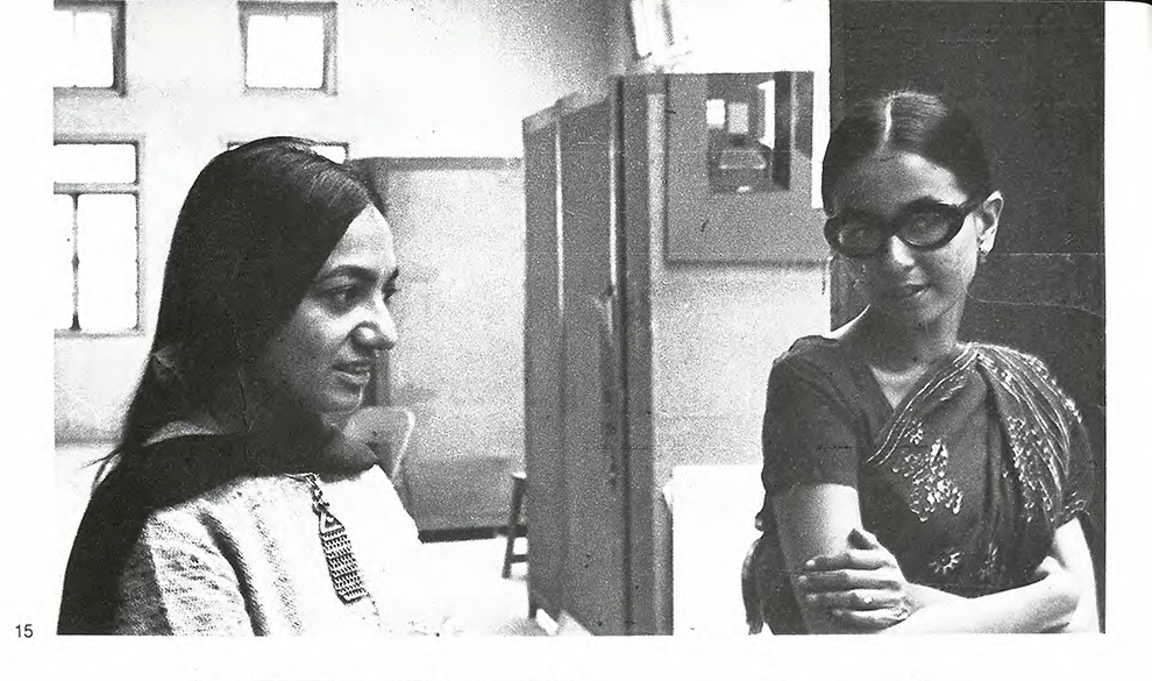
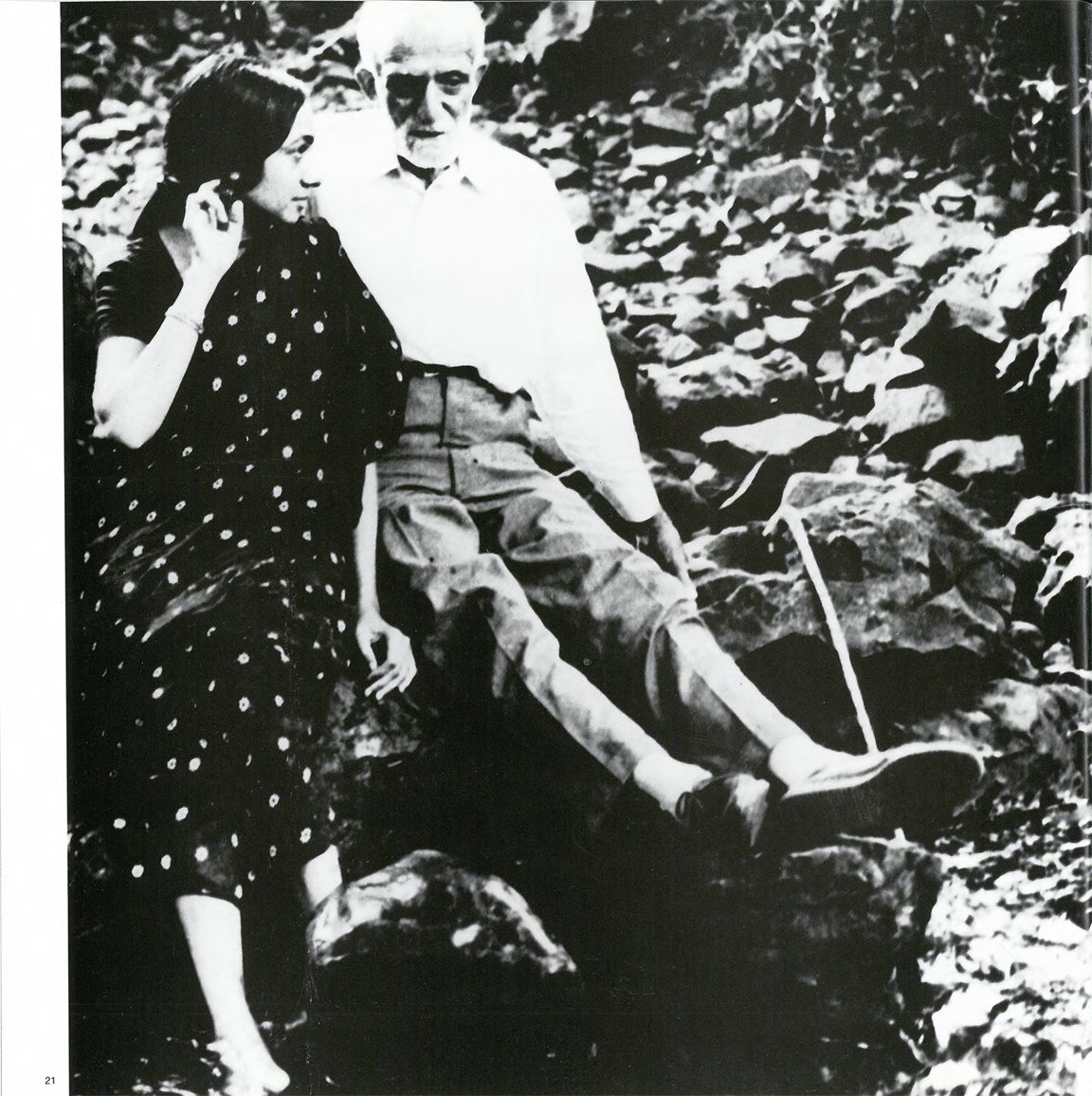
Some images from the Photo Album from “Nasreen in Retrospect” published in 1996 after her death by her family.

1 Nasreen’s Family with Nasreen age four – L to R – Back: Cmar, Saleh, Rukaya (sisters), Front: Anwar (brother), Akhfar (brother-in-law), Zainab (mother), Ashraf (father), Vazir (sister), Shams (brother) with Nasreen center age four.

15 With artist friend and colleague Nilma Sheikh, 1980.

16 With a student in M.S. University, Faculty of Fine Arts, Baroda.

20 With Krishen Khanna (artist) at Bhupen Khakhar’s residence, Baroda, 1970.

21 Nasreen with her father Ashraf, appx. 1969.

seeing Mohamedi’s work at the Kiran Nadar Museum of Art yesterday – posted 11/14/14 in Delhi

72 dpi nasreen_at_her_studio_in_bombay_at_the_bhulabhai_desai_institute_courtsey_sikander_and_hydari_collection

72 dpi KNMA 1655

72 dpi KNMA 1635

72 dpi KNMA 1623

72 dpi KNMA 1622

72 dpi KNMA 1646

72 dpi KNMA Untitled- Nasreen Mohamedi (1)

72 dpi KNMA 1656

72dpi KNMA Untitled- Nasreen Mohamedi (26)

72 dpi KNMA drawing table_MG_1385

These images are all courtesy of the Kiran Nadar Museum of Art and are images of Nasreen Mohamedi’s work that they hold in their permanent collection. The first image is of her studio in Bombay very early on. The work follows a somewhat chronologically accurate line from her earlier work with brush and ink in the late 50’s and early 60’s to her highly drafted work with pen and graphite. The final image is her actual drafting table which was in the exhibition of her work at Kiran Nadar Museum of Art in 2013.

looking at the monuments – posted 11/13/14 in Delhi

72 dpi _DSC5764 copy copy

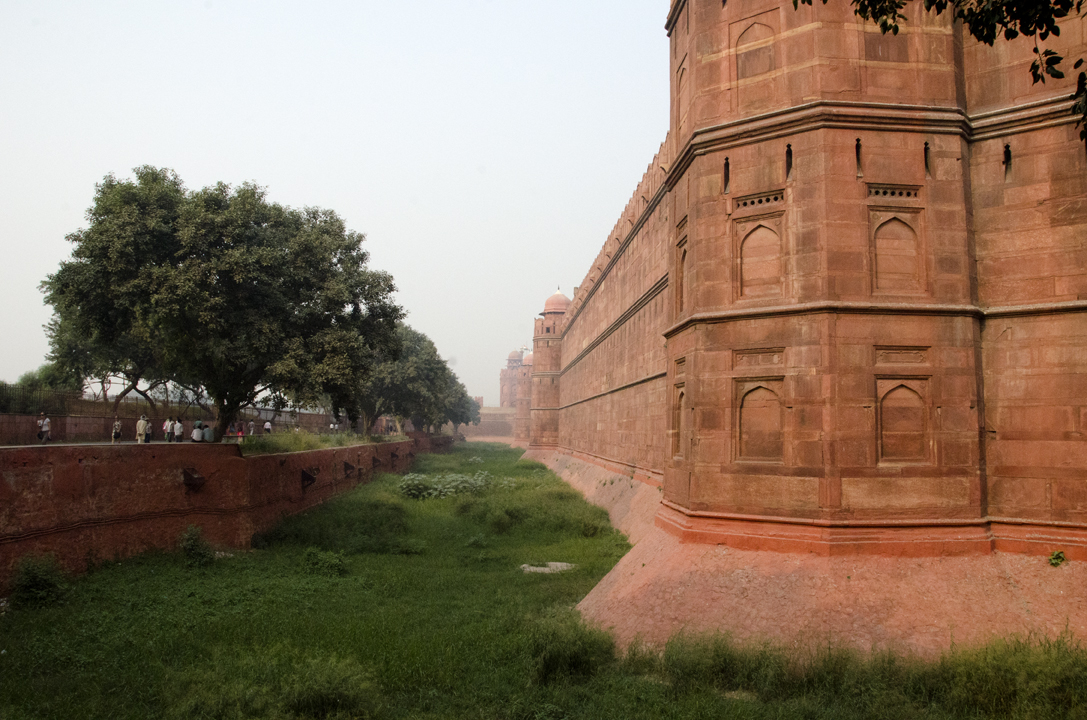
I am still looking with Nasreen, though her eyes sometime allude me because it is hard to look at the space and not be seduced by the forms and scale and monumental qualities. The monuments have an “oppressive” quality as well, being built on the backs of Indians by the Mughal conquerers. They are also the only relatively clean and open spaces that I can feel comfortable walking around in, other than Sankriti. I am looking for a sense of openness and transparency with Nasreen. These are images from the Red Fort and Humayun’s Tomb.

72 dpi _DSC5810 copy copy

72 dpi _DSC5784 copy

72 dpi _DSC5808 copy copy

72 dpi _DSC5551 copy copy

72 dpi _DSC5569 copy copy

72 dpi _DSC5583 copy

72 dpi _DSC5588 copy

still here and trying to draw – posted 11/8/14 in Delhi

72 dpi sculptures at Sanskriti 10 x 15 _DSC5201 copy copy

image above: sculptures at the Museum of Indian Terra Cotta at Sanskriti where I am in residence – a beautiful in and outdoor museum

These lovely sculptures at Sanskriti should cheer me up. There is a wonderful array of them at the museum here. This post might sound a little discouraged. I think this is normal in residencies (also on big trips and retreats and pilgrimages I have found.) I have been here two weeks now and I feel somewhat adjusted. Sanskriti is a lovely place and my project is a great opportunity for me – but India is hard and Mohamedi’s practice is difficult to emulate. I think she will shape my practice in some major way, she already has – it just has not resulted in my own drawing “product” yet. I posted last week that I found two Mohamedi drawings to look at in person at the National Gallery of Modern Art. I have been continuing to search for her work here and I am hoping to see a few more of her works that are in the permanent collection at the NGMA. However it is difficult to organize and involves many phone calls, emails etc.

My photography practice is changing (thank you Nasreen.) I had several nice prints made of some of my black and white photographs. I still have lots more photography (and printing) I would like to do in the next week. I am just getting to a level of abstraction with the photography that Nasreen is urging me towards.

I have been struggling with drawing and painting. No drawings I want to show yet. I am going to reduce back to just pencil, no paint, no color (Nasreen is leading me again.) If I can make one pencil drawing that I like in the next week I will be happy. I can then bring it and several black and white prints back into my studio at home in Boulder and have some part of India and Mohamedi to work with. I have a series in mind.

Three weeks is definitely not long enough to see a little of Delhi and try and to make much work, at least at my pace. All of the other artists at Sanskriti are here for at least one month and several are here for 2 or more months. Tomorrow morning I am going into Delhi to photograph around Humayan’s Tomb, a famous piece of Mughal architecture.

Please read my post “Mohamedi found” from November 3rd if you have not read it yet – much more upbeat.

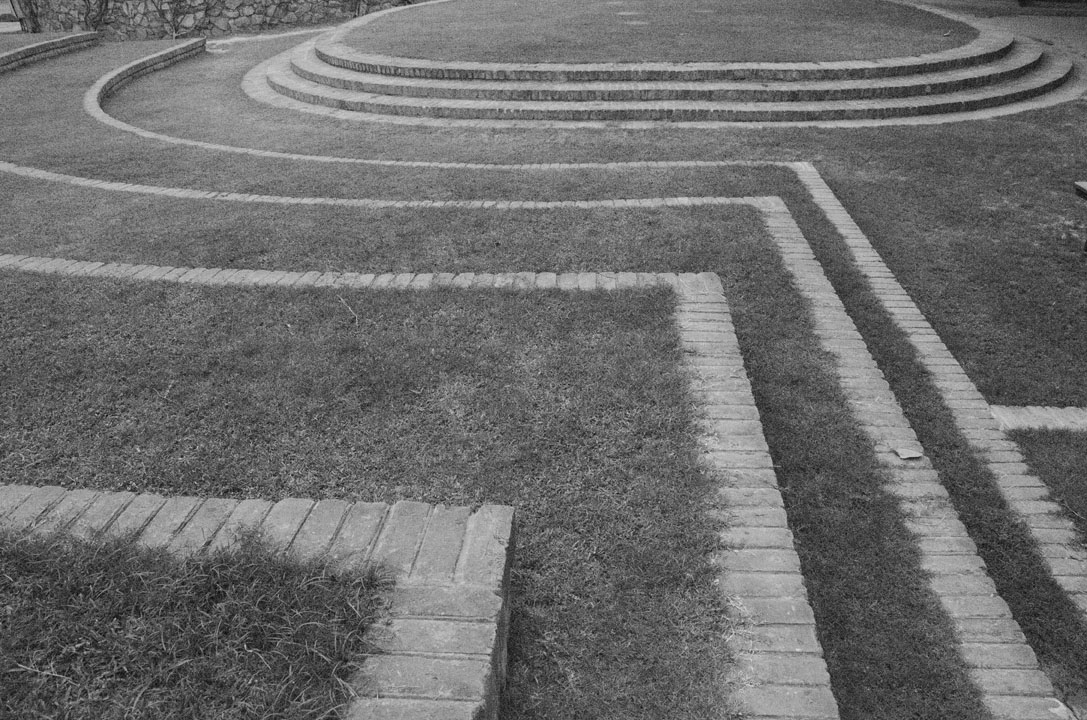
I printed the 4 images below I think they are beginning to communicate a view that I am “looking” for.

72 dpi Mehrauli _DSC5248 copy copy

72 dpi amph Sanskriti _DSC5059 copy

72 dpi step well  _DSC5273 copy

72 dpi rocks Sanskriti _DSC5109 copy copy

Mohamedi found! – posted 11/3/14 in Delhi

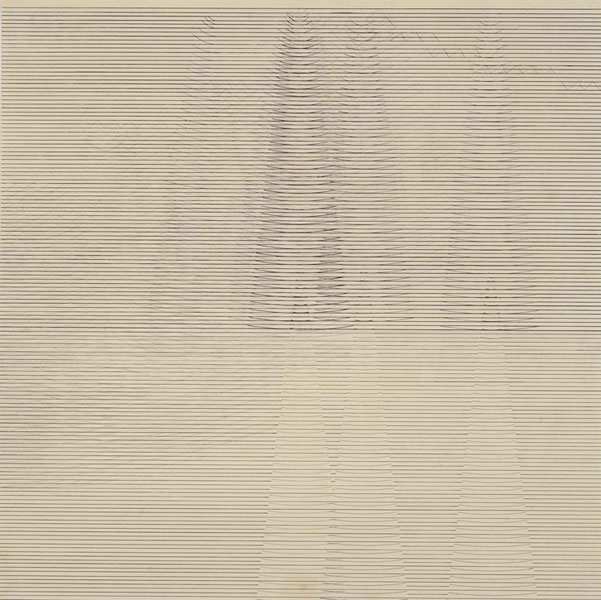
1200 72 dpi 18 x 18 graphite and ink on Paper

image above: Nasreen Mohamedi, c. 1970’s, 18″ x 18″, graphite and ink

look’s something like the image I saw at the National Gallery

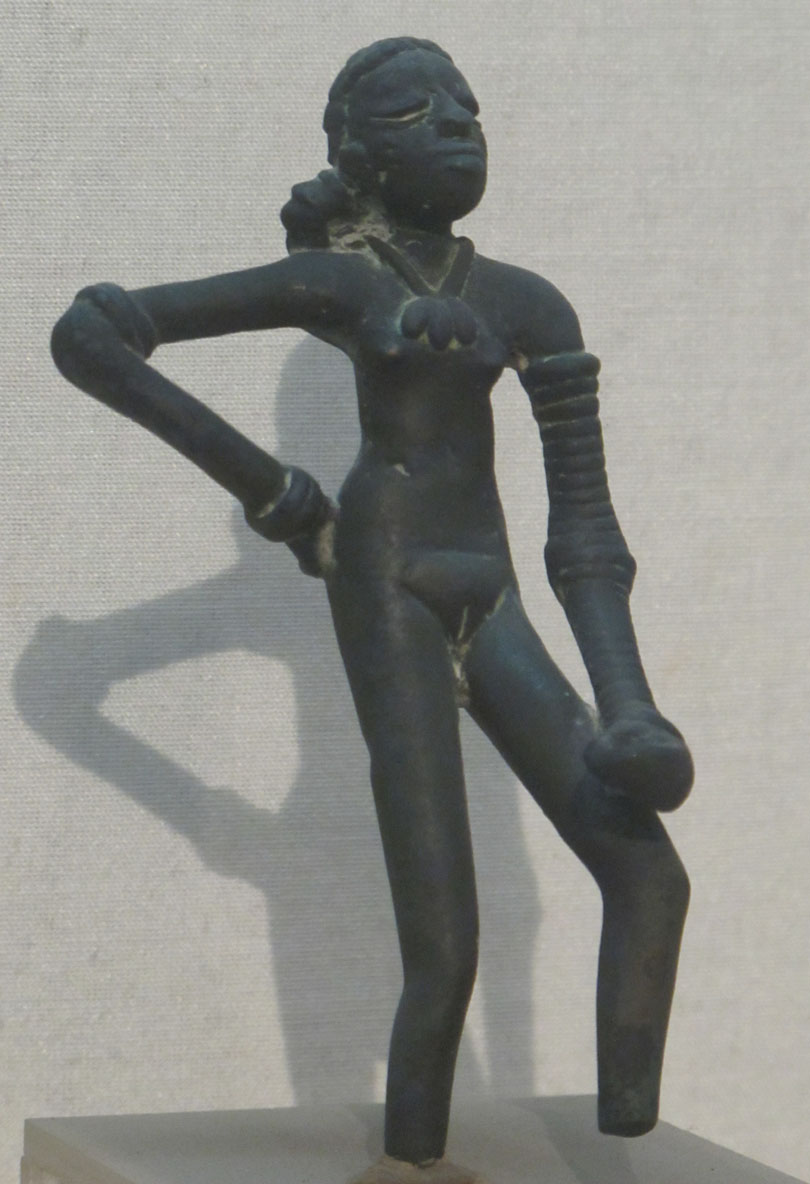
Yesterday my new Australian artist friend Genevieve found two beautiful Nasreen Mohamedi drawings at the National Gallery of Modern Art in Delhi. It was the end of a very long day. We were looking at Indian art from the Indus Valley (see the image of the Dancing Girl 2500 B.C. below) all the way to Indian art of contemporary times with a group of artists from the residency. We were getting ready to go back to Sanskriti and the National Gallery was closing when Genevieve found me and said “I found her.”

We made our way back through 100’s of pieces of contemporary art to a corner of the National Gallery where two large Nasreen Mohmedi drawings are showing, or really almost disappearing or transmuting amongst her fellow Indian artists. Mohamedi’s drawings are right next to a large Zarina Hashmi (b 1937,) a contemporary of Mohamedi’s who is still working and lives in New York. Mohamedi’s two drawings: delicate, intricate, infinite, simple. The guard would not let me photograph these works. I could not photograph them anyway with the glass and the bad light. But I was so excited and not disappointed after my long journey.

As Genevieve said, if this work is about the lack of the ego or self-naughting then it is very appropriate that it is so difficult to find and to see and certainly to photograph. It is like she is drawing space, time and sound or a score for a transcendent prayer. I see the connections to calligraphy, to music, to poetry – but there is also no reference. There is certainly a relationship to the work of Agnes Martin, as has been pointed out, and I also see a relationship with Sol Lewitt’s work – but it is also very different. As my friend Cydney said; her work is singular.

I don’t think I can emulate this work, but it definitely has its way with me. I am so glad to see her work “in person” for the first time in India amongst her contemporaries. It is unprecedented here. I love the work anywhere, and I will try to search for more of her work here in Delhi and I will search it out as it travels the world.

I have pictured below, some drawings that are similar to the ones I saw at the National Gallery, but not the same ones. These drawings were shown at the Talwar Gallery in New York. The drawings I saw yesterday seemed more intricate, but perhaps this is the nature of seeming them “in person.” I also posted  Zarina Hashmi’s image “Cage”, again not the one I saw yesterday hanging next to Mohamedi. “Cage” is in the Whitney Collection in New York. I also posted Zarina’s “My House.” I think Zarina’s work is actually more like my own work than Nasreen’s, but it is not as compelling for me. I have also posted an image of the Dancing Girl from the Indus Valley Civilization, 2500 BC.  I am feeling a bit exhausted but also very excited.

72 dpi NM 18%22 x 18%22 ink on pape c 1970s 1643 Mohamedi, c. 1970, 18″ x 18″

72 dpi 18 x 18 Mohamedi, c.1970, 18″ x18″

72 dpi 7 x 7 graphite and ink on paper c. 1970's 1640 Mohamedi, c. 1970, 7″ x 7″

72 dpi 7 x 7 graphite and ink on paper1627 Mohamedi, c. 1970, 7″ x 7″

72 dpi Zarina Hashmi, Cage, 1970., 19 x 19 Whitney Museum wo2011.9_hashmi_1706  Zarina Hashmi, “Cage”

72 dpi %22my house 1937 - 1958%22 1994 etching my_house_1937_19580 Zarina Hashmi, “My House 1937-1958”

1200 72 dpi Dancing_girl “Dancing Girl,” c. 2500 B.C.

what should Nasreen and Sherry photograph/contemplate/draw together? – posted 11/1/14 in Delhi

1 1200 72 dpi _DSC5219 copy copy

image above: Mehrauli Archeological Park, Delhi, India

I have been reading excerpts from Nasreen Mohamedi’s diaries to try to get into her head/eyes/mind. Her diaries are reproduced in the book “Nasreen in Retrospect.” Here are a few of her daily entries:  
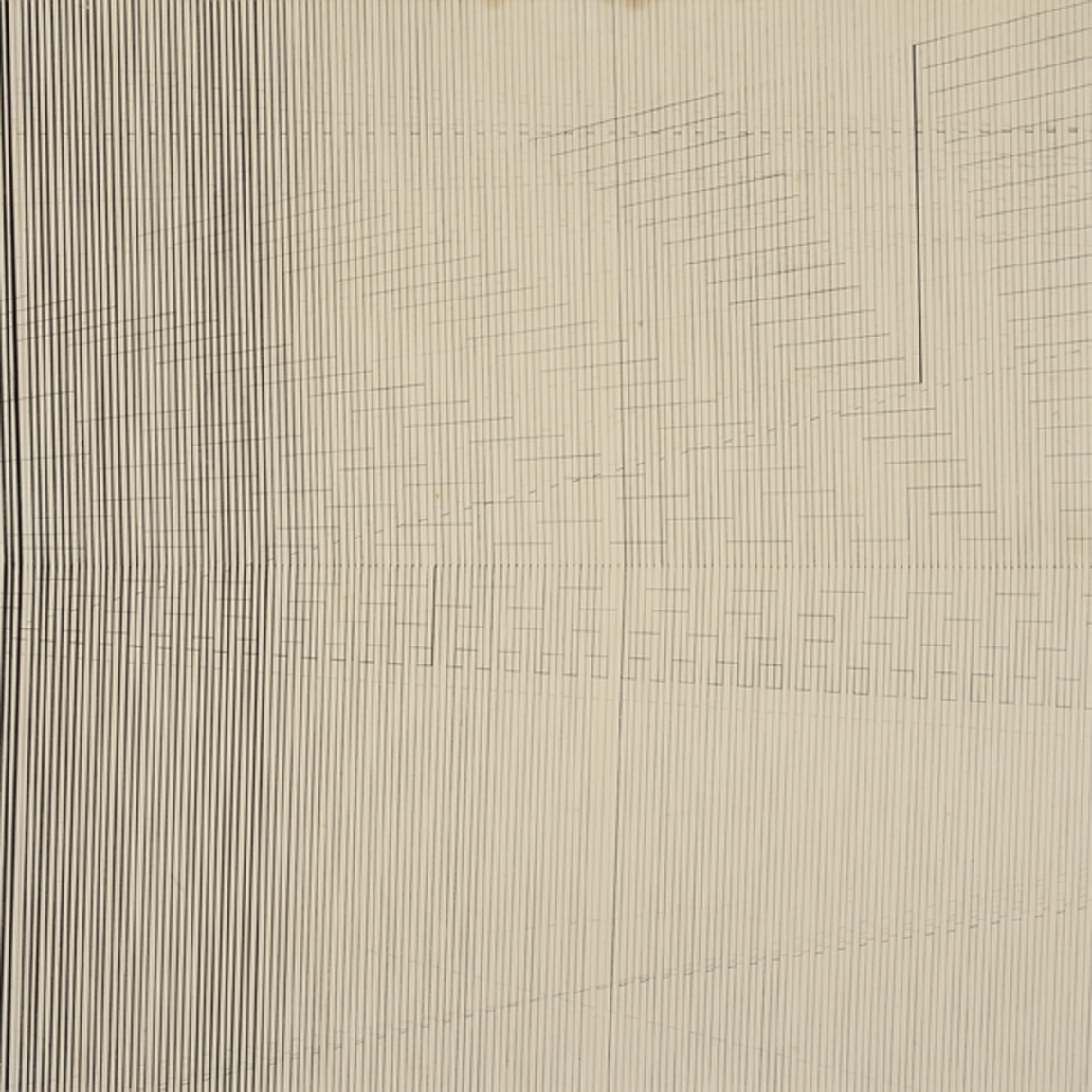
4th July 1967 “Where do I stand in relation to space and thought The layers in Indian sculpture, in Arabic calligraphy In waves – in connection with my work”

13th July 1969, London “When looking at painting Sculpture or anything – examine each contour Each dot, surface.
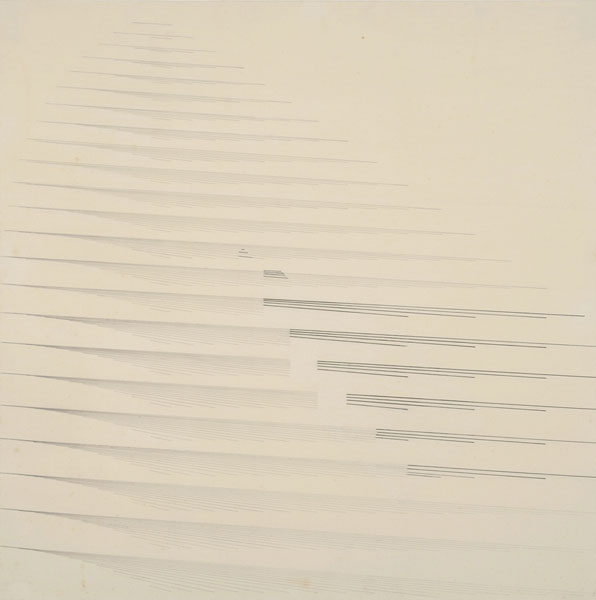
18th July 1969 “Study the EYE SPACE Observe some objects in Different light A cosmic rhythm with Each stroke Sounds and Vibrations”

There are three new posts which show a few of the structures, sculptures and paintings that I have been photographing/contemplating/and not yet drawing. India is so seductive. It is difficult to think and make art like Nasreen even though this is what I have set out to do. I realize how much she has reduced things. India is so NOT REDUCTIVE, it is so expansive. There is so much beauty and ugliness in abundance everywhere. I have been overwhelmed by the Indian art and architecture I have been seeing and studying. Being here makes me think of Nasreen’s work as all the more phenomenal – because it is so pure, so refined in this cacophony of India.

I have been going out to take pictures in various places. I photographed some of the ruins at the Mehrauli Archeological Park, a beautiful “stepwell” there and also the stunning tower of Qutb Minar. At the National Museum in Delhi I was overwhelmed by the sculptures – from all different eras, of course the Buddha’s. I have been researching once again the Devi or Goddess figures in sculpture and in painting. I have found some of the images of Devi in the Basohli/Pahari paintings from the 17th and 18th century at the National Museum. They have a huge collection of Indian Miniatures. I have studied these before – the lines, the colors are amazing and the energy is wild in these figures and paintings. Below are sets of some of these images I have been LOOKING at.

I have not started to draw yet. I am almost ready but truthfully a little intimidated by India and by Mohamedi.both. I am playing around with the black and white and the color. I have been here one week now, and I have a little more than 2 weeks left. There are three new posts below with images of Mehrauli Archeological Park and Qutb Minar, as well as some beautiful sculptures and some crazy Basohli Devi Paintings.