In Conversation—Cydney Payton with Sherry Wiggins

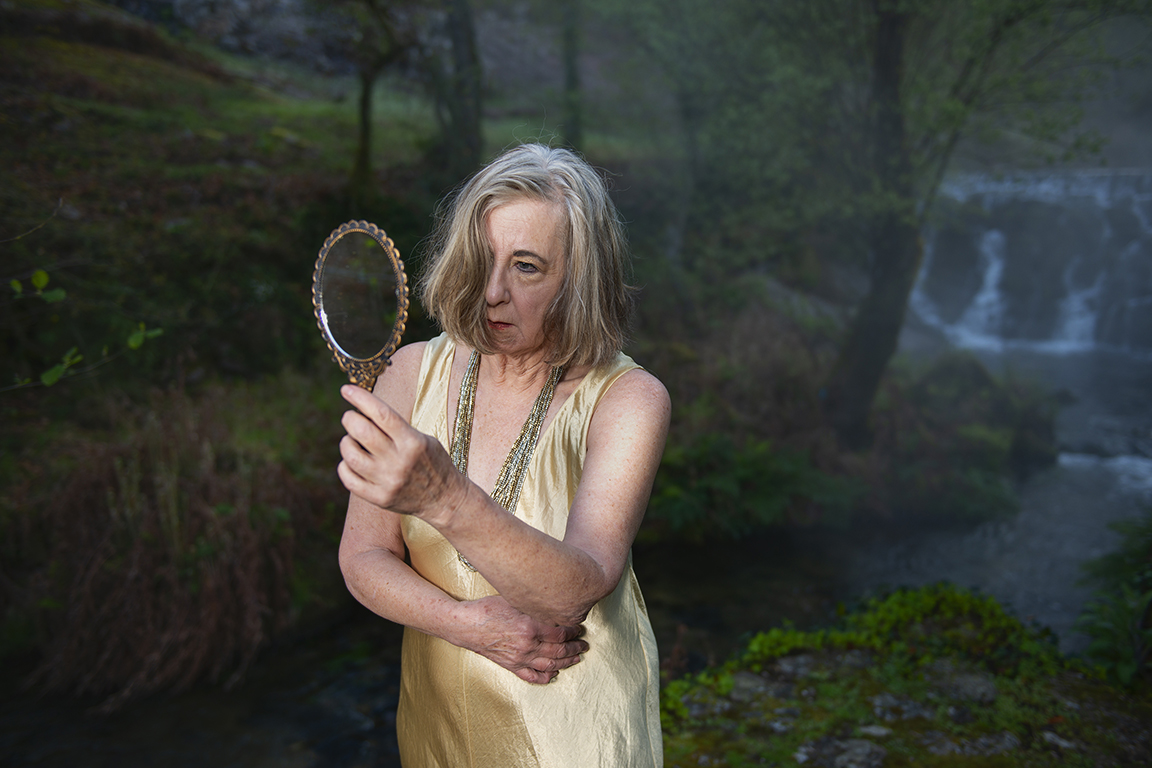
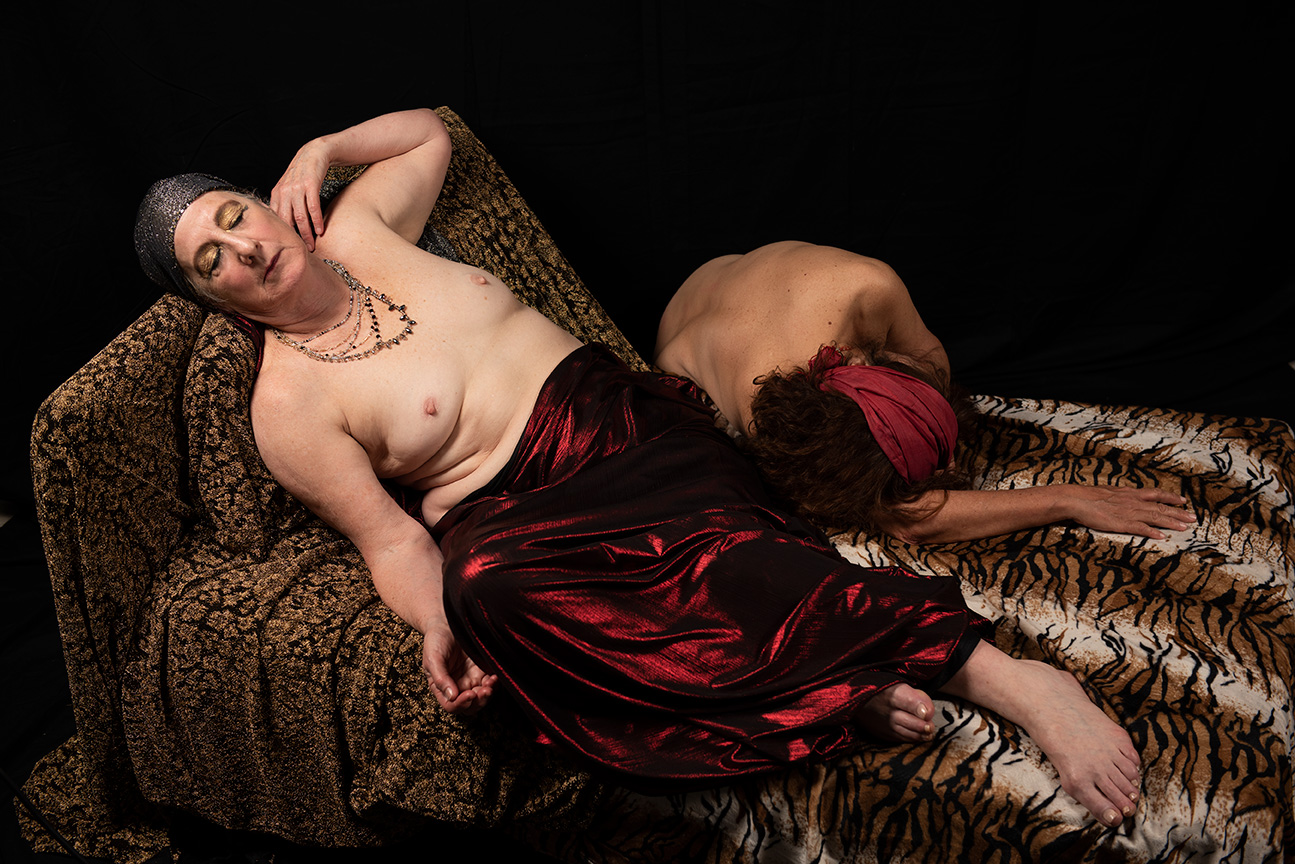
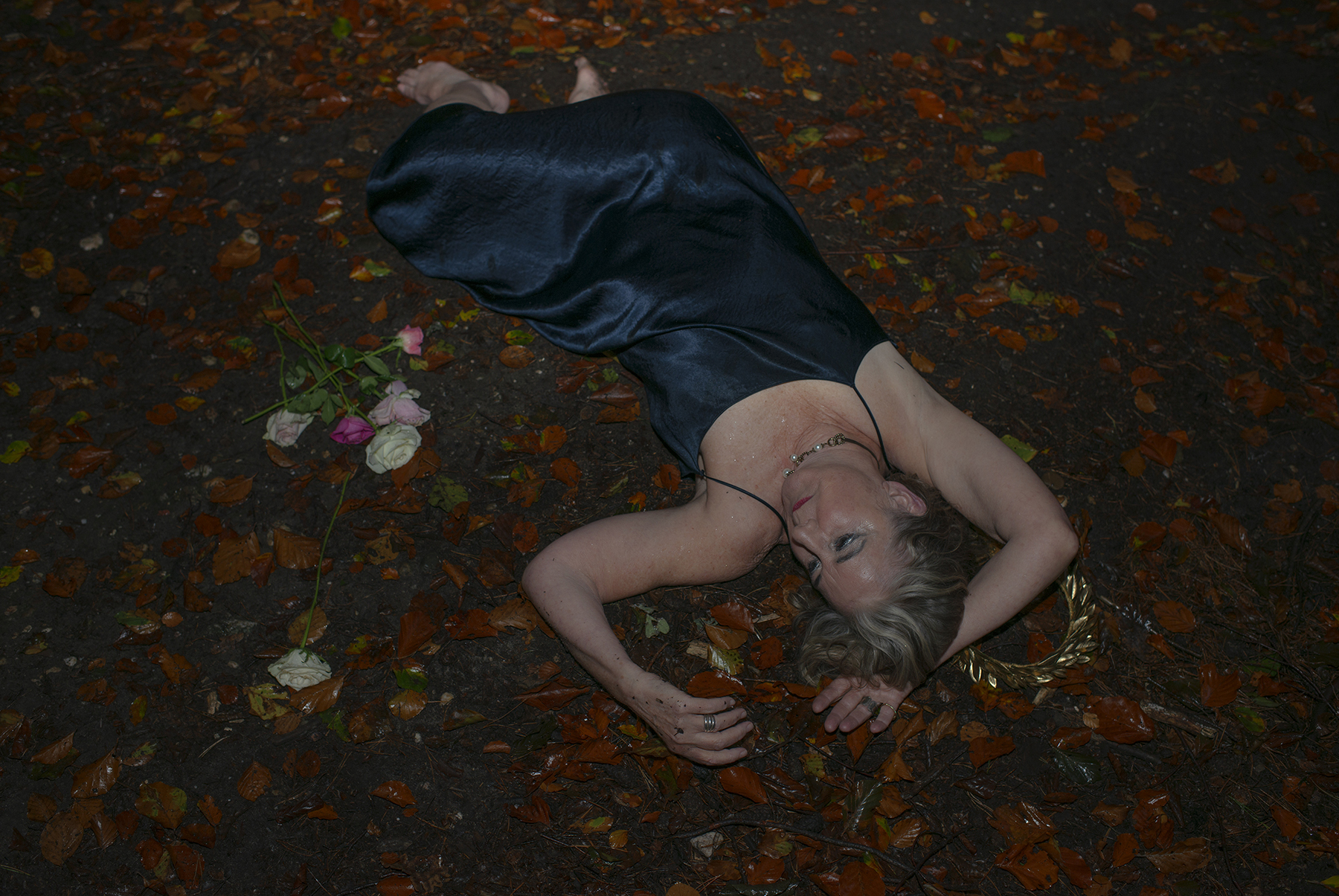
The Mirror of Helen, 20 x 30,” 2022

This conversation with curator and writer Cydney Payton took place in relationship to the exhibit On Sappho, Helen and Aphrodite, an exhibition of performative photographs I produced in collaboration with photographer Luís Filipe Branco. The exhibit will be on view at Michael Warren Contemporary in Denver, Colorado October 31st to December 2nd 2023. The opening reception  is November 2nd from 5 to 8pm and an artist talk will take place November 18th from 10:30 to noon.

CP:       Congratulations on your show, On Sappho, Helen and Aphrodite, at Michael Warren Contemporary.

SW:      Thank you. I’m excited to talk with you about it!

CP:       To frame our conversation, you have been engaging with other artists’ images and practices as a modality of self-exploration for more than a decade. You referred to your practice as performative but also as embodying and enacting.

SW:      I am compelled to study the lives and work of women. In doing so, I have found a kind of courage and sense of self-power. That has led me to create an artistic practice that is more performance based.

The women I study become the subjects of various projects and bodies of work. The photographs document my artistic process and the practice itself; the photographs are also the intended result. While I am performing, I envision the poses to be a photographic work. Yes, enactment and embodiment—the terms you mention—are definitely the terms that describe this work.

The beauty of performative art for me has been that my body can exist in different environments. Somehow those environments—sites, places, atmospheres—come to represent the women I am thinking about and making work about. That process is empathic, yet it exists because I have excavated and studied their lives and work. Until recently, most of those women were artists. Now, I am working with a broader representation of historical and feminine voices in creating the Heroines Project.

CP:       You are very process driven in your artistic practice. You make a lot of images.

SW:      The work is created through in-depth research, editing, and post-production of thousands of images. Each image goes through the processes of the performative act, lens and shutter, preproduction on a digital screen/film, printing, and, finally, exhibited object.

But in the end, I am forever an installation artist. Thus, the final narrative of an exhibition arrives because I care about the spatial dynamics between the audience and the art. An exhibition offers a liminal plane where the viewer and the object—the concept and the artist—participate. In the case of On Sappho, Helen and Aphrodite, I hope to create a way of confronting volumes of history largely written by men. 

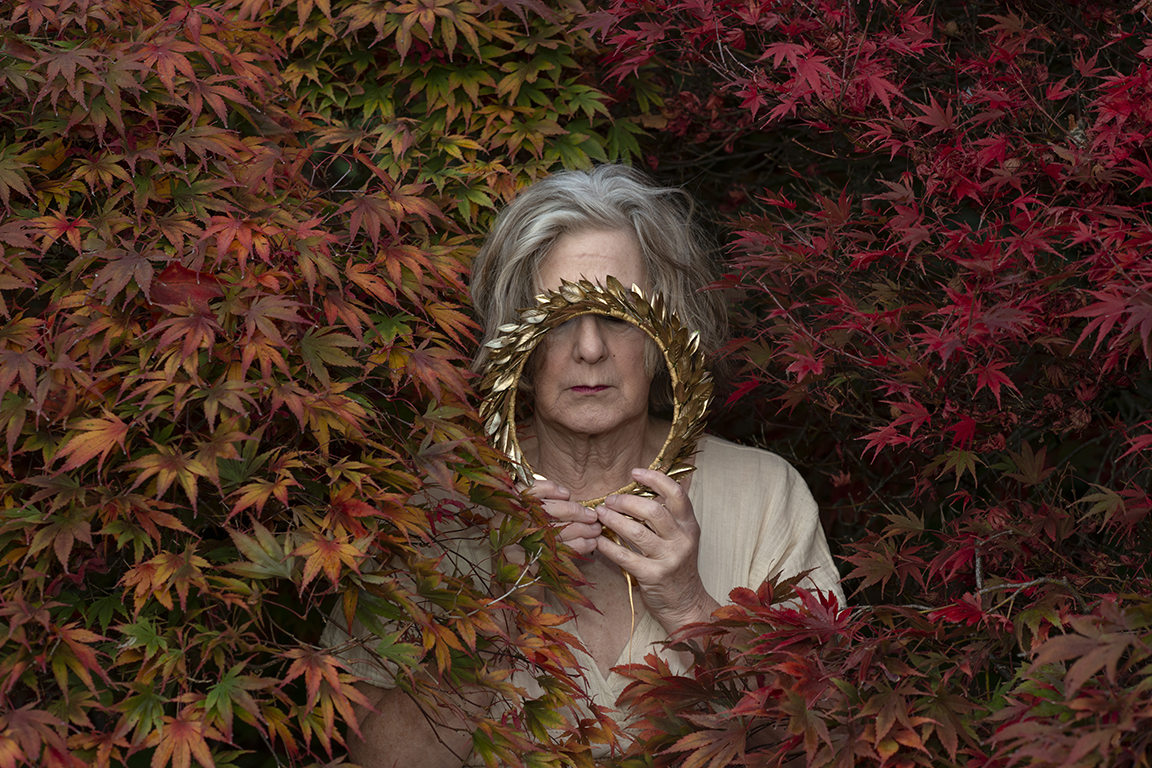
Sappho’s Crown, 22 x 33,” 2022

CP:       The exhibition insists upon directness of viewership. We cannot look away. We are obligated to make comparisons, historical and contemporary, among these three iconic representations of the feminine. Sappho is the first heroine you bring into view. Her words, from the few remaining papyrus fragments, are sprinkled throughout the installation in excerpts taken from translations by Diane Raynor and poet Anne Carson. These traces of Sappho, which have survived over centuries, to be investigated, translated, and (re)interpreted, anchor the show.

SW:      I investigate women, both fictional and real, such as Sappho. She was a real person; we know that because we have her words. Helen and Aphrodite are mythical and archetypal figures, but for me Sappho has an artist’s voice. As I delved into the translations of her texts, which were originally songs meant to be performed and sung and accompanied by dancers and instrumentation, I found her to be so modern. And her subjectivity feminist and feminine. She is speaking from 2,800 years ago, and, even so, the work resonates with me as being in the present moment.

In Poem #58, which is also called “The Old Age Poem,” Sappho speaks to me as an artist very directly, as she speaks about herself at an older age. In truth, I am inserting myself into the lives and stories of these heroines from my position as a sixty-something-year-old woman.

CP:       Even though your photographs present a type of romanticism in tone and composition, there is a feminist message about love in the work that pervades the exhibition.

SW:      Love means many things. Gender might be implicit, but it is also fluid. Though Aphrodite was not seen as a supporter of lesbianism in the ancient Greek world, maybe because it’s mostly stuff written by men, she should be seen as totally supportive of all forms of love (and sexuality, too). I love this line that Aphrodite speaks to Sappho: “Who, O Sappho, is wronging you? For if she flees, soon she will pursue. If she refuses gifts, rather will she give them. If she does not love, soon she will love, even unwillingly.”

CP:       Beautiful.

SW:      There is this complexity of love, the giving and receiving, the joy and the loss, in the poem. I just love this advice from Aphrodite. And Sappho loves Aphrodite—she’s her main goddess, and she speaks with her a lot.

Aphrodite with Roses I, 30 x 20,” 2022

CP:       The photographs also contain an abundance of symbolism, for example roses in the images of Aphrodite. For Aphrodite, you looked to the Pre-Raphaelite painting Venus Verticordia by Dante Gabriel Rossetti. The painting is of a beautiful young woman with an apple and a dart. In your diptych, Aphrodite with Roses, you present us with an apple and a bouquet of red roses against a figure on a proverbial bed of roses.

Venus Verticordia, 32 x 26,” Dante Gabriel Rossetti, 1864

SW:      I was riffing on Venus Verticordia. I don’t expect the viewer to make that connection, but roses do serve as a backdrop in both the painting and in the diptych. The roses are brought forward to perhaps deliver other meanings. Both Venus and Aphrodite are usually represented as beautiful and sometimes sexy young maidens. Rossetti’s painting sort of morphed into the work in the moments when photographer Luís Branco and I were making these pictures. I had an idea of where I wanted to go. We set up the photo shoot toward that idea. Even so, every photograph has its own performative life, such as it did with creating Aphrodite. The image is obviously me, an older woman, and you see all the wrinkles on my neck and face.

Aphrodite with Roses II, 30 x 20,” 2022

CP:       Your decolletage.

SW:      My decolletage. And my breast is exposed, as Venus’s is in the painting. The work is compressed and cropped, cut off, and presented larger-than-life size. The face and the boob and the arms, the roses, everything operates against a natural sense of scale.

CP:       Rossetti’s version was also the first time that he painted a nude figure. He, too, compressed and zoomed in to create an artificial reality that reads more intimate and sexualized. His other images were more full-bodied and fully clothed. There is a mirror between your image and Rossetti’s image as far as being on the heterosexual edge of desirability; it’s almost camp.  

SW:      After making and producing these photographs, I looked up who Venus Verticordia was in Roman mythology. I discovered that she was a goddess who protected young women and older matrons from their own sexual appetites. This is the opposite of what my Aphrodite and the Greek Aphrodite are all about. I am inserting myself into Rossetti’s view but as this older woman who is sexualized through my autonomy of choice. I’m in a bed of roses as an older woman, not as a subject posed against roses to suggest a social norm of idealized beauty. My Aphrodite is one of generosity. She is for ALL love.

CP:       Is Aphrodite your main goddess?

SW:      I’ve always thought it was Aphrodite. As I learn more and more about her, I do adore her. But she is kind of tricky too. She actually put Helen in a bad position. It was Aphrodite who made a promise to Paris. In the Judgment of Paris Aphrodite tells Paris that if he gives her the golden apple and deems her the most beautiful goddess over Hera and Athena, she will give him the most beautiful woman in the world, Helen of Sparta. That was a little presumptuous, her doing that to Helen!

CP:       Venus Verticordia also means “changes of the heart.” That could be one way of looking at Helen After Troy. The image presents us with a Helen full of regret, after the war, abduction, kidnapping (or elopement) with Paris. We all know about Helen from history, certainly the Odyssey and the Iliad, but you have augmented that reading with something new.

Helen After Troy, 33 x 22,” 2022

SW:      We shot that photograph in March. We were shooting Helen with her gown and crown and jewels in the swimming pool. When I got out of the pool, it was dark and I was cold. We can see how miserable I was. That’s when Luís said, “Just one more shot.” I was like, “You know, Luís, I am fucking cold.” 

Later, when I saw the proofs for the image, I thought, well here’s Helen after Troy. In the ancient story, Helen comes home from Troy with her husband, King Menelaus of Sparta. After the fall of Troy, he had been meaning to kill her when he captured her, but he couldn’t because she was so beautiful (and her breasts!). According to the Odyssey, he brings her home and they have a nice life in the palace in Sparta, entertaining guests with lavish parties.

And, who really believes that? How could she have gone through the torture of the ten-year war in Troy with thousands of Greeks and Trojans dying, purportedly because of her, and just go home and have a nice life in the palace? I thought this is what she really would have looked like. She would look like a drowned rat, a drowned queen. Helen After Troy is one of my favorite images in the show.

CP:       Helen After Troy brings us to an alternative ending of what has been known. You point us there through the meta structure of your work. For example, Sappho’s poems reference both Aphrodite and Helen. And, when we take in the larger view, we can see you enacting Sappho, Helen, and Aphrodite in the context of the twentieth-century artist/performer Claude Cahun. How has Claude Cahun influenced this body of work?

SW:      As you know, from the artist’s book THE UNKNOWN HEROINE that you and I worked on, Claude Cahun is the artist who has been influencing my work for a while now. Cahun was incredibly well educated. Her grandmother taught her ancient Greek, so she understood the breadth of history and classical literature. She was both a performance artist and an imagemaker who used herself in her photographs. Helen and Sappho came to me originally from Cahun, from her Heroines text, where she writes about fifteen women, mythical, real and fictional. She portrays Sappho in her short essay, written to be performed as a monologue, as Sappho the Misunderstood. And Helen is Helen the Rebel.

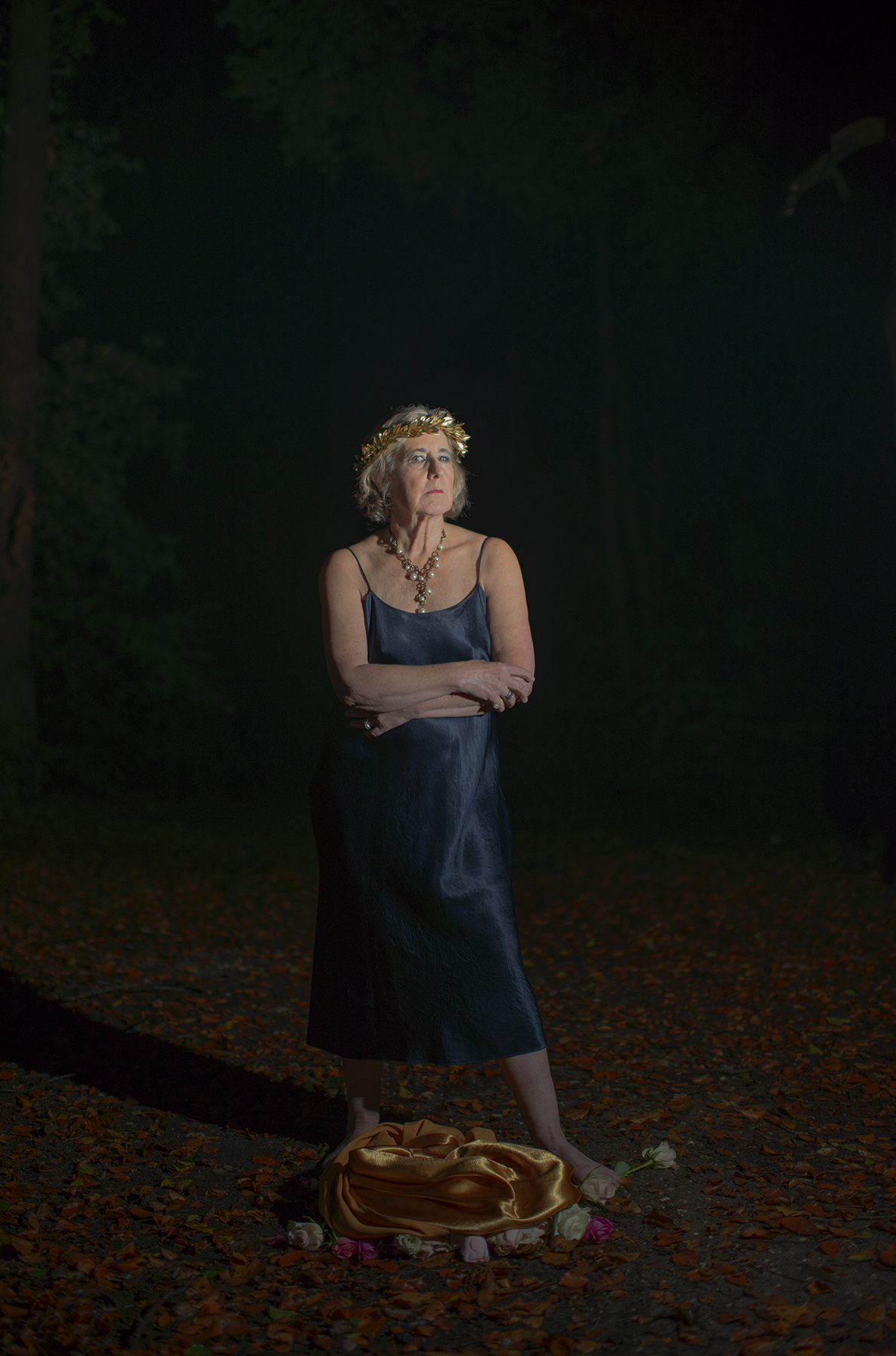
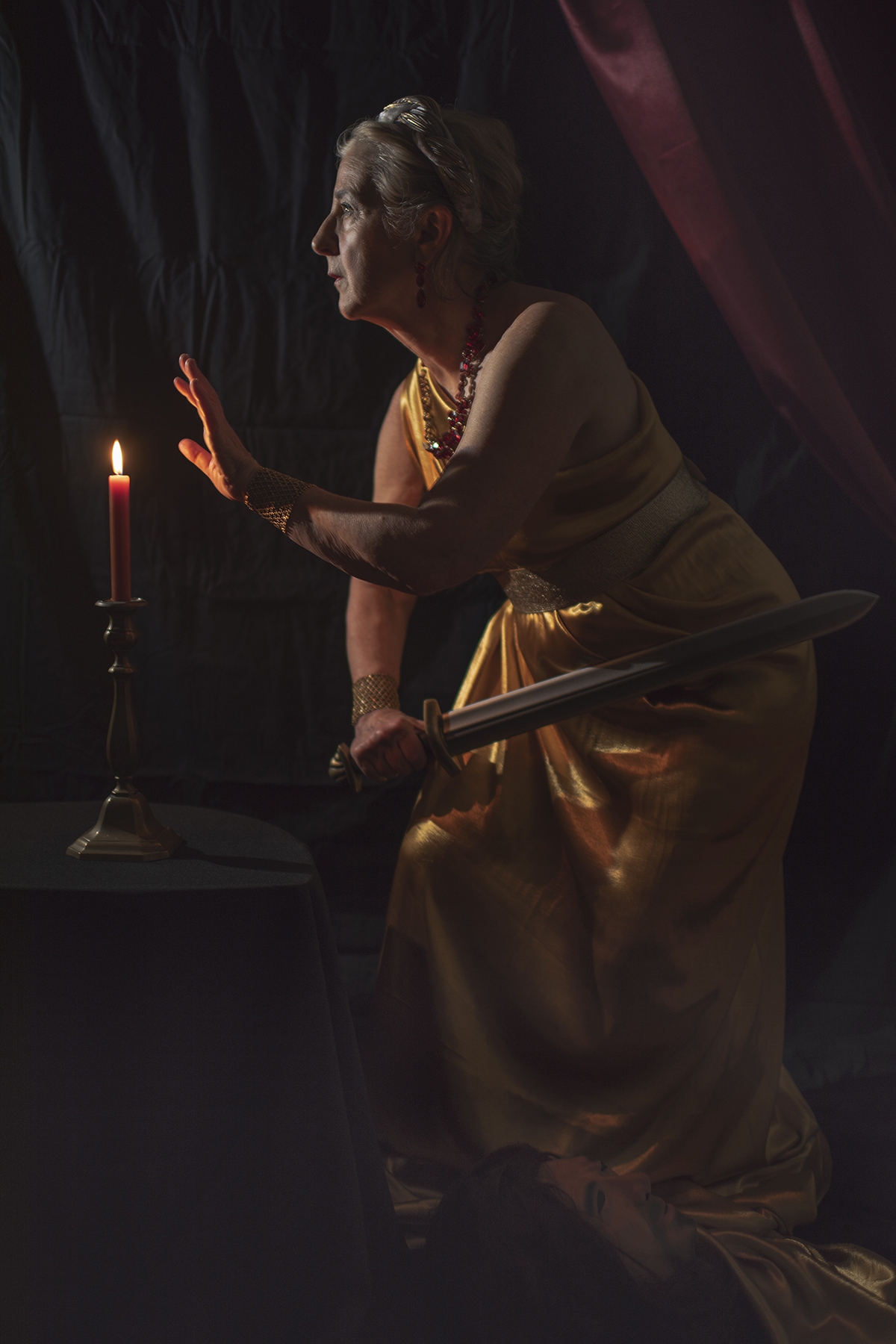
CP:       Your photograph Sappho the Misunderstood is a parallel of Helen After Troy. Both figures step out of the darkness; neither is idealized. Even with the theatrical lighting, we can penetrate the deeper questions about Helen and Sappho. With Sappho, we sense all that ambiguity around her identity and life. 

SW:      Sappho is misunderstood on all these levels—her sexual preferences, whether she loves men, whether she loves women, whether she loves both. These are things that have been discussed throughout the ages. And then all the mythology of her jumping off the Leucadian cliff. Sapphic lore tells us that later in life, she was in love with Phaon, a young ferryman, who ditched her for a younger woman. Supposedly, she was so upset she jumped off the Leucadian cliff.

CP:       You disagree with this?

SW:      Sappho would not be undone by Phaon’s betrayal. She was way too conversant with the fickle ways of love.

Sappho the Misunderstood, 33 x 22,” 2022

CP:       The photograph suggests a defiance, as if she’s looking back at us across the ages. It is a tantalizing expression of a mystery that will never be solved.

SW:      Yeah, I like that image a lot, too.

CP:       Maybe this is the moment to ask: How does your feminist perspective inform your collaboration with Luís Branco as far as process and vision?

SW:      When Luís and I work together, it’s like making a film. Beforehand, part of the research might be reading Sappho’s work, reading what historians and critics have thought about Sappho’s work, and studying paintings that have been made of Sappho through the ages. I also bring props, makeup, and outfits. We find sites, sometimes we create a staged setting. For Sappho, Helen and Aphrodite we worked outdoors in different locations in Holland and in Portugal.

It takes me a while to get into character. Part of the process becomes interacting in different spaces at different times—early morning, day, and night. What happens emerges from the connection to the site, the materials, the research, and the collaboration. In the process I do not camouflage my sixty-something-year-old persona. I attempt to embody these female icons from the truth of my body. Luís is very good at pushing me into character. We do literally take hundreds and hundreds of images to find those that are just right.

CP:       There are many artists who are working with identity, such as Cindy Sherman, who take their own pictures. You know how to take pictures. What does Luís’s perspective bring to the work that you couldn’t do on your own?

SW:      Our interaction, the collaboration, we call it a push-pull. He is, in essence, the viewer. People have asked why I don’t work with a female photographer. The fact that he is a man creates a kind of friction. Sometimes friction, sometimes seduction, that goes back and forth. For example, with the making of Helen After Troy, he saw what was possible.

CP:       He brings an objectivity to the moment that you could not.

You describe it as cinematic or filmic, which sits within the language of moviemaking. Is that a more important language for you now than the language of performance? Have you crossed over from thinking about visual art into thinking more about the cinematic nature of visual art?

SW:      I’m not trained as a performer—that’s something that’s just happened through this process, happened more and more. Taking on these big-time heroines, I must rise to be Aphrodite, to be Helen of Troy. I would say, there is this cinematic quality to the images because they are photographs. On Instagram these images operate in the public melee of social media. But when I exhibit them in a gallery, the physicality of the images allows people to really respond. The response is not just older women saying, “Wow, this is really cool!” Younger women, older men, queer people, respond. Everybody has a mother or a sister or a lover or whatever. I’m your everyday girl, but …

CP:       There is a kind of surrogacy in the visual plane that you can step into.

SW:      People see me not just as Helen but as me, the sixty-eight-year-old artist-performer woman who is not afraid to be seen.  

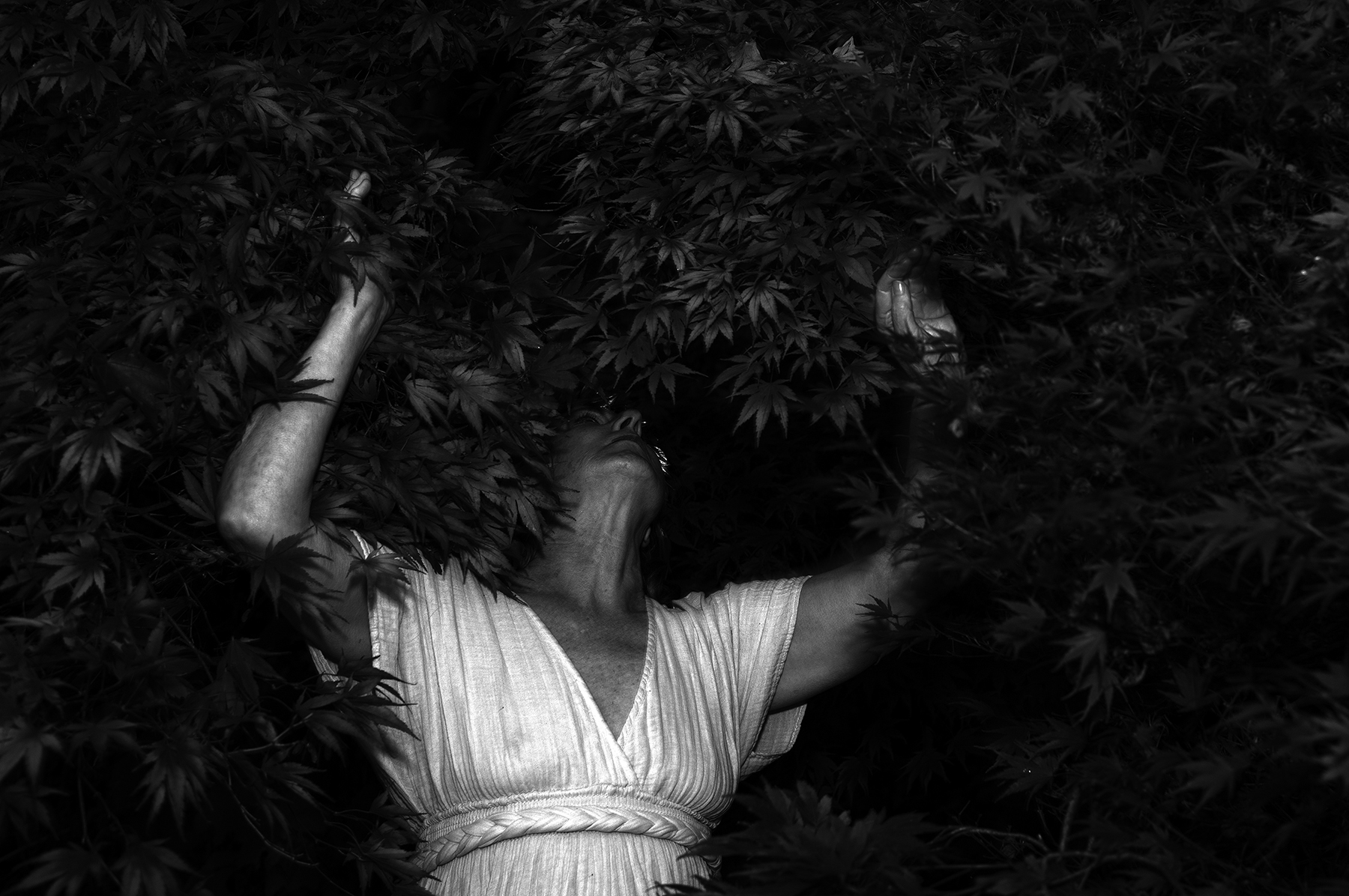
Helen’s Eidolon, 30 x 20,” 2022

The exhibit On Sappho, Helen and Aphrodite will be on view October 31st to December 2nd 2023 at Michael Warren Contemporary in Denver, Colorado. https://www.michaelwarrencontemporary.com/

The opening reception is Thursday November 2nd from 5 to 8pm and the artist talk will be Saturday November 18th from 10:30am to noon. There is a concurrent exhibition of Ann Marie Auricchio’s work. Gallery hours are Tuesday to Saturday 11am to 5pm.

Video about EXIT PARADISE –  an exhibition of the artwork of Sherry Wiggins and Luís Filipe Branco

Salome at Sunset Series, still photograph, Sherry Wiggins and Luís Filipe Branco

I am posting the video here that documents my collaborative work with Portuguese photographer Luís Filipe Branco that was in the exhibition Exit Paradise held at Seidel City Contemporary Art Gallery in Boulder, Colorado during Month of Photography in March and April 2023. It was a wonderful exhibit and I was so happy to exhibit Luís and my work alongside the work of fabulous photographers Mark Sink and Kristen Hatgi Sink. Ron Landucci of Infinite Editions produced beautiful prints for us. Terry Seidel was a great host and Seidel City is a fantastic contemporary art space. In this video I explain my intentions and sources for this work about my biblical heroines Eve, Judith (who took the head of Holofernes) and Salome and we also show the works themselves along with installation shots in the galleries. Videographer Robert Kittilä shot and edited this short video for me.

Here is the link to our video on You Tube:

It was so much fun to work with my friend Robert Kittilä to make this video and I am glad to have this document. I have had a difficult summer with some physical problems that I am slowly recovering from. Meanwhile I have been editing and producing more of Luís and my Heroines work and I am looking forward to upcoming exhibits of our work: with a show at Michael Warren Contemporary in Denver opening November 2nd titled “On Sappho, Helen and Aphrodite,” a group show at East Window Gallery in Boulder titled “Aging Bodies, Myths and Heroines” curated by Todd Herman opening November 10th, and another group show that will be opening at BMoCA in January curated by Jane Burke. Hugs to all near and far.

the snake, a wig, boobs and bad makeup: my Cleopatra series—posted July 10, 2023 in Boulder, CO

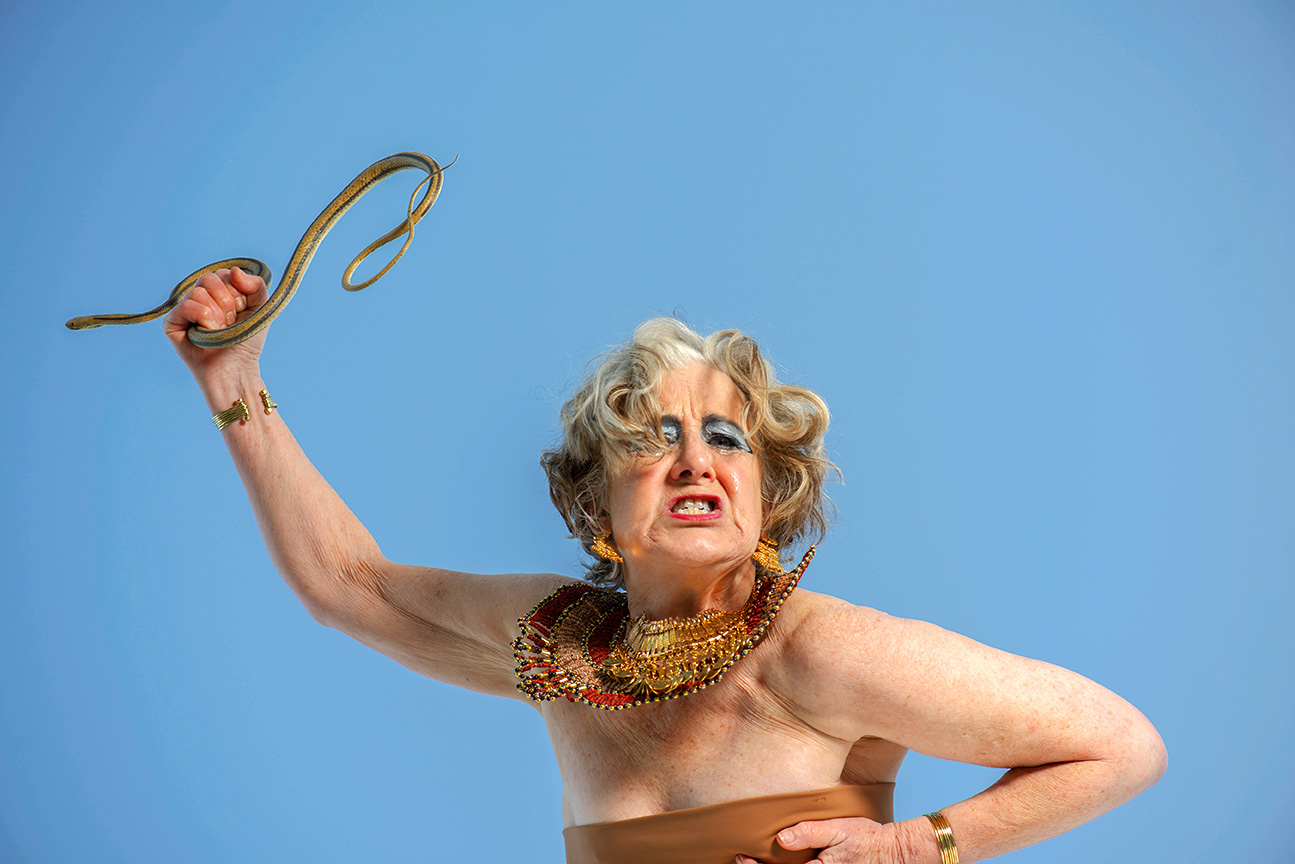
my Cleopatra (with a snake and a cigarette), Sherry Wiggins and Luís Filipe Branco, 2023

There is truthiness in the image above titled “my Cleopatra (with a snake and a cigarette).” Photographer Luís Branco and I made this image in the first few days of our time at the Cortiço Artist Residency in Montemor-o-Novo, Portugal in February this year. I like that Cleopatra is sitting with me. My Cleopatra stares out at the camera / Luís / the viewer and she (me) appears undaunted and complicit; she assents to being seen and photographed.  We hold a cigarette in one hand and a snake, entangled with our jewelry, in the other. Our boobs are obscured,  but we wouldn’t care if they were bared.

This image reveals something about my process and practice with my various heroines. These iconic and ancient women—Eve, Salome, Helen of Troy, Sappho, Cleopatra, the great goddess Isis—they enter my body and mind. Together we reimagine and reinvent our histories. We think about our accomplishments, children, lost lovers, the ghosts of our past lives. Luís Branco helps to push and pull me and them across the boundaries of time and place and captures the images in rapid fire.

I realize that I am treading on controversial territory, joining  my sixty-something-year-old-white-lady face and body with the infamous Queen Cleopatra VII (the last queen of the Ptolemaic Dynasty in ancient Egypt). Issues of racism, sexism, misogyny and nationalism are at play, as are the inherent problems with the ways her story has been told (until recently, mostly by white men). Cleopatra has been my most difficult heroine to date and I puzzle with why.

I found an essay “Disorienting Cleopatra: A Modern Trope of Identity,” by scholar Ella Shohat, that helps me think about my art practice with Cleopatra in a new way. Here is a brief but pithy excerpt from Shohat’s essay:

“Engaging with the subject of Cleopatra almost necessarily entails addressing the question of image making and visual representation. For millennia, her story of love and death, of power and sexuality, of domination and subordination, and of the imperial intercourse between Greek, Egyptian, and Roman civilization has excited the popular imagination, triggering passionate opinions about her identity. The historical and the fantastical have mutually nourished each other. The uncertainty about her looks, meanwhile, has allowed each generation to shape her image in the form of its desire. Each age, one might say, has it’s own Cleopatra, to the point that one can study the thoughts and discourses of an epoch through its Cleopatra fantasies. The ancient queen therefore constitutes more than a historical figure who can be relegated to the domain of archaeology and Egyptology; rather, she allegorizes highly charged issues having to do with sexuality, gender, race, and nation, issues that reach far beyond the geocultural space of her times.”

Right on… and for me I would add “age” to Shohat’s “issues having to do with sexuality, gender, race and nation.” So what does Cleopatra have to say to me? How does this monumental figure meld with me? And what are my Cleopatra fantasies?

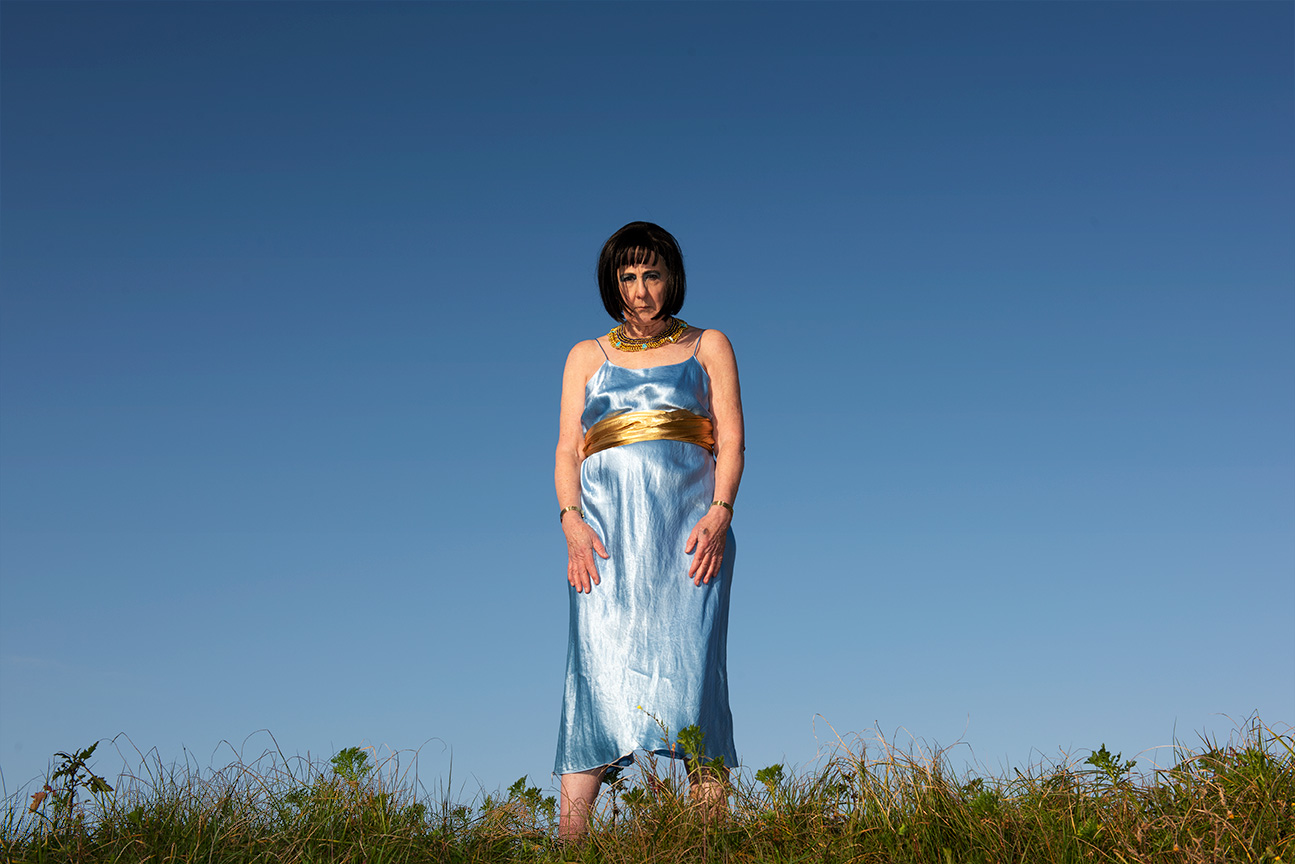
my Cleopatra (blue sky), Sherry Wiggins and Luís Filipe Branco, 2023

One of my Cleopatra fantasies arrived on the hillside at Montemor-o-Novo. The sky above was brilliant blue and the earth lush green below. My Cleopatra has a 1960s cinematic glamour in these images. I am not sure if the wig works, but the “real” Cleopatra and other ancient Egyptian royalty wore wigs, as did Elizabeth Taylor in the lavish 1963 film Cleopatra. These images convey my Cleopatra’s bravery, confidence, fierceness and sensuality.

my Cleopatra (in the grass), Sherry Wiggins and Luís Filipe Branco, 2023

my Cleopatra (drama queen), Sherry Wiggins and Luís Filipe Branco, 2023

It was Luís’s idea to shoot my Cleopatra in the café in Montemor early in the morning. I call these images in the café the “my Cleopatra (morning in Montemor) series.” It was near the time of carnival in Portugal so the other clientele in the café were okay with our occupation of the space. The harsh fluorescent lighting shines on my Cleopatra. We are world-weary—we are having a coffee, a beer, a cigarette, a break. We are isolated and alone in the café, though others are present—most notably, a world-weary man whose gaze is as diffuse as ours is direct. We are well aware of our own objectification / subjectification in relationship with the camera.

my Cleopatra (morning in Montemor) series, Sherry Wiggins and Luís Filipe Branco, 2023

my Cleopatra (morning in Montemor) series, Sherry Wiggins and Luís Filipe Branco, 2023

my Cleopatra (morning in Montemor) series, Sherry Wiggins and Luís Filipe Branco, 2023

We shot the below images of my Cleopatra immersed in the landscape near the clothesline on the grounds of the Cortiço Artist Residency. I took off the wig but kept the wig “grip” on my head. These images invoke the “drag” quality of my embodiments with Cleopatra. The bad makeup, the elaborate jewelry and the golden gown contrast with the simple and mundane quality of the clothesline and the surrounding landscape. I love the fake tiger-skin blanket. Both humor and a tragic quality pervade these images of “my Cleopatra (clothesline drag-queen).” And, yes, a woman can be a drag-queen.

my Cleopatra (clothesline drag-queen) series, Sherry Wiggins and Luís Filipe Branco, 2023

my Cleopatra (clothesline drag-queen) series, Sherry Wiggins and Luís Filipe Branco, 2023

my Cleopatra (clothesline drag-queen) series, Sherry Wiggins and Luís Filipe Branco, 2023

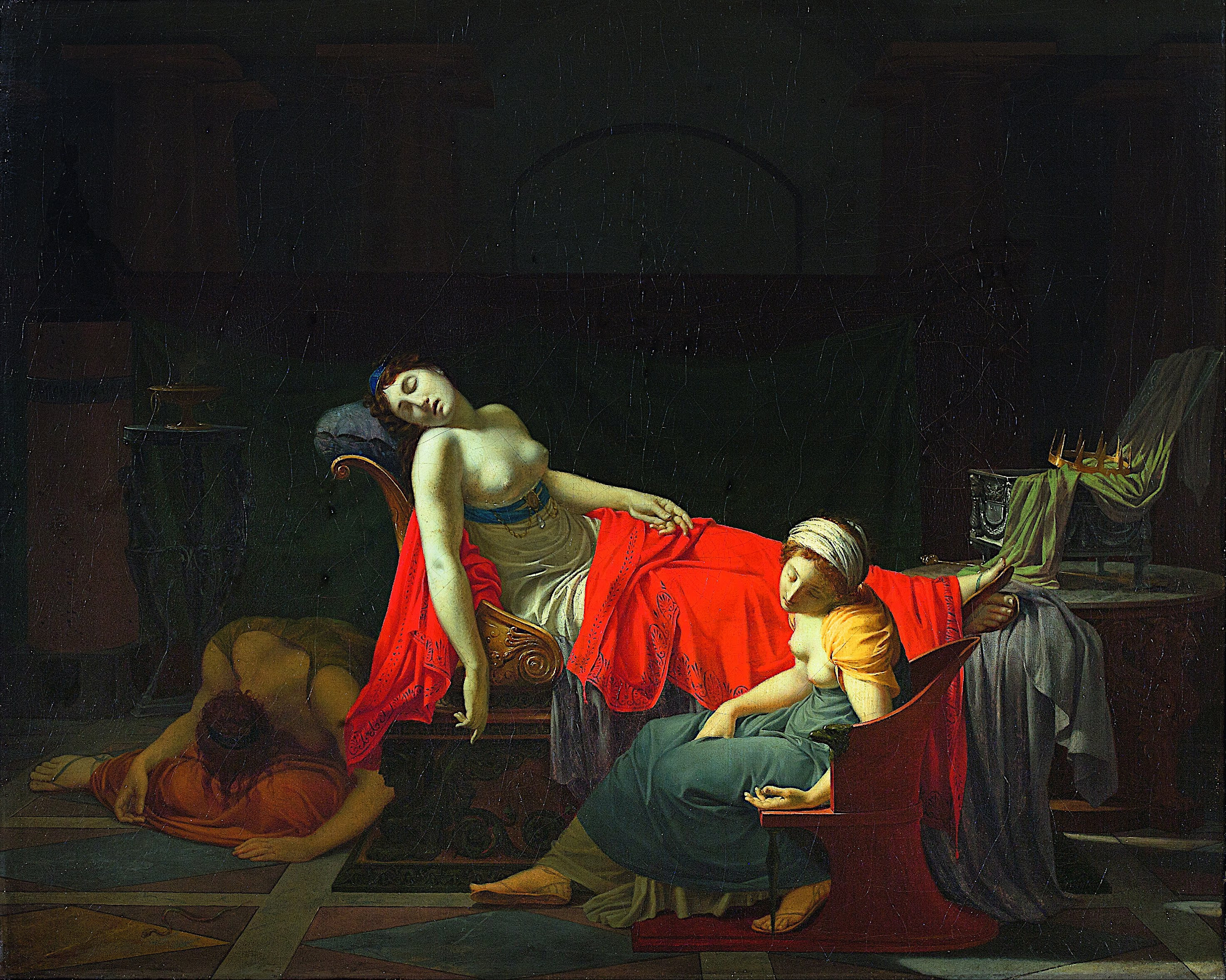
I wanted to create another historical painting re-enactment, like the ones Luís and I have created with other heroines. We were inspired by the 1796 painting “Death of Cleopatra” by French painter Jean-Baptiste Regnault. Cleopatra’s death is a subject that has been represented in paintings, films, plays and more. Cleopatra committed suicide in August of 30 BC as the Roman general Octavian arrived in Alexandria with the goal of capturing and killing his political rival, Mark Antony, Cleopatra’s husband. Octavian sought to wrest control of the Egyptian empire from Cleopatra and Antony. There are differing stories of how Cleopatra took her own life.  Some say it was by the bite of a venomous snake, others say she took some kind of poison. I wrote a blog post about the subject of her death and how it has been represented and most likely misrepresented. Here is the link: https://sherrywigginsblog.com/2023/01/22/the-death-of-cleopatra-posted-january-22nd-2023-in-boulder-co/

The Death of Cleopatra, Jean-Baptist Regnault, 1796

Luís and I set up a photoshoot to create our own version of Cleopatra’s death inspired by the Regnault painting. I wanted to play with the overwrought orientalist drama and beauty that Regnault’s painting portrays. In the painting Cleopatra is shown with her two maidservants. We found a model, a friend of a friend, who was willing to work with us and act as Cleopatra’s maid servant. I embedded my Cleopatra’s body into this scene. Luís shot hundreds of images. In the end, we chose one image that Luís and I are both happy with. I call it “my Cleopatra (for Regnault).”  This was a new way of working for me (with a model or another subject), and I think it was quite successful.

my Cleopatra (for Regnault), Sherry Wiggins and Luís Filipe Branco, 2023

Artifice, improvisation and sometimes magic mingle in my work with Luís. This last series is the “my Cleopatra (snake wrangler) series.”  We were shooting my Cleopatra on the upper terrace of the house at Cortiço. Luís was shooting me from the ground floor below. I was wearing my over-the-top Cleopatra makeup and jewelry, and I had the snake. We were fooling around with perspective; I was hanging over the terrace wall and Luís was lying on the ground below. The perspective (and gravity and age) makes my face and skin and jewelry hang and droop and dangle. My Cleopatra appears both glamorous and grotesque, sexy and silly, strong and vulnerable. My fantasy here is that my Cleopatra has beaten the odds and has lived to a ripe old age. Of course, we are still surrounded by the danger (the snake) of being misunderstood and misrepresented.

my Cleopatra (snake wrangler) series, Sherry Wiggins and Luís Filipe Branco, 2023

my Cleopatra (snake wrangler) series, Sherry Wiggins and Luís Filipe Branco, 2023

my Cleopatra (snake wrangler) series, Sherry Wiggins and Luís Filipe Branco, 2023

“Exit Paradise” at Seidel City March 18- April 30, 2023 –posted in Boulder, CO March 25, 2023

Serpent Woman, Sherry Wiggins and Luis Branco, 2021

Luis Branco and I are excited to be exhibiting fifteen large-scale performative photographs portraying the biblical heroines Eve, Judith, and Salome in the galleries at Seidel City. We have created multiple images of each heroine. These performative photographs narrate our revisioning of each woman in my somewhere-in-her-sixties-year-old form.

All About Eve, Sherry Wiggins and Luis Branco, 2021

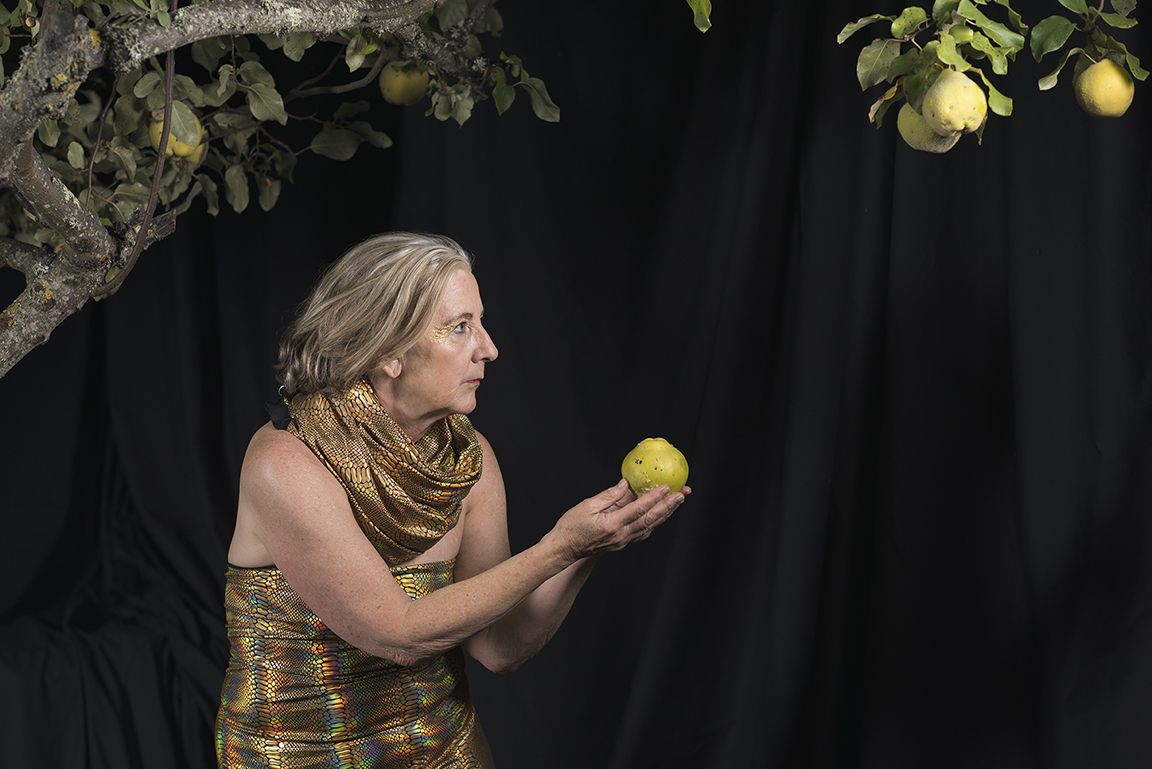
Eve (me) is depicted in a snakeskin dress under a quince tree in a stage-set-like mise-en-scène. I combine the Serpent and the original Woman in one form—she is both offering and taking the forbidden fruit, both temptress and tempted. Luis Branco and I shot these images of Eve / the Serpent under the quince tree in the courtyard at the OBRAS Artist Residency in Portugal in 2021.

Forbidden Fruit, Sherry Wiggins and Luis Branco, 2021

I love the artifice created by surrounding the quince tree with black fabric. Some speculate that the forbidden fruit in the Garden of Eden was not an apple but perhaps a quince, a fig, or a pomegranate.

Exit Paradise I, Sherry Wiggins and Luis Branco, 2021

Exit Paradise II, Sherry Wiggins and Luis Branco, 2021

The story of the original temptation and the forbidden fruit baffles me. Why wouldn’t Eve want to know the difference between good and evil which the fruit from the Tree of Knowledge offers? And how did this idea of Eve as the original “dangerous woman” get passed down through millennia? In the large-scale diptych Exit Paradise I and II, Eve/the Serpent sheds her dress/skin as she exits paradise and is forever blamed for her singular act.

Judith and her Maid, Artemisia Gentileschi, 1625

Pictured above is my next heroine Judith, the beautiful Jewish widow who saves her people by seducing the Assyrian General Holofernes only to cut off his head. I particularly love this portrayal by Baroque artist Artemisia Gentileschi. Renaissance and Baroque artists (such as Giorgione, Caravaggio, and Gentileschi) loved the drama, intrigue, and gore of Judith’s story—a tale of power, piety, seduction and revenge. In the ancient biblical tale, “The Book of Judith,” Judith is a pious widow living in the village of Bethulia in Judea. The village is under siege by the Assyrian general and his army, who are camped outside her village. Judith decides to outwit the general and save her people “with God’s hand.” Judith removes her simple widow’s garments and decks herself out in jewels and sumptuous fabrics and goes with her maid to the camp of Holofernes. Judith gains Holofernes’s confidence, explaining that she plans to help him find the best route to conquering her village. Holofernes is charmed and seduced. A feast is held in Holofernes’s tent and he proceeds to drink too much wine. Judith takes advantage of his weakness and decapitates him using his own sword. She takes Holofernes’s head back to her village where they post it on the gate to the village. The Assyrian army is leaderless and in disarray after the murder of their general and they quickly leave Judea. Judith has saved her people and is forever renowned for her bravery and for using her feminine wiles and skills at seduction in the service of God and country.

Judith (after Artemisia Gentileschi), Sherry Wiggins and Luis Branco, 2022

I sometimes re-enact historical paintings of my various heroines, inserting myself into the painting. Judith has been represented as pious and sexy, brave and vengeful, cunning and seductive. Artemisia Gentileschi’s 1625 portrait is particularly interesting to me. Artemisia is another heroine of mine. She was the victim of a sexual predator at a young age and still managed to become one of the most prolific painters of the Baroque period. Artemisia painted many biblical heroines and characters, often painting her own visage onto her subjects. One can see Artemisia’s portrait of Judith as a portrayal of revenge, a me-too act. When I insert my 60-something-year-old-self into this portrait, Judith, Artemisia, and I echo one across time and space.

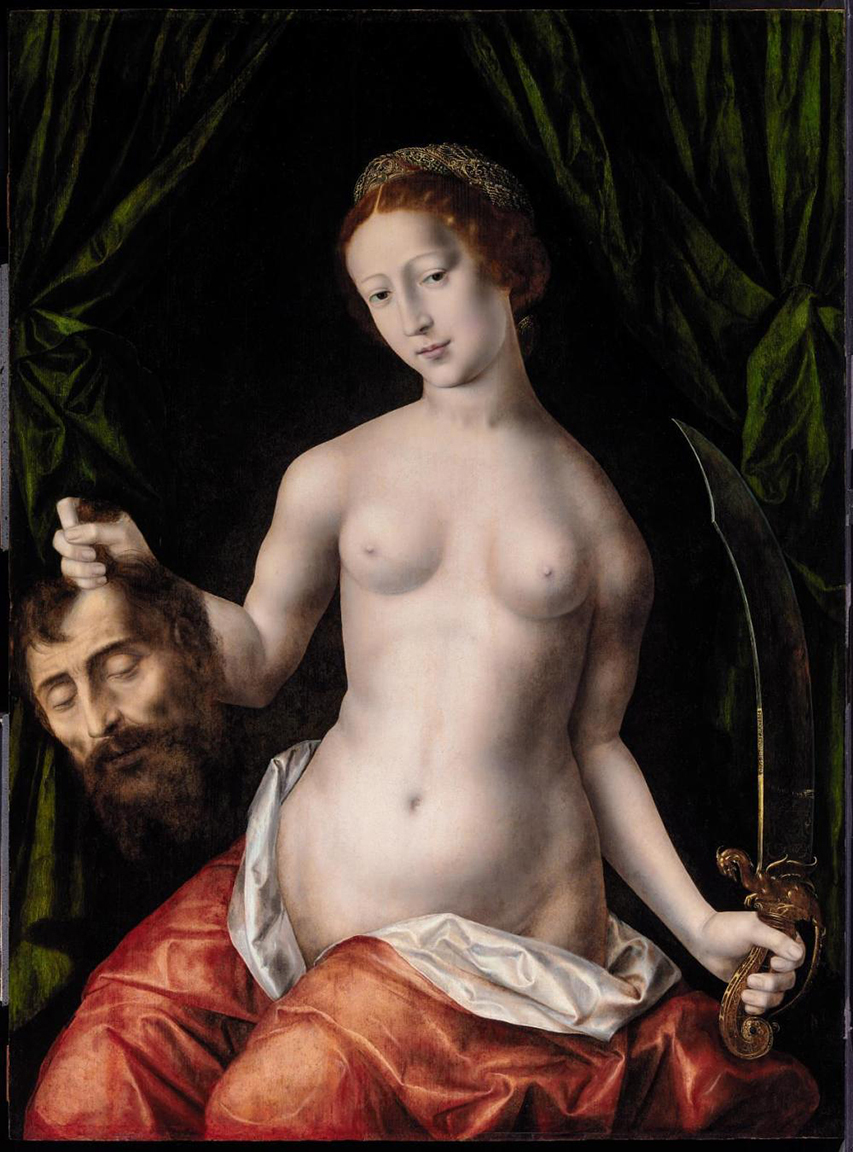
Judith with the Head of Holofernes, Jan Massys, 1543

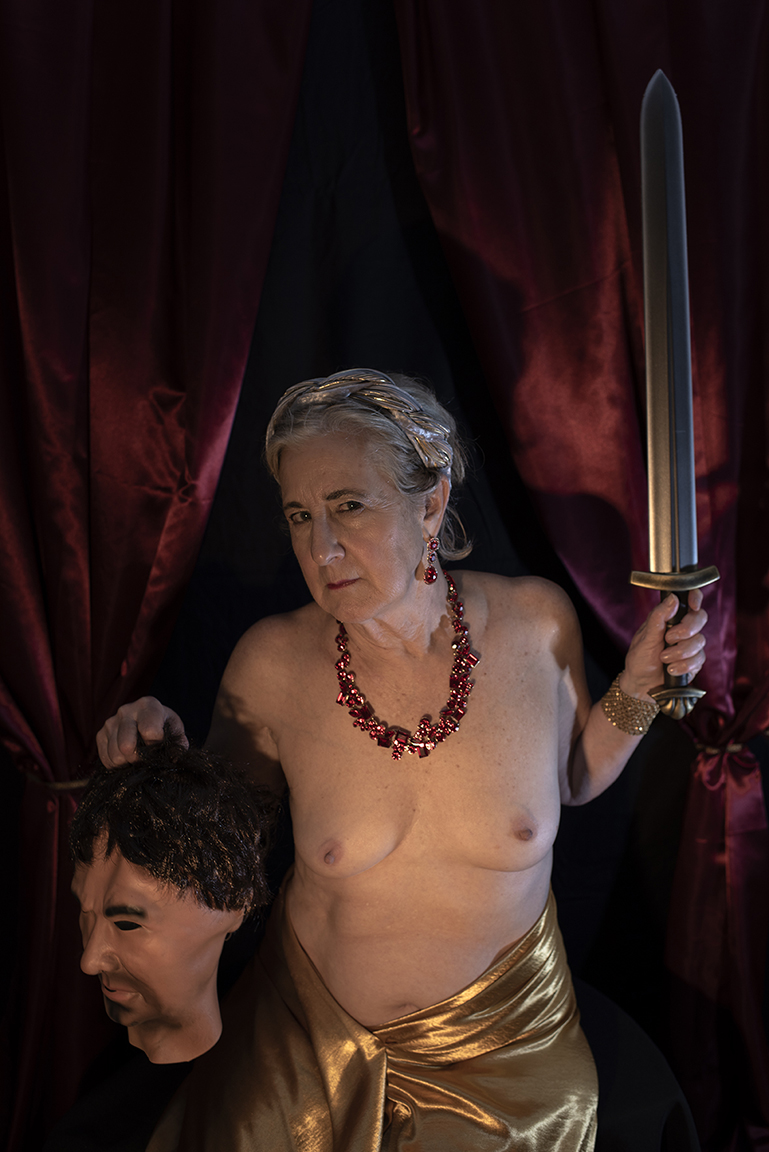
The Sadistic Judith?  Sherry Wiggins and Luis Branco, 2022

We recreated another portrait of Judith, one by Flemish artist Jan Massys. In The Sadistic Judith?, my bare-breasted Judith stares outward as she grasps the head of Holofernes in one hand and his sword in the other. She is no young, coy maiden, as she is in Jan Massys portrayal; she is, instead, a woman well aware of her brutal accomplishment and power.

The Apparition, Gustave Moreau, 1876

More heads roll in the story of the biblical princess Salome who famously and seductively dances before King Herod. He, in turn, grants her any wish whatsoever. Salome’s story has transfixed many in its multiple versions: in the Gospels of Mark and Mathew and in paintings, plays, and operas over the centuries. Salome has been portrayed as a young, beautiful temptress who, after dancing before King Herod and his guests, asks for the head of John the Baptist on a platter. Why would Salome ask this? The back story is that Salome’s mother, Herodias, married King Herod Antipas after divorcing her first husband, King Herod Antipas’s half-brother. John the Baptist criticized Herodias and King Herod and declared their marriage unlawful, which pissed off Herodias. When Salome asked for the head of John the Baptist, she was following her mother’s demand for revenge. So there are two femmes fatale’s in this story: the vengeful mother and the seductive daughter. Blame the daughter, blame the mother.

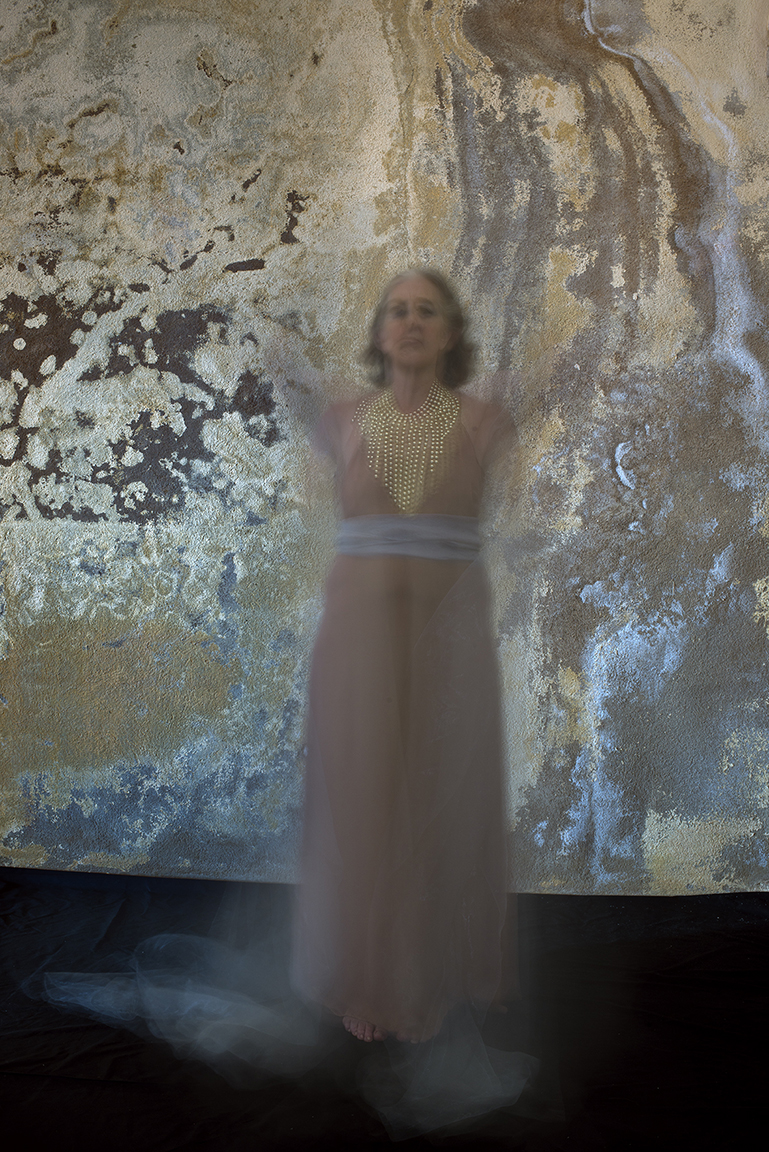
The Apparition, Sherry Wiggins and Luis Branco, 2021

One of my favorite renderings of Salome is found in the 1876 Gustave Moreau painting, “The Apparition,” above. In our The Apparition, Salome/me appears before a golden wall in a ghostly gauze, the result of Luis’s magical long exposure. We have printed this image at 72 x 48 inches for the exhibit and it looks great!

The triptych Salome at Sunset I, II, III depicts a contemporary Salome bedecked and bejeweled in a car—the joke being that the beautiful princess Salome is an older woman (in her sunset years) in a rental car, and she even bares her breasts.

Salome at Sunset I, II, III, Sherry Wiggins and Luis Branco, 2021

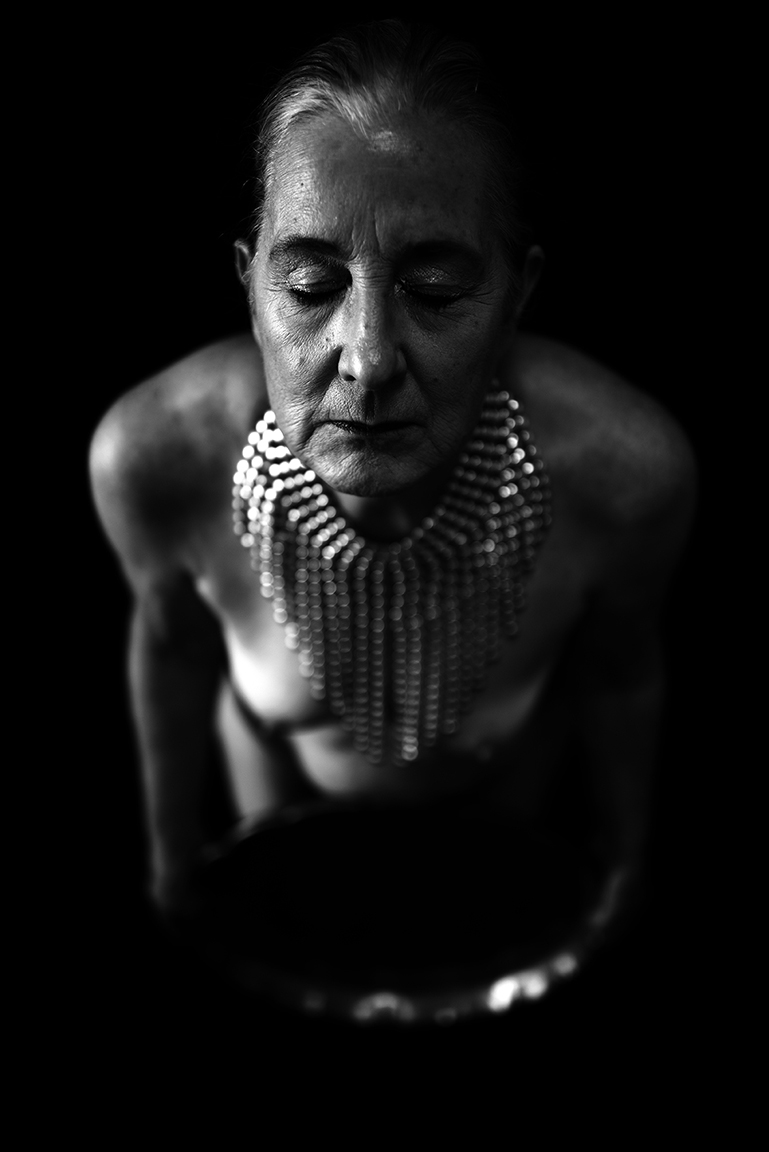
In the black-and-white image below, Salome for Oscar Wilde, Salome bows forward in a kind of fugue state, perhaps conscious of the results of her deadly wish. In Oscar Wilde’s kind of kinky play Salome, she is actually in love with John the Baptist and kisses his decapitated head.

Salome for Oscar Wilde, Sherry Wiggins and Luis Branco, 2021

These images question views of women throughout history, engaging with ideas of beauty, power, sexuality and aging.

The works in the exhibition are part of the larger project, Our Heroines. Our Heroines includes the works in this exhibition along with other alternative representations of additional heroines from classical, biblical, and other historical contexts. Along with Eve, Salome, and Judith, I have thus far embodied and performed Aphrodite, Helen of Troy, Sappho, Cleopatra, and the ancient Egyptian goddess Isis. My performances of these heroines have been captured in still photographs made with Luis Branco over the last two and a half years. Humor, serious research, feminist critique, and sometimes a little kitsch all coexist in these representations.

We are so happy to be showing these works at Seidel City alongside the works of fabulous artists Kristen Hatgi Sink and Mark Sink. “Exit Paradise” is up through April 30.

Seidel City is open Fridays and Saturdays by appointment from 1 to 4 pm. We have an artist talk on April15 from 2 to 4pm and a closing reception on April 30 from 3 to 6 pm. You can also contact me to see the exhibit at your convenience.

Here is the link to the Seidel City website for more information.

https://www.seidelcity.com/exit-paradise

The Death of Cleopatra – posted January 22nd 2023 in Boulder, CO

The Death of Cleopatra, Hans Makart, 1875

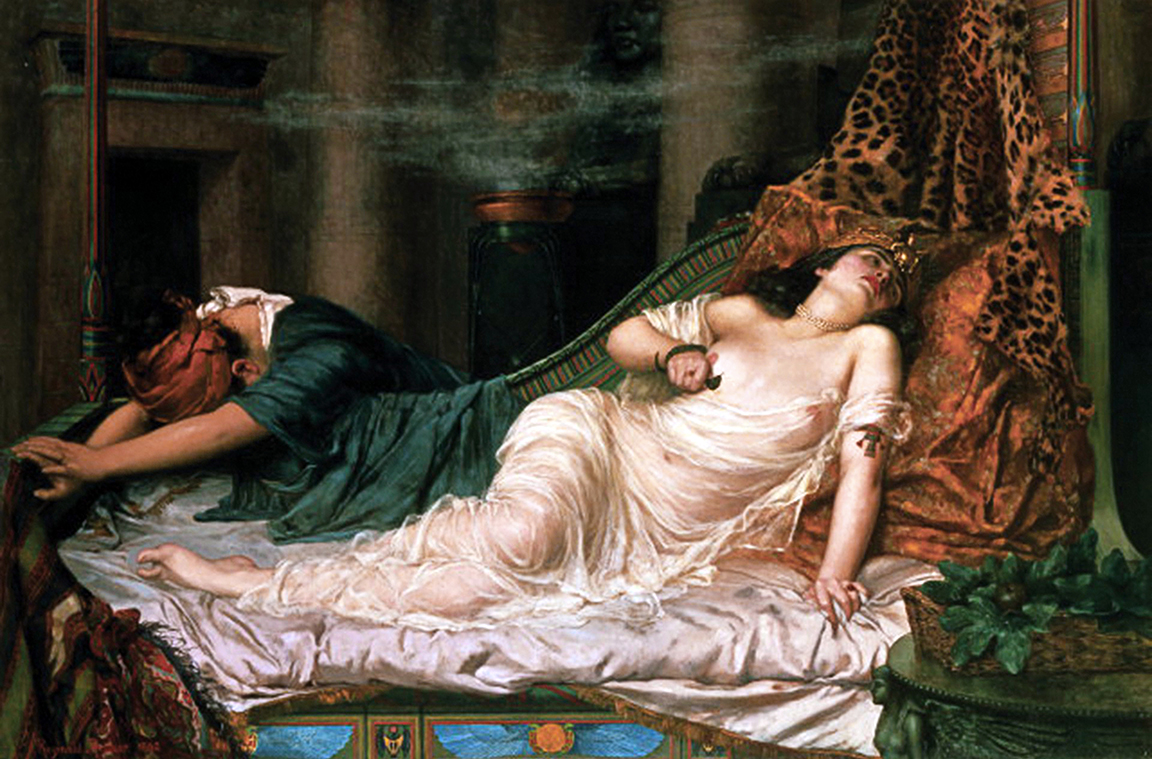
I am a sucker for all the drama, the romance, the glamour and to some extent the orientalism surrounding portrayals of Cleopatra VII Queen of Egypt. I love the aesthetics of this 1875 painting above “The Death of Cleopatra” by Austrian painter Hans Makart—the asp circling her arm, coiling around her breast, a drop of blood on her breast seemingly where the snake has bitten, her torso contorted, her face and body bejeweled and bedangled. Makart’s painting of Cleopatra is a gorgeous example of 19th century orientalist painting, the genre of painting by white Western European men who exoticize “the East” and sexualize women from the Middle East, Asia and Africa. Cleopatra’s life story and death story have suffered this form of Western orientalist misogyny since her story began being told more than two millennia ago.

Cleopatra’s death (and its representation in art and literature) is one of the questions that intrigues me as I have delved into Cleopatra’s life and history. I am preparing to embody and “perform” and make photographs of Queen Cleopatra the VII of Egypt with photographer Luis Branco in Portugal in February as part of the “My Heroines” series. In my previous studies and representations of heroines Eve, Salome, Judith, Aphrodite, Sappho and Helen of Troy, I have researched these figures and their representations (and misrepresentations) in literature, mythology, paintings, performances, sculptures, films, and in contemporary feminist criticism. I have to assume a certain amount of hubris as well as openminded investigation and humor as I embody these historic women in my 60 something year old cis-gender white woman form.

Cleopatra the VII Philopater the last Ptolemaic ruler of Egypt was born in 69 BC and died in 30 BC. She ruled Egypt from 51 to 30 BC. Her life (and death) story was written almost exclusively by Greek and Roman men years after her death. The Greek historian and philosopher Plutarch is a primary source. Plutarch wrote his Parallel Lives around the beginning of 200 AD, more than 200 years after Cleopatra’s death. Parallel Lives describes the lives and the characters of important Greek and Roman men. Plutarch writes about Cleopatra primarily because of her relationships with Gaius Julius Caesar (Caesar) the famous Roman general and statesman and the infamous Marcus Antonius (Mark Antony) also a Roman general and politician and Caesar’s righthand man. Skepticism is important when reading Plutarch since the Greeks and the Romans were overtly critical and wary of this most renowned and wealthy Eastern Queen and of her relationship and hold over both Julius Caesar and Mark Antony. Whatever was the real story of Cleopatra’s love life, she bore Caesar’s only son and three of Mark Antony’s children and was one of the most powerful rulers of her time.

The Battle of Actium, Lorenzo A. Castro, 1672

To set the story for Cleopatra (and Mark Antony’s) demise and death—I begin with the Battle of Actium. After Caesar’s death/murder on the Ides of March in 44 BC Gaius Octavius (Octavian) was named as Caesars’ heir. There was an uneasy sharing of power amongst various leaders of the Roman Empire with lots of infighting and bloody battles, Romans against Romans. Mark Antony was said to have control of the East and Octavian of the West. To make a long story short, Octavian and Mark Antony (with the support and assistance of Cleopatra) fought it out for control at the Battle of Actium. The famous naval battle took place in the Ionian Sea between Octavian’s fleet (led by General Agrippa) and the combined fleet of Mark Antony and Cleopatra. Antony and Cleopatra’s fleet was ingloriously defeated by Octavian’s forces. Most of Antony’s soldiers defected to Octavian.  Mark Antony fled with Cleopatra back to Alexandria, a broken soldier and man. Ultimately Octavian arrived in Alexandria wanting Antony’s head and Cleopatra’s wealth and control of her Egypt. He also wanted to drag Cleopatra back to Rome to display her and exhibit his bounty to the Roman people. Both Mark Anthony and Cleopatra died and or committed suicide in Alexandria sometime in August in 30 BC. It is most likely they died separately. I like the 1963 film version with Mark Anthony dying in Cleopatra’s arms and then her own suicide, very Romeo and Juliet-ish with a gender reverse.

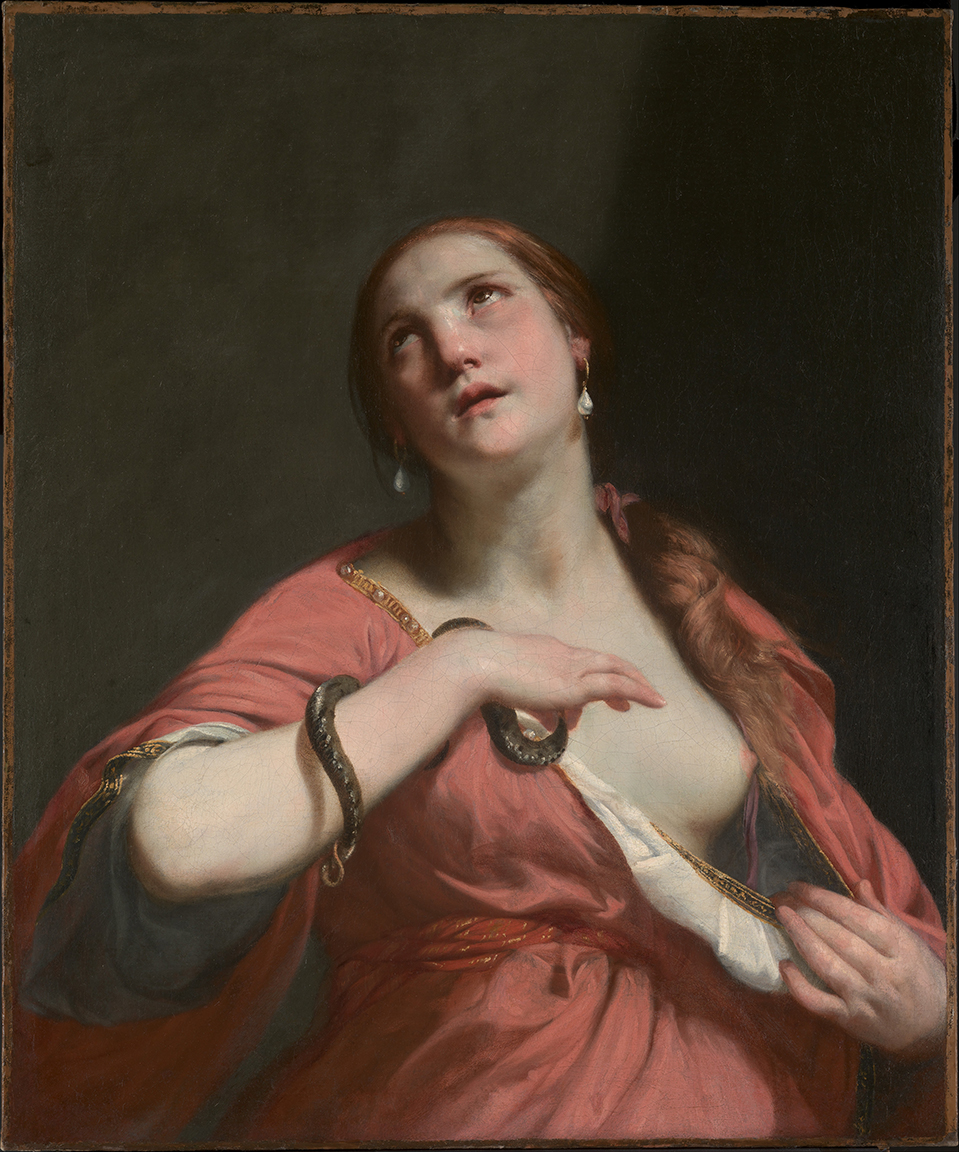
For Cleopatra, whether death was by asp or the poison is a big question. Here are some of the many paintings of The Death of Cleopatra, all painted by Western European men. Cleopatra is shown as a white woman, though there is dispute about her racial heritage. The drama, the boobs, the snake, are all beautifully depicted.

Death of Cleopatra, Giampietrino, 1500

The Death of Cleopatra, Guido Cagnacci, 1645-55

Death of Cleopatra, Jean-Baptiste Regnault, 1796-97

The Death of Cleopatra, John Collier, 1890

The Death of Cleopatra, John Collier, 1890

Here is Plutarch’s account of Cleopatra’s death written more than two hundred years after her death:

It is said that the asp was brought with those figs and leaves and lay hidden beneath them, for thus Cleopatra had given orders, that the reptile might fasten itself upon her body without her being aware of it. But when she took away some of the figs and saw it, she said: ‘There it is see, you see,’ and baring her arm she held it out for the bite. But others say that the asp was kept carefully shut up in a water jar, and that while Cleopatra was stirring it up and irritating it with a golden distaff it sprang and fastened itself upon her arm. But the truth of the matter no one knows; for it was also said that she carried about poison in a hollow comb and kept the comb hidden in her hair; and yet neither spot nor other sign of poison broke out upon her body. Moreover, not even was the reptile seen within the chamber, though people said they saw some traces of it near the sea, where the chamber looked out upon it with its windows. And some also say that Cleopatra’s arm was seen to have two slight and indistinct punctures; and this Caesar (Octavian) also seems to have believed. For in his triumph an image of Cleopatra herself with the asp clinging to her was carried in procession. These, then, are the various accounts of what happened”

Plutarch, Life of Anthony, 86. Translated by B. Perrin

The Death of Cleopatra, Edmonia Lewis, 1876

I would like to conclude with one of my favorite representations of The Death of Cleopatra. In my research I came upon a remarkable 1876 sculpture of Cleopatra by Edmonia Lewis. Edmonia Lewis was an American sculptor of mixed African American and Native American heritage. Lewis was born “free” in New York in 1844, she died in London in 1907. Edmonia led a  remarkable and difficult life, ultimately finding refuge in the international art community of Rome in 1865.  Her monumental sculpture “The Death of Cleopatra” was shown in the 1876 Centennial Exposition in Philadelphia and was both fervently admired and controversial in her portrayal of Cleopatra’s death.  Edmonia Lewis was one of the few women artists of color working in the US at this time and the only woman of color exhibiting in the Centennial Exposition. Her representation of Cleopatra’s death has an integrity about it that you just don’t see in other representations of Cleopatra; there is not a sexualization of Edmonia’s Cleopatra though her breast is bared and she is certainly beautiful. Cleopatra leans back in her throne, an informality and peacefulness in her death. Cleopatra is not a drama queen here. Lewis purposely represents Cleopatra as a white woman. Edmonia Lewis’s representation of this powerful and controversial Queen in the hour of death is graceful, intimate and regal.

I leave for Portugal for the Cortico Artist Residency February 1st and I will be embodying Cleopatra and the Egyptian goddess Isis.

Sappho – The Misunderstood – posted in Boulder, CO November 14th 2022

All images: WIP Sappho Series – Sherry Wiggins and Luis Filipe Branco, 2022

I have been editing the images I made in Holland in October with Luis Branco.

And I have been thinking about you Sappho, the feeling of you, my feelings for you, embodying you . . .

Claude Cahun led me to you— your words, your songs, the fragments. Cahun called you “Sappho The Misunderstood” in her essay on you in their 1925 “Heroines” text.

I have been contemplating the rumors, the conjecture and the fictional histories written about you. These unaccountable stories about you have been going on for more than two thousand years.

Did you love women, did you love men, did you jump off the Leucadian Cliff because the beautiful boatman Phaon jilted you? Well of course you loved women and you loved men and you went for that young Phaon. But I don’t believe for a minute that you would jump  . . .

When I was shooting with Luis in the autumn landscape in Holland your words were kind of everywhere for me.  This is fragment 168 C – translated by Anne Carson in “If Not Winter-Fragments of Sappho.”

                                    spangled is

              the earth with her crowns

But the beauty, the colors, the roses, It can get a little overly romanticized with you. I like this one (I know I am overdoing the cigarette shots):

This following song/ fragment could have been written about any of your lovers or any of mine  . . . 

Sappho # 3 – Anne Carson’s translation “If Not, Winter – Fragments of Sappho.”

] to give

] yet of the glorious

] of the beautiful and good, you

            ] of pain.            ] me

] blame

] swollen

] you take your fill. For [ my thinking

] not thus

] is arranged

] nor

all night long ] I am aware

                           ] of evildoing

                        ]

                        ] other

                        ] minds

                        ] blessed ones

                        ]

                        ]

We did a series in the nighttime woods. I can’t decide between these two:

To read more about Sappho, her songs and her various histories and portrayals you can read my previous blog posts:

The Sadistic Judith? – posted in Boulder, CO November 14, 2022

All images: WIP Judith Series – Sherry Wiggins and Luis Filipe Branco, 2022

I have been editing the images I made with Luis Branco in Holland in October.

The night that Judith took the head of Holofernes began with a feast. Holofernes got very drunk.

There are many readings of Judith’s story: that Judith was doing “God’s will” to protect her people with her own hand; or that she was/ is a feminist super heroine taking revenge on the evil general Holofernes (or even for all woman against all men who have abused them); or as Claude Cahun portrayed Judith in her 1925 essay as “The Sadistic Judith.” I see all of these readings in my performance of Judith. The revenge angle or the “me too” angle is the most compelling to me.

“The Sadistic Judith”  is the 1925 essay by Claude Cahun’s in their Heroines text. Here Judith describes the fictional general Holofernes:

“ We have to believe that he despises women, and doesn’t hide it (after all, he himself says so); that he is coarse, as only a warrior can be. After he kissed his slave, he would furtively wipe his lips. He doesn’t remove his garments for fear of soiling his body more than absolutely necessary. During nights of love, his boots are stained with the crimson in which he wallows, symbolically dyed with the red poison of his victims, tracking everywhere, according to the season, the dust or mud of the roads, or worse. But as the cock crows, he has his bath, sends the girl away—and has the sheets changed (blood clotted on silk sheets).”

Here are a few of my representations / embodiments / drag portrayals of Judith after the slaying of Holofernes. This first one is after one of Artemisia Gentileschi’s Judith paintings.

This next one is after Jan Massys 1543 painting.

And this is after Giorgione’s 1504 painting. And the next three images show Judith’s ambivalence and horror the “morning after” after the act.

You can read my previous blog post with the stories and representations of Judith that I was thinking about before (and during) my own performances of Judith:

Besotted by Artemisia’s paintings of Judith and Holofernes – posted in Renkum, Holland October 7, 2022

Judith Beheading Holofernes, Artemisia Gentileschi, 1611 – 1612, Museo di Capodimonte, Naples

I am at the OBRAS Artist Residency in Renkum Holland preparing to embody and photograph my new but ancient heroines Judith and Sappho with my collaborator photographer Luis Branco. I am relooking at Italian Baroque artist Artemisia Gentileschi’s (1593-1656) paintings of the ancient heroine Judith. Artemisia painted several portraits of Judith during her remarkable career as well as many other female heroines.

I have been studying the ancient fictional heroine Judith, who in the Book of Judith cut off the head of the (fictional) Assyrian general Holofernes. The Book of Judith is non historical fiction and can be seen as a theological novel or a religious parable (it is also considered to be a deuterocanonical book and/or apocrypha). It is not part of the Hebrew Bible, it’s canonicity in Christianity is complicated: however the story is well known in most Jewish and Christian religious traditions. The history of western art is filled with paintings of Judith— the Baroque painters particularly loved the gore and glamour of the story of Judith. You must recognize the magnificent painting by Caravaggio below that influenced Artemisia’s earliest paintings of Judith.

Judith Beheading Holofernes, Caravaggio, 1598 – 1599 or 1602, Galleria Nazionale d’Arte Antica, Palazzo Barberini, Rome

I have been reading The Book of Judith, in one version titled “Apocrypha Judith of the  King James Bible 1611”. The original story was probably written sometime around the 2nd century BC. The story goes that Judith was a beautiful Jewish widow, told to be extremely virtuous and pious (the name Judith literally means woman from Judea). She lived near the fictional town of Bethulia ( supposedly near Jerusalelum). Judith spent her days praying in a tent on the roof of her house clothed in a widow’s poor sack cloth. The first chapters of the book tell of how the greedy (fictional) Assyrian king, Nebuchadnezzar, had sent his large army under the leadership of the general Holofernes to Palestine to conquer the Israelites. The Assyrian army camped in the valley near the town of Bethulia cutting off their water and food and ready to attack Bethulia and go on to take Jerusalem. The townspeople had no way of protecting themselves from the large army and they feared that their God would not save them. Our heroine Judith stepped into the situation and told the townspeople that they must not question God’s protection. Judith tells them that she will send prayers and messages to her/their God to “break down their (the Assyrian army) stateliness by the hand of a woman” to save the Jewish people. Judith made a plan which she did not reveal to the townspeople, and apparently God gave her the go ahead . . .

Then Judith took off her poor widow’s clothes and washed and anointed herself with precious ointments and dressed herself in her best garments:

“And she took sandals upon her feet, and put about her her bracelets, and her chains, and her rings, and her earrings, and all her ornaments, and decked herself bravely, to allure the eyes of all men that should see her.” {Apocrypha, Judith of the King James Bible 1611, 10:4}

And she went with her loyal maid Abra to the Assyrian camp (bringing with her wine and cheese and fine bread) and asked the soldiers to take her to their general Holofernes for she had a plan to help him to conquer the town of Bethulia. The soldiers were overwhelmed by her beauty and believed her words and led her to the tent of Holofernes who was also besot by her countenance and fooled by her words.

For several days and nights Judith acts to seduce and soften Holofernes, though she never takes to his bed . . .  One night there is a feast in Holoferne’s tent and he gets very drunk and passes out on his bed. Holoferne’s servants and guards leave the tent and Judith takes this opportunity to cut off his head by her own hand with Holoferne’s sword. She smuggles the head out of the camp to Bethulia in the middle of the night aided by her maid Abra. When the townspeople see what Judith has accomplished they hang the head of Holofernes at the gate for all to see. They are amazed at what Judith has accomplished to save  the Israelites and word goes out to all. The soldiers and servants of Holofernes discover the decapitated body in the tent and are horrified and afraid and quickly take up their horses and flee. As the Assyrian soldiers run away, the Israelites take their spoils. Judith is the savior of Israel and a heroine forever more. I won’t get into the religious, political, historical, patriarchal and feminist implications of this story—there are many ways to interpret this story. I am not Christian or Jewish, I am a Feminist and I do love this story of Judith’s intelligent maneuvering, her courage and her careful execution of her plan. The the jewelry, the fine clothes, the food, the seduction, the sword: what’s not to love?

Judith and Her Maidservant, Artemisia Gentileschi, 1613 – 1614, Palazzo Pitti, Florence

There are many paintings by many painters depicting Judith decapitating Holofernes and the aftermath. The several paintings that Artemisia Gentileschi painted of Judith over a period of 30 years always show Judith with her loyal maid servant Abra. As in many of Artemisia’s paintings, she often inserted her own visage in the place of the heroine and here she might insert herself as both Judith and Abra. All of these paintings captivate me! The story of Judith was most certainly originally written by a man. Artemisia’s viewpoint is, of course, reflective of a woman’s experience and perhaps even of Artemisia’s own experience negotiating and manipulating her career and life in a 17th century man’s world. Artemisia was most certainly a feminist as well as an incredibly productive and remarkable artist. She had suffered sexual violence, herself, at a young age by the older painter Augustino Tassi, who was a friend of her father the painter Orazio Gentileschi. Tassi was put to trial for the act but never really suffered any repercussions, while Artemisia suffered many consequences. Artemisia was a 17th century “me too” woman who managed to live a productive and creative life, though there is often a subtle element of violence in her paintings and there is most certainly an intense subjectivity that is not often seen in the paintings by men. Below is my personal favorite of Artemisia Gentileschi’s paintings of Judith.

Judith and her Maidservant, Artemisia Gentileschi, 1625, Detroit Institute of the Arts

A few of my favorite Judiths’ by men . . .

Judith, Giorgione, 1504, Hermitage, Saint Petersburg

Judith with the Head of Holofernes, Lucas Cranach the Elder, 1530, The Metropolitan Museum, NYC

Judith with the Head of Holofernes, Jan Massey, 1543, Museum of Fine Arts, Boston

and some more contemporary performances of Judith . . .

Martha Graham Dance Company performing Judith, with Peggy Lyman, 1980

And I love this performance of Judith by Martine Guitierrez (from their Icon series made for bus stations in NYC), 2021

And finally one more by Artemisia—this last painting below was only recently found. A younger Judith (and an older Abra) look out of the frame, the head of Holofernes in the center of the painting. This is one of Gentileschi’s later paintings of Judith.

Judith and Her Maidservant and the Head of Holofernes, Artemisia Gentileschi, 1639 or 1640, Nasjonal Museet, Oslo

I have many ideas and a sword to be wielded as I prepare to perform Judith (and also Sappho)! This blog post was written with some haste, please forgive the writing. I am working in Holland until the 27th of October.

Part One – Sappho’s songs – posted in Boulder, CO Sept 17, 2022

The line drawing above depicts the ancient lyric poets Alcaeus and Sappho. This was drawn on an Attic vase that is attributed to the Brygos painter, 480-470 BCE. The ancient vase is housed in the Staatliche Antikensammlungen Museum, Munchen, Germany. The line drawing is by Valerie Woelfe

I have been studying the ancient lyric poet Sappho as part of the My Heroines project. I am getting ready to go to the OBRAS Artist Residency in Renkum, Holland to work on my “embodiments” and portrayals of the great poetess in performative photographs with my collaborator photographer Luis Branco.

The drawing above is taken from an ancient Greek vase  (circa 470 BC) and it pictures the two lyric poets Alcaeus and Sappho who both lived and performed on the island of Lesbos during the 6th century BC. This is one of the earliest representations of Sappho (that we know of) and it was created at least some 100 years after her death. The two poets (Alcaeus and Sappho) did live during the same time on Lesbos, whether they played together is not known. There are many unsubstantiated ideas about Sappho, one is that Sappho and Alcaeus were lovers. We do know that Sappho was born and lived on the island of Lesbos between 630 and 570 BC. She was born to a wealthy family. We also know that she was a prolific lyric poet and she was heralded and praised in her own time and on throughout the ages. Her works were composed to be accompanied by music, sometimes with a female chorus for groups of women and men. Some of her songs were performed solo. She sang in the Aeolian dialect (different then the dialect used in Greece and Athens at that time). It is not known if Sappho herself wrote down her words/songs. It is thought that her songs were written down in about 500 BC in Greece and that there were approximately 10,000 lines compiled in several “books” of her poetry (8 or 9 papyrus scrolls). These scrolls were housed in the great library in Alexandria in about 300 BC and in other places as well. These books/scrolls have been lost and today only approximately 650 lines of her large body of lyric poetry survive and have been compiled and translated. None of the music that accompanied these lines exists today.

This Attic red-figure vase above is from the 5th century BC and features a seated woman reading from a papyrus scroll with three women attendants. Some think the seated figure is meant to portray Sappho. It is housed in the British Museum.

I have been reading various translations (in English) of these famous remains of Sappho’s lyric poetry. I have also been looking into the reception and understanding of Sappho’s work through the ages—from Plato (who called Sappho the “tenth muse”) through to contemporary queer and feminist studies of Sappho as well as some of the most recent translations and scholarship on her work. This is a daunting task and I have only skimmed the surface.

Sappho has been portrayed in paintings, poems, operas, plays, performances and critical analysis as a brilliant poetess and musician, a priestess of Aphrodite, a teacher of young women and sometimes as a wanton woman. There has always been much speculation, invention and mythologizing about her love life and her sexual proclivities. Does she love men, or women or both?

Anne Carson wrote in the introduction to her wonderful translations of Sappho’s work: If Not, Winter‑Fragments of Sappho:

Controversies about her (Sappho’s) personal ethics and way of life have taken up a lot of people’s time throughout the history of Sapphic scholarship. It seems that she knew and loved women as deeply as she did music. Can we leave the matter there?”

I don’t think it is possible to “leave the matter there” for any of us as Ms. Carson suggests. We all read into the words of Sappho what we want to. We project onto Sappho our innermost sensibilities and questions: of identity, of sexuality, of love, of subjectivity, of female power and the repression there of. It seems to me that even the scholars and translators who have devoted their lives to her study aren’t entirely objective either. Sappho’s effect on all of us is sensorial and transformative‑her words ignite us in various ways.  These words and poems were originally performed with musical instruments and often accompanied by a chorus of young women singing and dancing. I feel the urge to insert myself into these songs, these performances and complete them. And many others have felt the same.

I have selected several poems and fragments that I intend to work with in my own “performances” and embodiments of Sappho. I begin, here, with the most complete extant poem of Sappho. This translation is by Anne Carson from her book If Not Winter, Fragments of Sappho. This is known as poem #1, or Prayer for Aphrodite or Ode to Aphrodite.

Deathless Aphrodite of the spangled mind

child of Zeus, who twists lures, I beg you

do not break with hard pains,

O lady, my heart

 but come here if ever before

 you caught my voice far off

and listened left your father’s

golden house and came,

yoking your car. And fine birds brought you,

quick sparrows over the black earth

whipping their wings down the sky

through midair—

they arrived. But you, O blessed one,

smiled in your deathless face

and asked what (now again) I have suffered and why

(now again) I am calling out

and what I want to happen most of all

in my crazy heart. Whom should I persuade (now again)

to lead you back into her love? Who, O

Sappho, is wronging you?

For if she flees, soon she will pursue.

If she refuses gifts, rather will she give them.

If she does not love, soon, she will love

even unwilling.

Come to me now: loose me from hard

care and all my heart longs

to accomplish, accomplish. You

be my ally.

Sappho #1 (translation by Anne Carson, If Not, Winter‑—Fragments of Sappho)

This is a call to prayer for Aphrodite—the goddess of love, sexual love, passionate love, married love, all love. Here Sappho calls to Aphrodite in a very intimate way. Aphrodite arrives flying her golden car with sparrows and says: “Who, O Sappho, is wronging you?” Aphrodite (Sappho) uses (now again) three times in the poem. It is as if Aphrodite has heard Sappho’s complaints and heart aches many times before. Here Sappho emphasizes the universal experience of pain when you are deserted by the one you love.  Aphrodite’s advice to Sappho is somewhat ambiguous: “For if she flees, soon she will pursue. If she refuses gifts, rather will she give them. If she does not love, soon, she will love even unwilling.” It is not clear if “she,” the object of Sappho’s affection, will pursue Sappho or if “she” will pursue another. The point being that none of us has any control in this situation of love. Sappho asks Aphrodite to be her “ally” in this heart wrenching situation. Sappho calls on Aphrodite in several of her other poems as well, Aphrodite and Sappho are forever entwined.

The sweetness and the bitterness of erotic love and desire or “eros” is one of the themes that permeates Sappho’s surviving work. Fragment #130 (Sappho’s poems have been numbered over time) is one of Sappho’s most famous fragments. Here she brings to us the term “sweetbitter.” I have posted three different translations of the lines. It is interesting to note how Sappho’s lines are translated so differently.

Eros the melter of limbs (now again) stirs me—

sweetbitter unmanageable creature who steals in

Sappho #130 (translation by Anne Carson in  If Not, Winter‑—Fragments of Sappho)

Once again Love, that loosener of limbs,

bittersweet and inescapable, crawling thing,

seizes me.

Sappho #130 (translation by Diane J. Rayor in “Sappho – A New Translation of the Complete Works”)

That impossible predator,

Eros the Limb-Loosener,

Bitter Sweetly and afresh

Savages my flesh.

Sappho #130 (translaton by Aaron Poochigian in “Stung with Love: Poems and Fragments)

Above is an image of the fragments known as the “Cologne papyri” which are fragments of Sappho’s poem # 58 also known as the Tithonus poem, dating to the third century BC, these fragments preserve twelve lines of the poem. Published in 2004, the finds drew international media attention.

One of my favorite songs is Sappho #58, also called the “old age poem” or the “Tithonus poem.” This beautiful song appears to be a very personal song about Sappho’s aging process and it is believed that she sang this song with a group of younger women. The poem has been the subject of much excitement and discussion in the 21st century because new (but ancient) papyrus fragments were identified in 2004, making this song one of the few substantially complete poems of Sappho. In this song Sappho alludes to the story of the goddess Dawn’s (Eos’) love for the mortal Trojan prince Tithonus. Eos requests that Zeus make Tithonus immortal and Zeus does so. However the goddess forgets to ask Zeus to grant Tithonus eternal youth. Thus Tithonus lives out his long life (with Eos) and ages into an old shriveled man. According to some stories Tithonus eventually turns into a cicada. I love this song of Sappho’s and feel it in my bones. Here I have posted the translation by Diane J. Rayor from her book “Sappho A New Translation of the Complete Works.

[I bring] the beautiful gifts of the violet Muses, girls,

And [I love] that song lover, the sweet-toned lyre.

My skin was [delicate] before, but now old age

[claims it]; my hair turned from black [to white].

My spirit has grown heavy; knees buckle

That once could dance light as fawns.

I often groan, but what can I do?

Impossible for humans not to age.

For they say rosy-armed Dawn in love

went to the ends of earth holding Tithonos,

beautiful and young, but in time gray old age

seized even him with an immortal wife.

                                    . . . believes

                                    . . . may give

Yet I love the finer things . . . this and passion

for the light of life have granted me brilliance and beauty.

Sappho #58 (translation by Diane J. Raynor in “Sappho – A New Translation of the Complete Works”)

Please read my recent blog post (Part Two – Sappho: projections, portrayals, portraits and performances) https://sherrywigginsblog.com/2022/09/17/part-two-sappho-projections-portrayals-portraits-and-performances-posted-in-boulder-co-sept-17-2022/ to see some of my favorite portrayals of Sappho in paintings and performance.

Part Two – Sappho: projections, portrayals, portraits and performances – posted in Boulder, CO Sept 17, 2022

Sappho and Erinna in a Garden at Mytilene, 1864, Simeon Solomon, watercolor on paper, 33 x 38 cm, The Tate Gallery

The painting above by British artist Simeon Solomon pictures the famed ancient lyric poetess Sappho (on the right with the laurel leaf crown) with another ancient poetess Erinna. They are posed in an intense embrace on a bench in a garden in Mytilene, the ancient capital of Lesbos. Is this “lesbian” love or the ardor of one female artist/muse for another? What is Solomon striving for here? Little is known of both poetesses lives but we do know that Erinna lived a few hundred years after Sappho and Errina was definitely not from the island of Lesbos. In the painting there is a statue of Aphrodite near Sappho, as well as her lyre. The palette is muted, feminine, roses abound. Sappho embraces Errina passionately as a lover and as a fellow poetess. This gorgeous painting adds romantic fodder to the mystique around the great poetess Sappho. Simeon Solomon was himself a closeted homosexual who was later jailed for attempted sodomy.

Please read my previous blog post  “Part One – Sappho’s Songs” to learn more about Sappho’s remarkable lyric poetry. Sappho is the woman /the heroine / the artist I am currently studying as part of the “My Heroines” project. Here I have been researching ancient women heroines. I immerse myself in these women’s stories and representations in texts, writings, paintings, sculpture and critical discourse. I then reimagine and revise these figures in my own visage in performative still photographs that I have made and will continue to make with my collaborator photographer Luis Branco. Over the last year we have manifested Eve, Salome, Aphrodite and Helen of Troy in my sixty-something year old form in images that are weird, powerful and sometimes funny. You can see some of these performative works on my previous blog posts and also on Instagram https://www.instagram.com/sherrywigginsart/. In October (very soon) I will return to the residency at OBRAS Holland to work with Luis on the embodiment and performance of the great poetess Sappho and also the biblical heroine Judith (I will write more about Judith later).

Sappho and Phaon, Jacques-Louis David, 1809, oil on canvas 225 x 262 cm, Hermitage Museum

The Jacques-Louis David painting above portrays Sappho with another one of her mythological lovers Phaon. Aphrodite/ Venus’s loyal messenger Cupid accompanies them. According to the ancient myth Phaon was a ferryman who served the isle of Lesbos. He was supposedly old and ugly when Aphrodite came to his boat in the disguise of a croan. Phaon ferried her across the waters and would take no payment. Aphrodite was grateful and gave Phaon a special ointment in payment. When he rubbed himself with the ointment Phaon became young and very handsome. In the subsequent story Sappho, as an older woman, had an intense love affair with the beautiful young Phaon. However, Phaon eventually grew to resent her and rejected her love. Sappho was so heart broken that she decided to throw herself in the sea to either cure herself of the love affair or die. Thus the idea of the “Leucadian Leap”. According to this ancient legend, Sappho did die.

Mythical stories, paintings, performances and writing about Sappho (who lived during the time 630 – 570 BC) abound throughout the millennia along with the adoration of Sappho’s songs. Everyone loves Sappho but whom did she love? Did she love men? Did she love women? Or both? And why has this legend that Sappho committed suicide by jumping off the Leucadian cliffs persisted throughout the ages? In the late 19th and early 20th century there was a major resurgence of interest in Sappho amongst artists and poets as well as an exploration and acknowledgement of Sappho’s love of women. In fact, the word “lesbian” (which in previous times meant someone who came from the island of Lesbos) came to be used to describe the homosexual love and sexual relationships between women. Sappho and “sapphism” became a part of the cultural dialogue even when homosexual men were being persecuted and jailed (think Simeon Solomon, Oscar Wilde and others). Operas and plays with Sappho as the main character abounded. Sappho also came to the fore amongst lesbian artists and poets—there were the famed gatherings in Natalie Barney’s home in Neuilly, France where women dressed in Greek togas and danced around the garden. In the late 20th and early 21st century the term “sapphism” has also become an umbrella term describing the attraction or relationships between women—whether they identify as lesbian, bi, pan, asexual, trans or queer. Sappho is one of our most famous queer icons.

Above and following are some of my favorite 19th and early 20th century paintings and portrayals and performances of Sappho.

Sappho, 1893, Ary Renan, oil on canvas, 56 x 80 cm, Museo Ernest Renan

The Death of Sappho, 188, Miguel Carbonell Selva

Sappho (at Sunset), 1893, Gustave Moreau, location unknown
The Death of Sappho, 1873-4, Gustave Moreau, 81 x 62 , oil on canvas, location unknown
Sappho, 1852, James Pradier, marble sculpture, Musee d’Orsay
Sappho, 1873, Charles Mengin, 230 x 151 cm, oil on canvas, Manchester Art Gallery
Sappho, Julius Kronberg, 1913, oil on canvas, private collection
A gathering of women including Eva Palmer, Natalie Barney and possibly Liane de Pougy in Barney’s garden in the early 1900’s in  Neuilly, France. From the Washington, D.C., Smithsonian Institute Archives, Alice Pike Barney Papers.
A gathering of women including Eva Palmer, Natalie Barney and possibly Liane de Pougy in Barney’s garden in the early 1900’s in Neuilly, France. From the Washington, D.C., Smithsonian Institute Archives, Alice Pike Barney Papers.
Production photo of Régina Badet as Sappho. Le Théâtre 319 (1 April 1912)

I too have come to Iove Sappho—both her songs and all her mythical manifestations throughout the ages. I am excited (and nervous) about my project with the great poetess. I am traveling to the OBRAS Artist Residency in Renkum, Holland (where I worked on the project THE UNKNOWN HEROINE in 2019) in a few weeks to work on performing and embodying the great poetess with my collaborator photographer Luis Branco. Wish me luck.