I’m in training (with Claude Cahun)- posted July 30, 2025

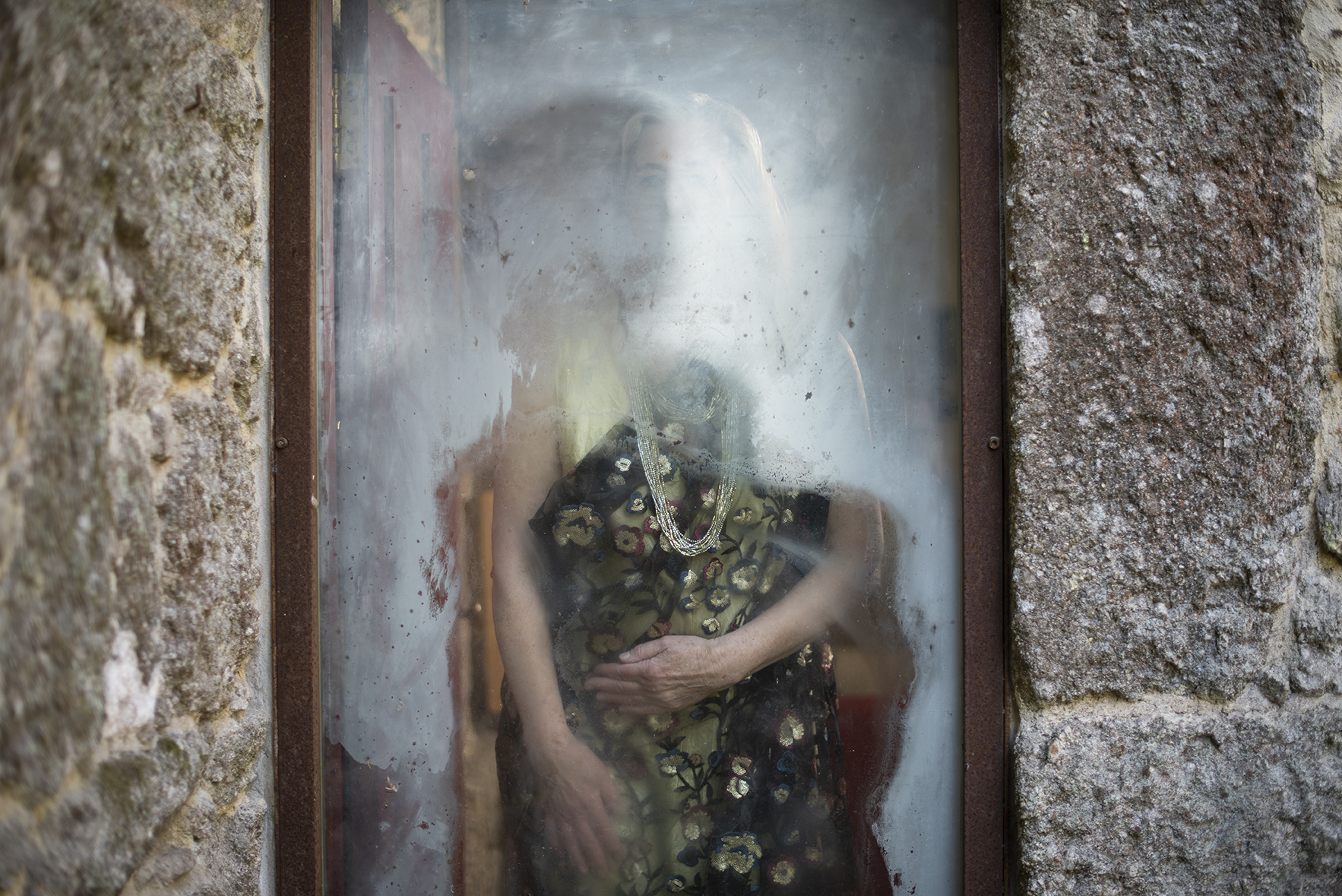
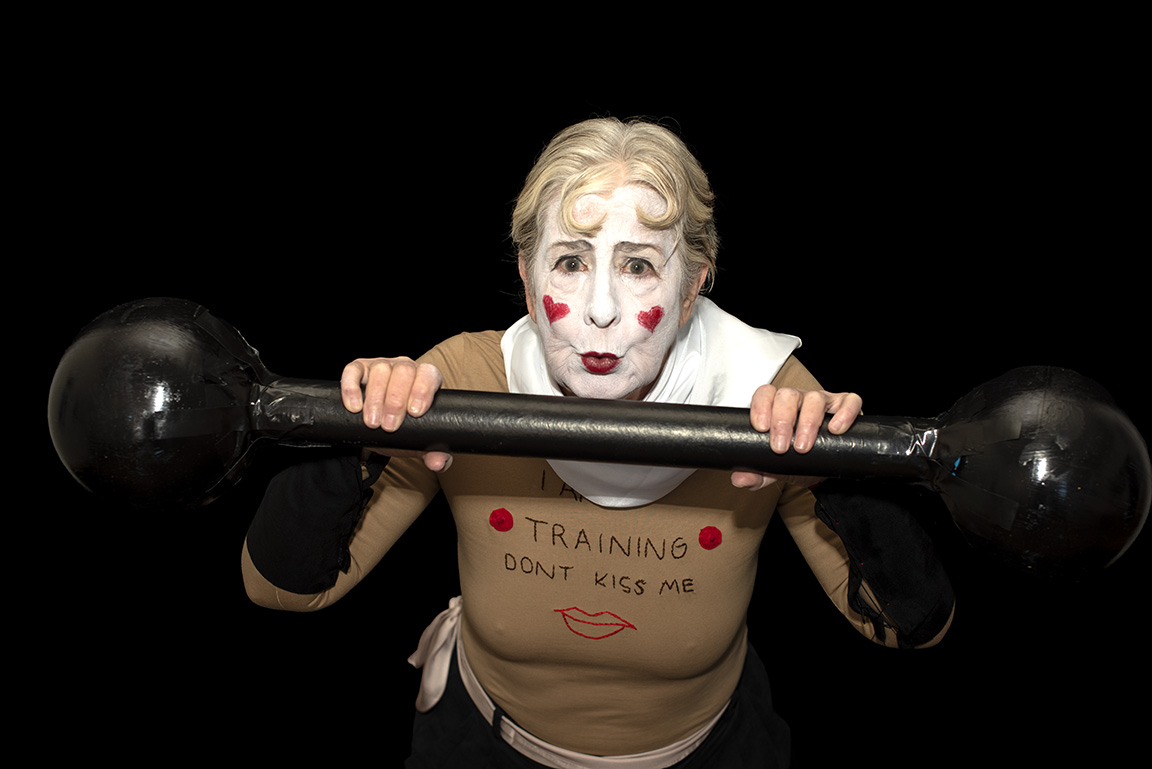
“Don’t Kiss Me I,” Sherry Wiggins and Luís Branco, 2025.

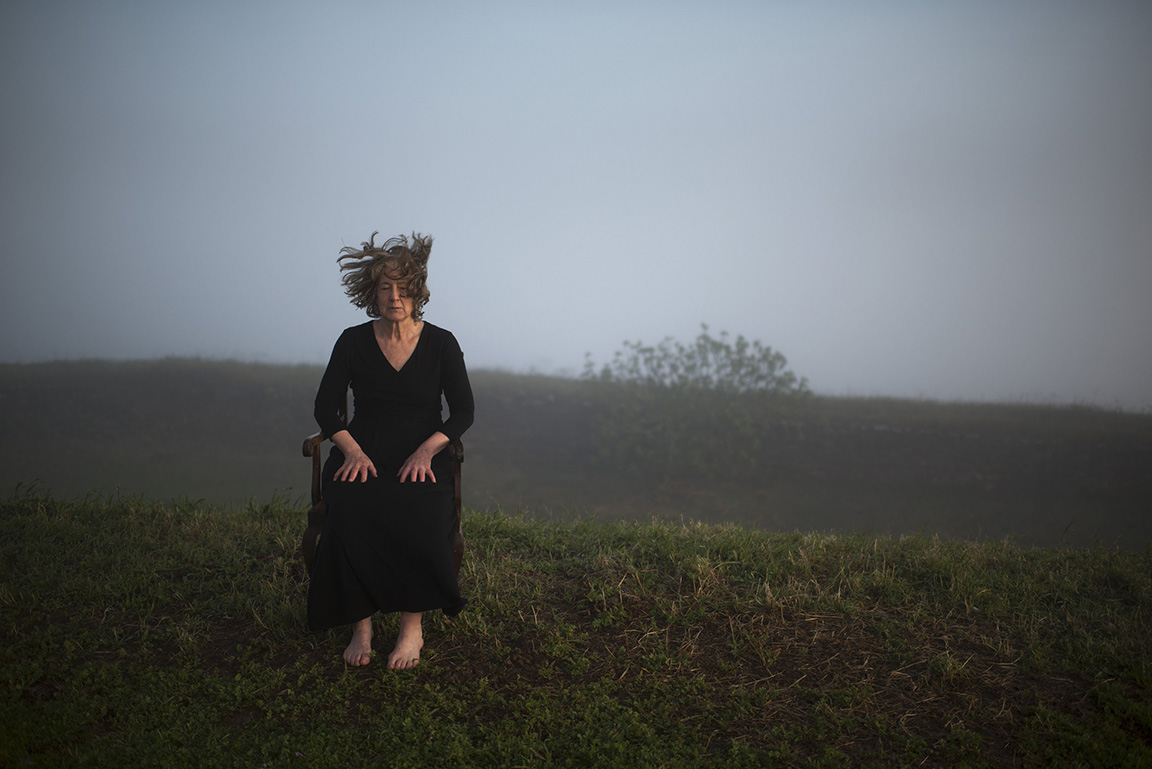
In February, I enacted a performance and embodiment practice with early-twentieth-century French artist Claude Cahun. This practice resulted in a direct transmission from Claude to me through Luís Branco’s magic camera.

Luís and I shot hundreds of images on the French Riviera at La Napoule Art Foundation. In the studio and in and around the beautiful Chateau de la Napoule, we created a body of work in conversation with Claude Cahun and her lifelong photographic practice, much of which was produced with her partner in art and life, Marcel Moore.

Cahun (1894 – 1954), a surrealist intellectual, was a significant, multitalented artist. She was a performance artist, photographer, sculptor and writer. She was also a committed, even jailed, anti-Nazi activist. Cahun was gender ambiguous, a lesbian and a cross-dresser. (I use she/her pronouns for Cahun; the gender-neutral pronouns they/them, while perhaps more appropriate, were not in use during Cahun’s lifetime.) Cahun’s work, in both photography and writing, explores the many masks of selfhood. Cahun encourages us to examine the theater of identity, where we perform and inhabit roles that are imposed upon us as well as roles that we invent. Claude Cahun is my queer superheroine.
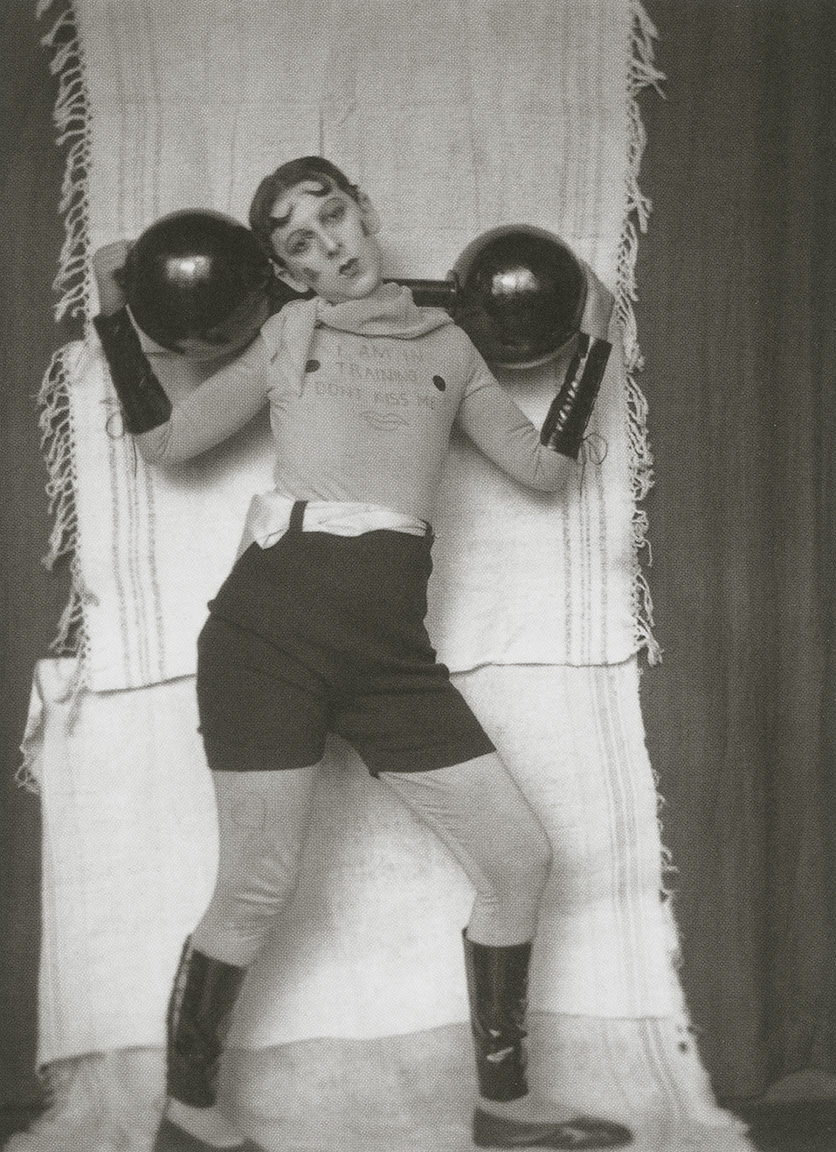
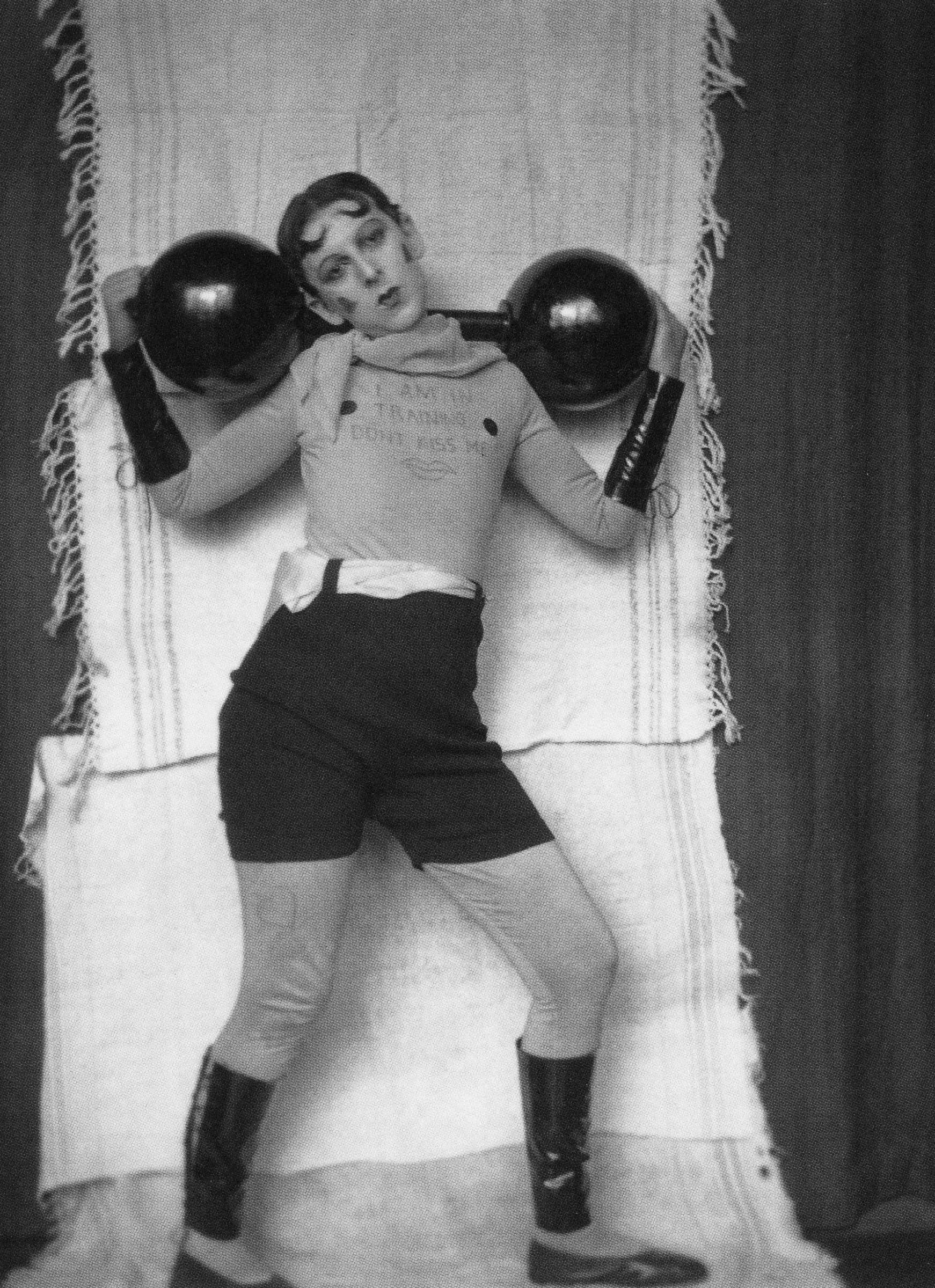
Untitled, Claude Cahun (with Marcel Moore), 1927.

The 1927 image of Cahun posing as a body builder (above) is one of my favorites in Cahun’s oeuvre. It plays on all sorts of tropes of identity and performance. The costume in the image is both masculine and feminine: the misplaced nipples and lips on the shirt, the delicate neck scarf and silk waist sash, the “I AM IN TRAINING DON’T KISS ME” message, the enormous dumbbell across her shoulders and the contrapposto stance that would never bear its weight. What is she in training for? The curlicue hair, the hearts on her cheeks and the dishtowels hung as a backdrop. It is all just plain funny and indicative of Cahun’s lifelong pursuit of “dressing up,” a pursuit she accomplished in her everyday life and in theater productions in Paris in the 1920s.  For my enactments of this image, assemblage artist Jensina Endresen helped me create my own body-builder costume. My partner, Jamie, constructed the inflatable barbells that I brought with me to France. Et voilà!
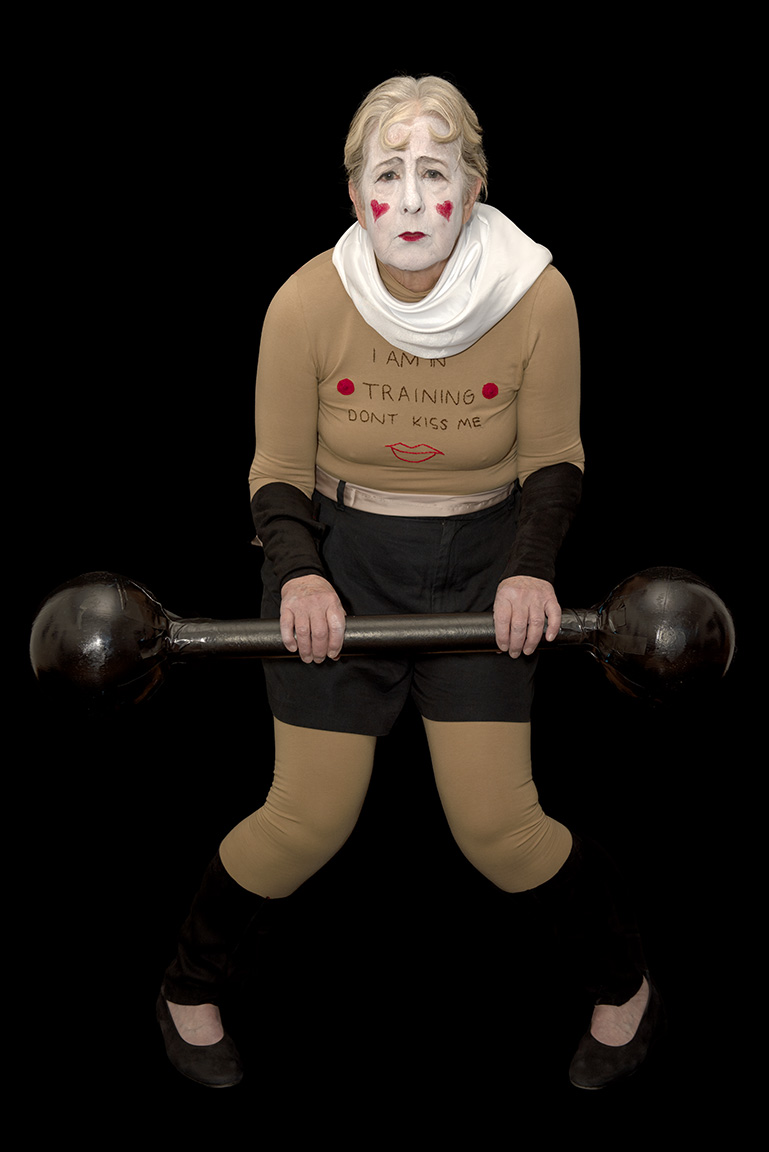
“Don’t Kiss Me II,” Sherry Wiggins and Luís Branco, 2025.
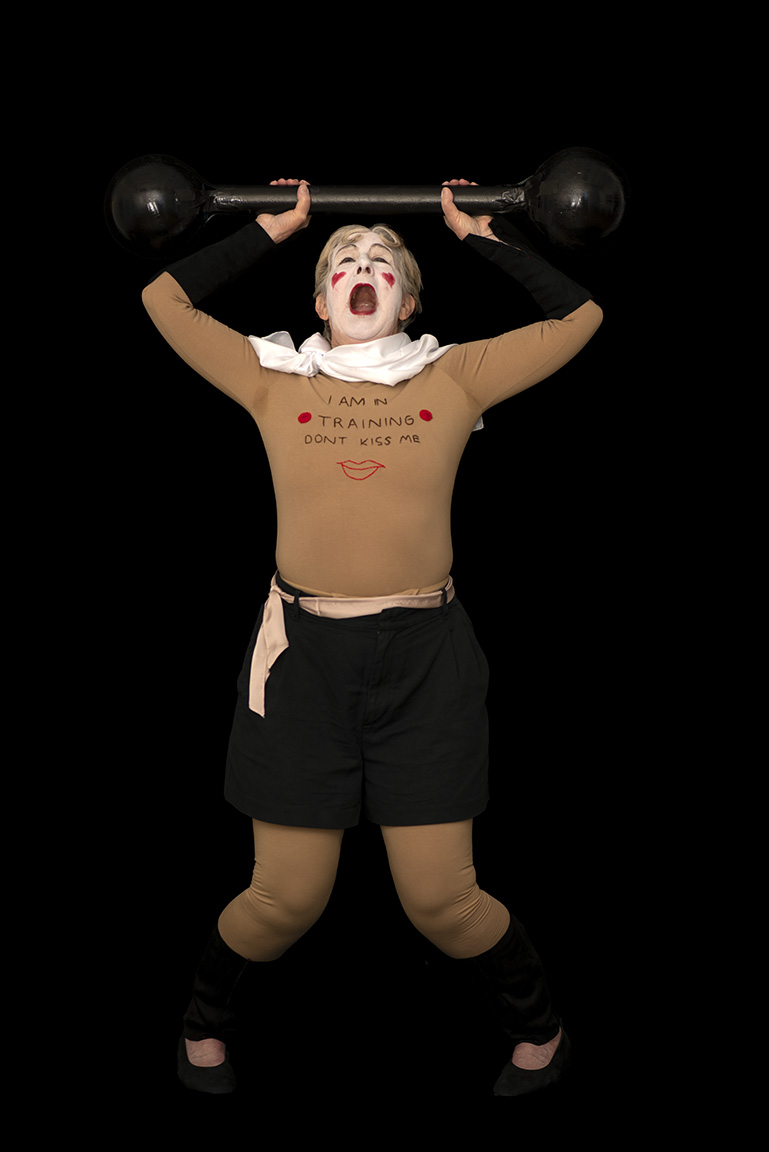
“Don’t Kiss Me III,” Sherry Wiggins and Luís Branco, 2025.

On a more serious note…


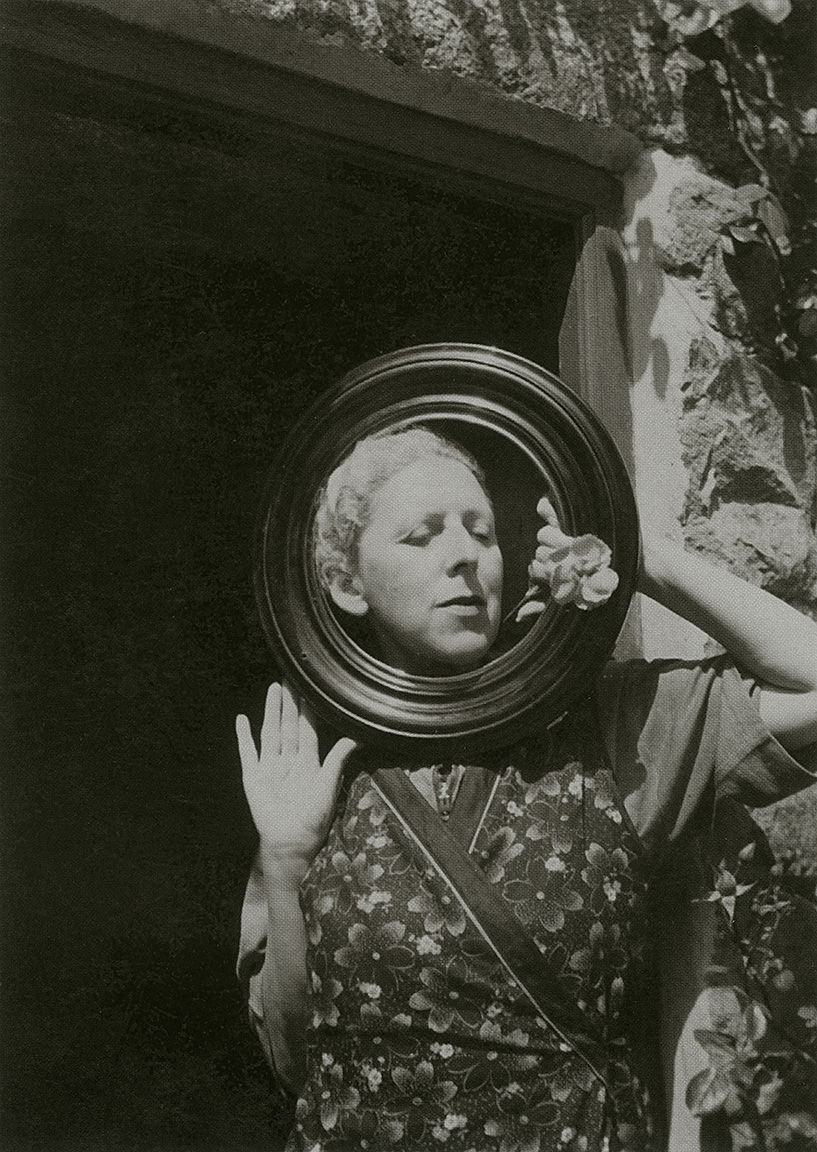
Untitled, Claude Cahun (with Marcel Moore), 1928.

The photograph above, of Cahun standing beside a mirror, is eerily striking. The mirror doubles her image—the “real” Cahun gazes toward the camera and us, while the mirror image of Cahun looks into the mirror itself and beyond. Cahun’s gaze is deadpan, serious. Her hair is shorn, very butch or masculine—hommasse in French. The jacket and the gesture are also masculine. Cahun was always toying with ideas of self-reflection, self-questioning and gender ambiguity.

“Masculine? Feminine? It depends on the situation. Neuter is the only gender that always suits me.”

 – Claude Cahun, Disavowals, trans. Susan de Muth (Cambridge: MIT Press 2007), 151. Originally in Cahun’s Aveux non Avenus, 1930.
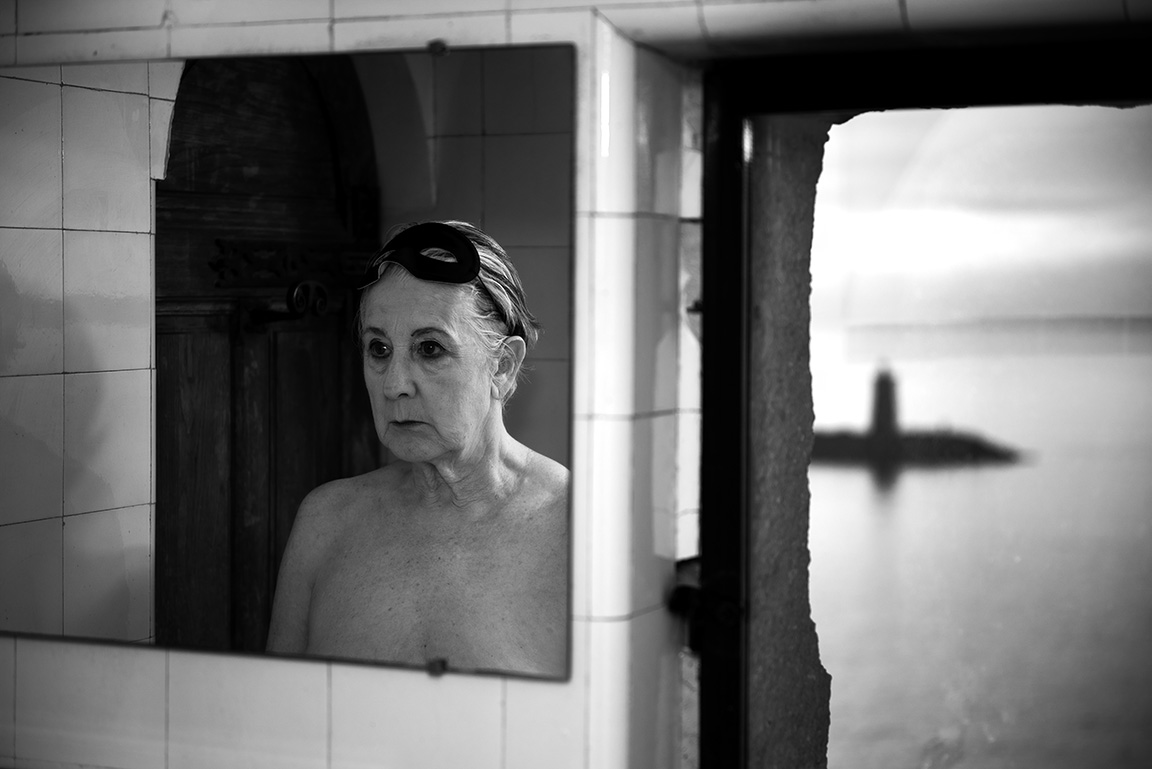
“I’ve been thinking about Claude Cahun I,” Sherry Wiggins and Luís Branco, 2025.

In our triptych “I’ve been thinking about Claude Cahun,” Luís and I did not attempt a direct copy of Cahun’s photograph. Instead of gazing sidelong, as Cahun does, I gaze directly into the mirror. The three photographs depict the process of me “performing” my more butch, more masculine self. I cut my hair short (then later cut it off entirely). In all three images, the water and horizon of the Mediterranean are visible through the windows. I donned a Cahun-inspired checked jacket and a mask. The costume and the setting allude to an art-deco-era past or early Hollywood. I will be showing this triptych in a group exhibition called “Queer Perspectives” at Michael Warren Contemporary in Denver opening July 31st and up through August 30, 2025.
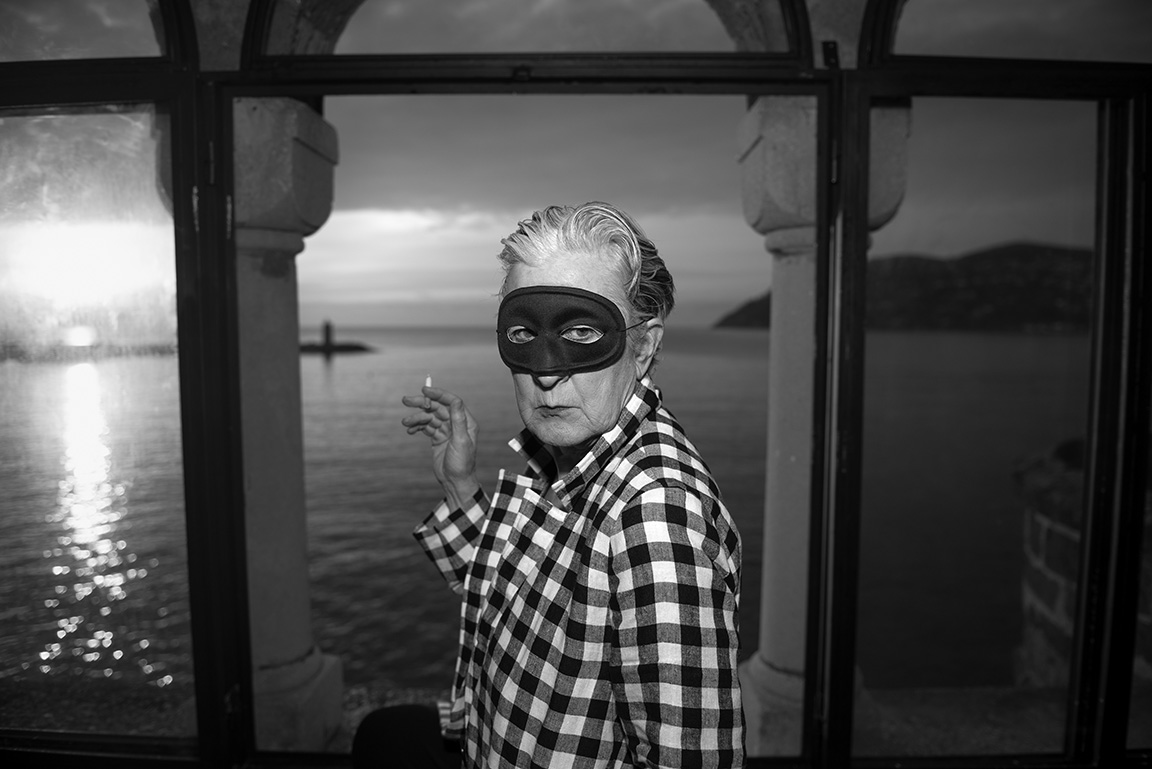
“I’ve been thinking about Claude Cahun II,” Sherry Wiggins and Luís Branco, 2025.
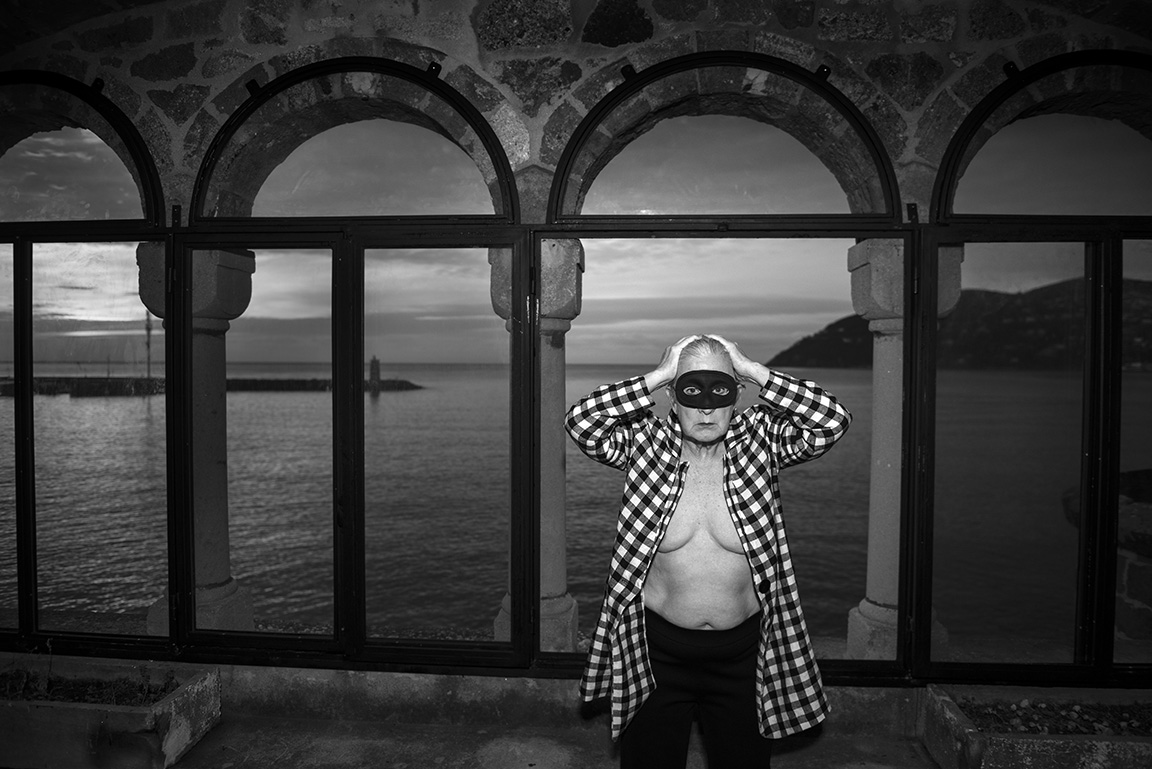
“I’ve been thinking about Claude Cahun III,” Sherry Wiggins and Luís Branco, 2025.
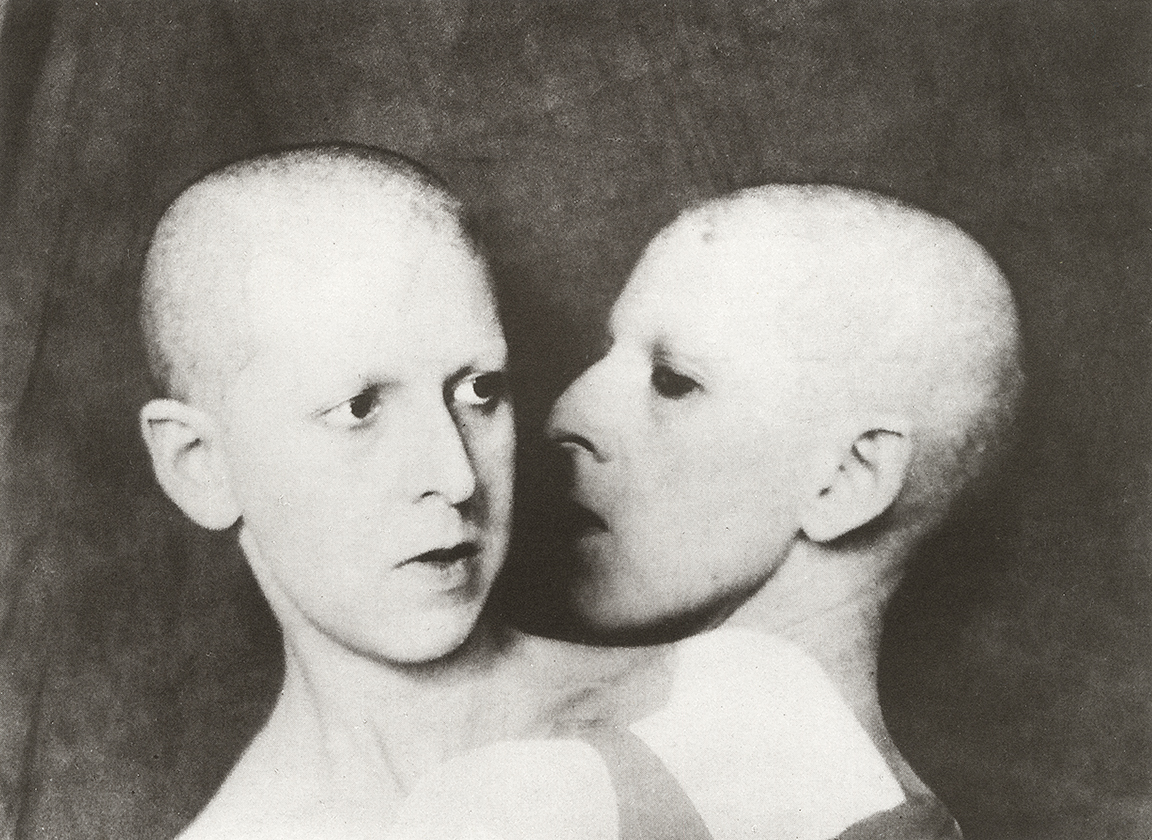
Que me veux tu?”  Claude Cahun (with Marcel Moore), 1929.

The double-headed image of Claude Cahun (above) is one of Cahun’s few titled photographs. “Que me veux tu?”, or “What do you want from me?”, speaks to Cahun’s never-ending existential struggle with and questioning of identity in her life and art

I had my head shaved at the beauty shop in La Napoule. It was kind of liberating. Luís shot a whole series of double exposures of this new hairless and quite androgynous “double me,” creating our own version of “What do you want from me?”

What do you want from me?” Sherry Wiggins and Luís Branco, 2025.

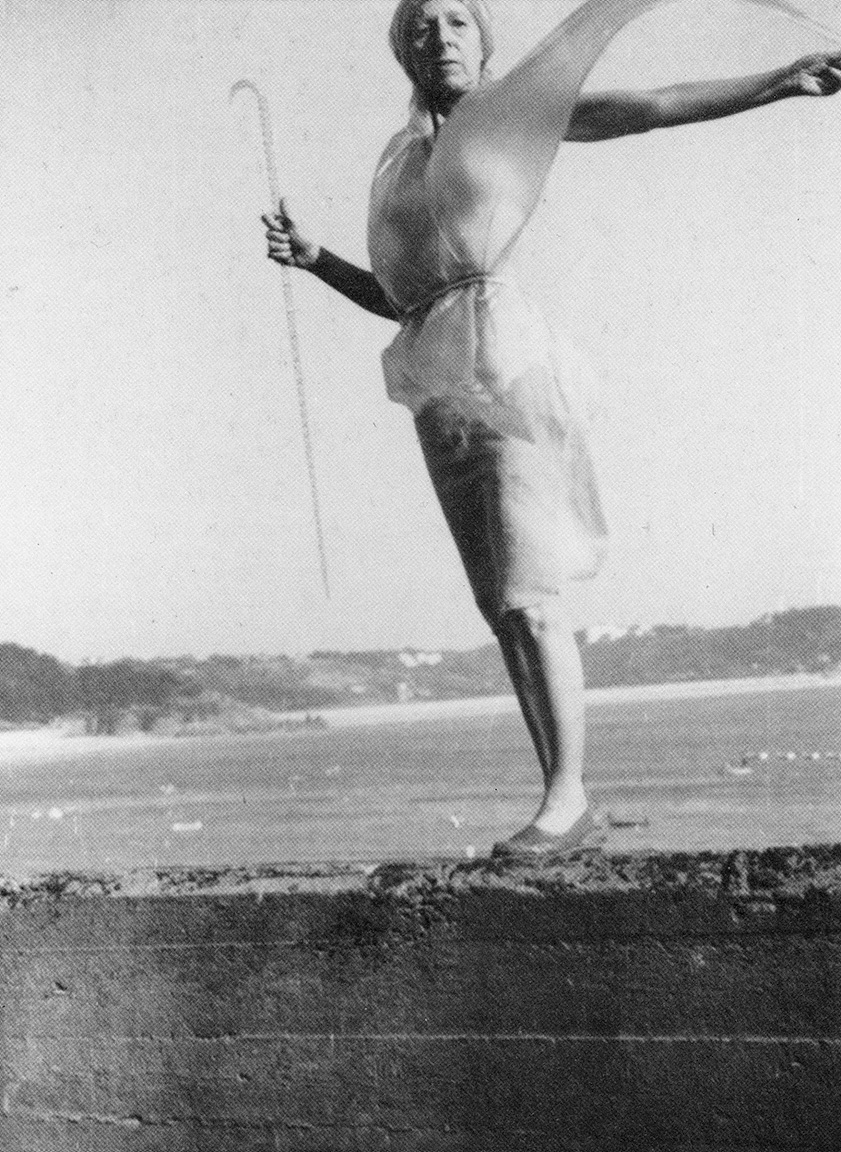
Untitled, Claude Cahun (with Marcel Moore), 1920.

Marcel Moore must have taken this image (above) of Claude in her dandy and gentleman-like attire in the early 1920s in Paris. They were living a life that allowed Cahun to explore her gender ambiguity in full.

“Masked (after Claude Cahun),” Sherry Wiggins and Luís Branco, 2025.
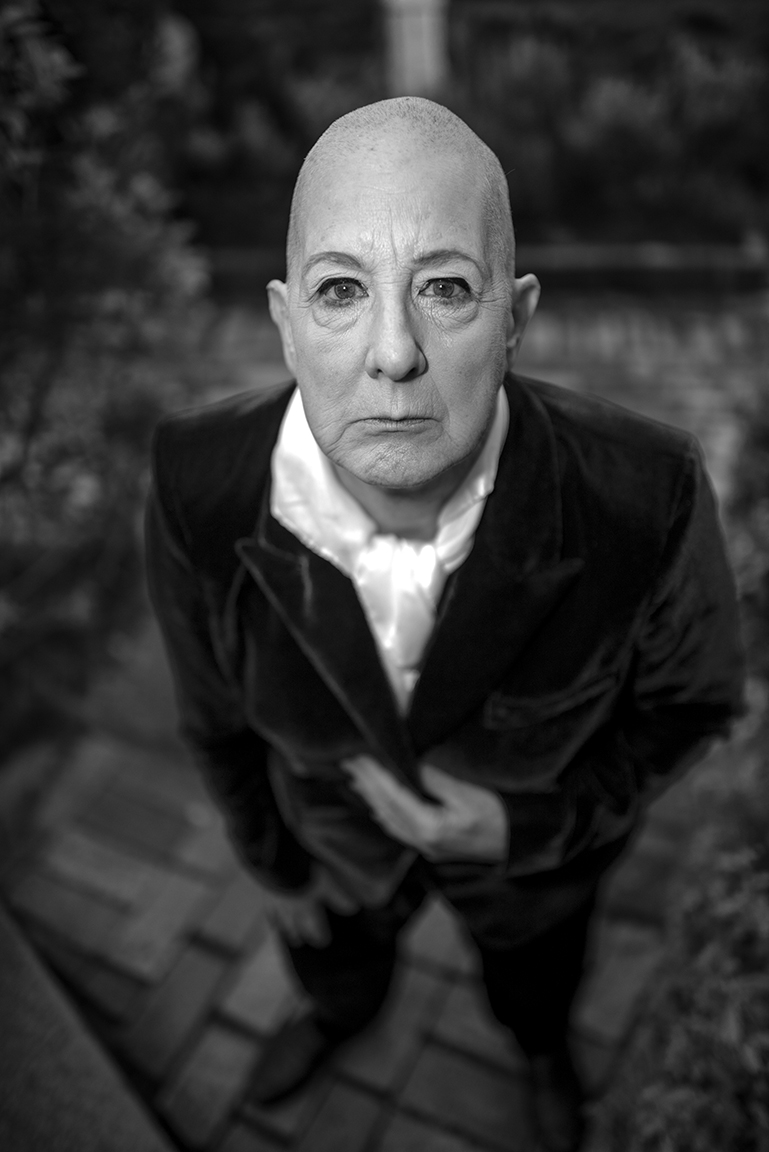
As a Gentleman (after Claude Cahun), Sherry Wiggins and Luís Branco, 2025.
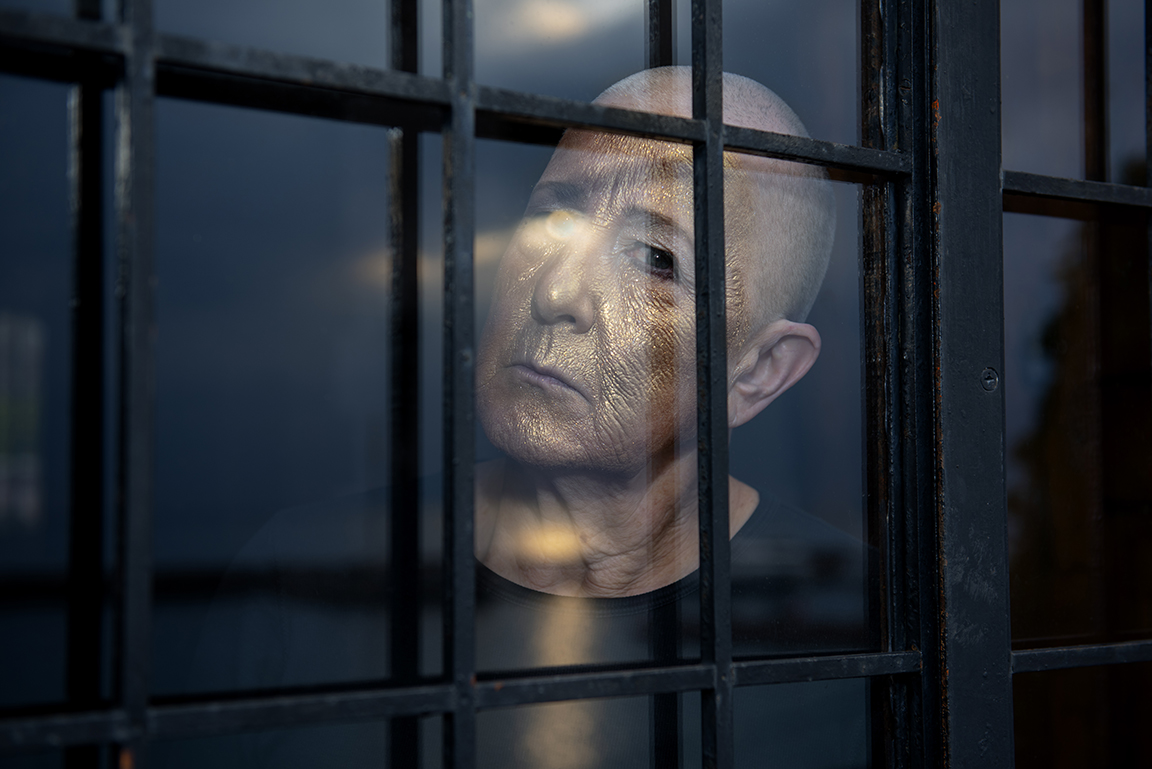
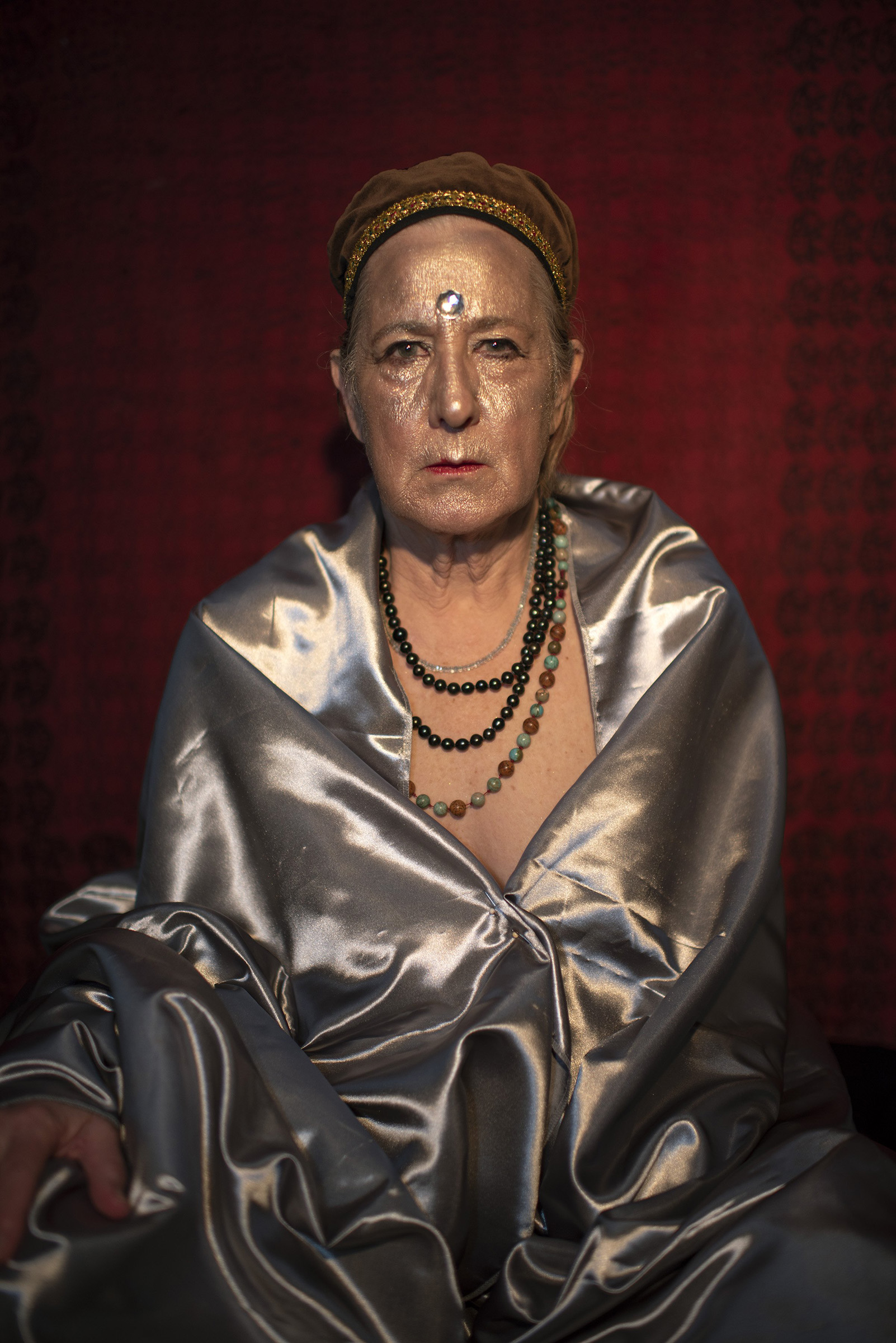
Gilded, Sherry Wiggins and Luís Branco, 2025.

I received a transmission from Claude Cahun during this intense period in France. This last image, which I call “Gilded,” is one of my favorites. This was taken during our last photoshoot at La Napoule. I had applied gold makeup to my face. Cahun’s golden light shines through me.

serious play with Claude Cahun – posted in Boulder, CO January 29, 2025

Claude Cahun Series (mask), black-and-white digital image, Sherry Wiggins and Luís Branco, 2022.

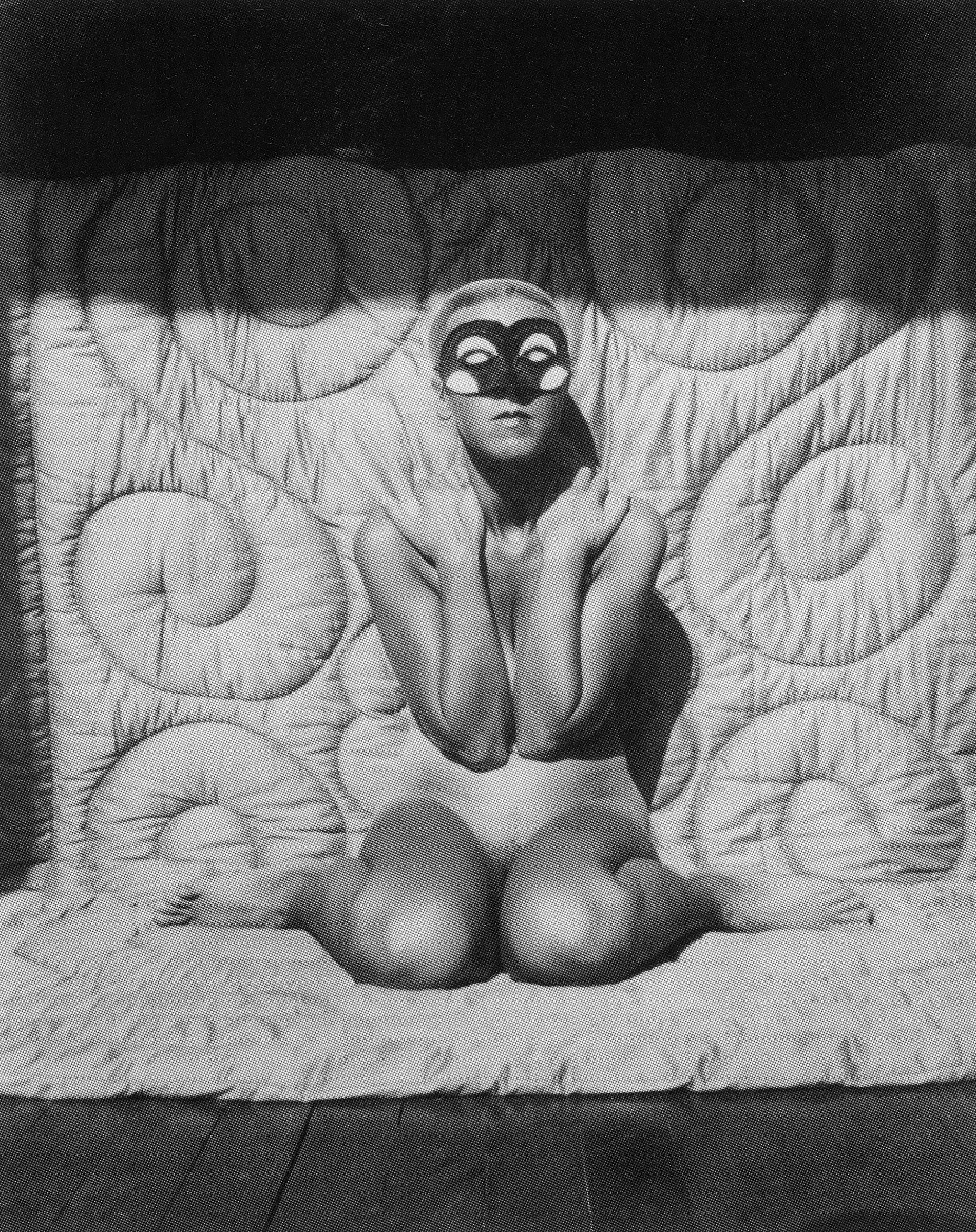
Luís Branco and I shot the above image in a strange and beautiful hotel in Amsterdam in 2022, referencing French artist Claude Cahun’s 1928 masked image below.

Untitled, black-and-white photograph, Claude Cahun (with Marcel Moore), 1928.

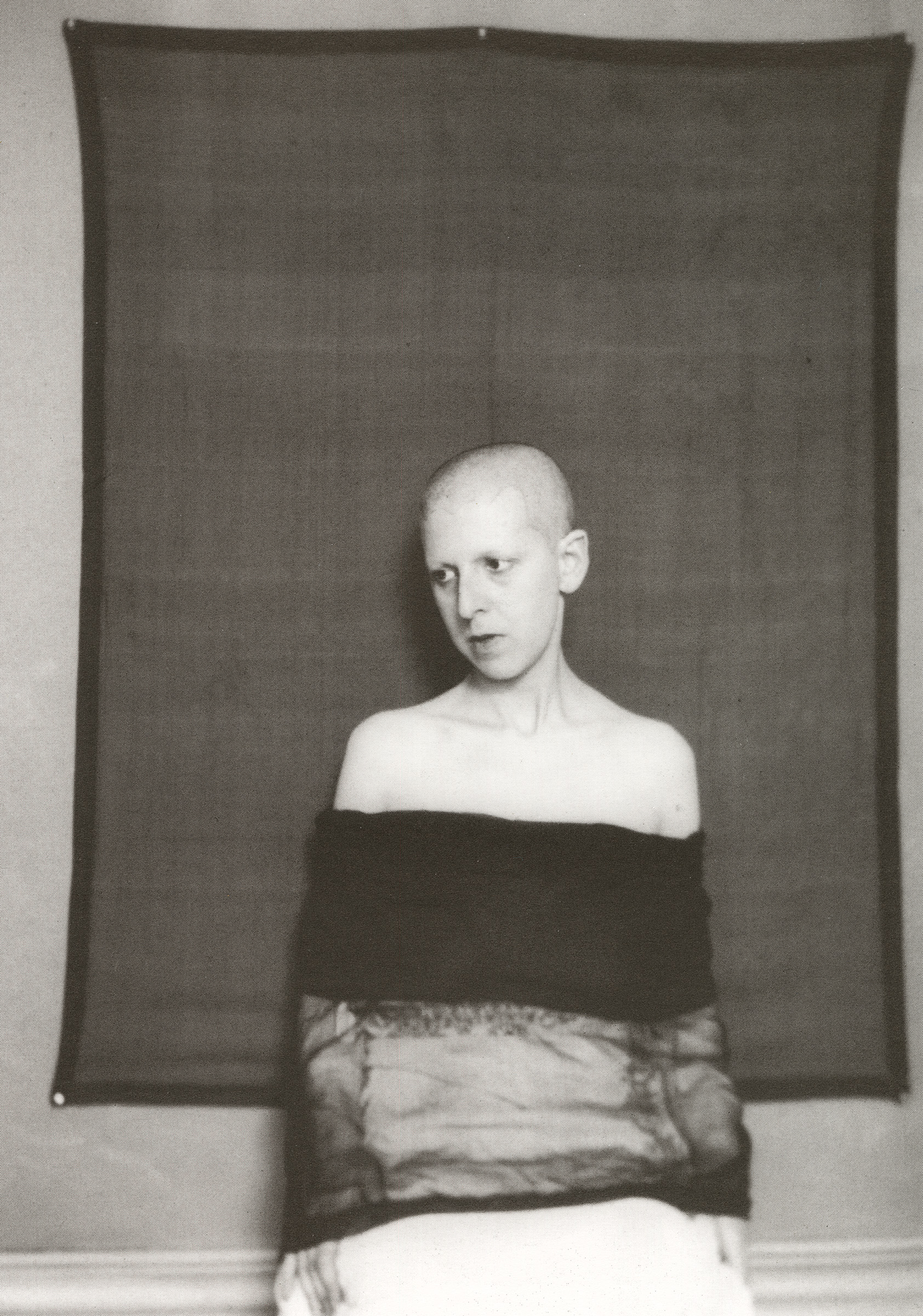
I love this image of Cahun, taken by her partner Marcel Moore. Cahun is masked and naked, her gender identity obscured and conflated by the covering of her breasts and her closely cropped hair. Cahun, born Lucy Mathilde Schwob, refused and resisted a prescribed female identity from a young age, as did Moore, who was born Suzanne Malherbe. Despite her gender nonconformity, I will not refer to Cahun (or Moore) as “they” or “them,” as these gender terms were not in use during their lifetime. Cahun had her own take on gender, saying,

“Shuffle the cards. Masculine? Feminine? It depends on the situation. Neuter is the only gender that always suits me.”

– Claude Cahun, Disavowels, trans. Susan de Muth (Cambridge: MIT Press, 2007), 151. From Claude Cahun’s Aveux non Avenus, 1930.

In early February, I will begin a residency at La Napoule Art Foundation in southern France with Luís Branco. There, we will make new performative photographs in direct conversation with Claude Cahun’s portraits and photographs. This residency will offer me further opportunity for some serious play with this complex artist (and lots of costumes and in France to boot!). We are excited to work in the historic Château de la Napoule and the gardens and grounds of the La Napoule Art Foundation on the Côte d’Azur. American sculptor Henry Clew and his wife Marie bought this historic property in 1918 and actively redesigned and restored the château and gardens in the 1920s and 30s. They welcomed other American expatriates and European aristocrats into their home for lavish parties and cultural events. This is the same period of time when Claude Cahun and her partner Marcel Moore were active in the vibrant cultural life of Paris. In 1951 Marie Clew established the property as the La Napoule Art Foundation. The foundation welcomes artists from around the world for artist residencies, exhibitions and other cultural events.

Claude Cahun (1894 – 1954) has been my main muse over the last several years. Cahun’s remarkable self-portraits, with Marcel Moore (1892 – 1972) behind the camera, confirm her courage in exploring the fluidity of identity and gender. These images reveal Cahun in flux—as masculine and feminine, masked and masquerading. The images depict Cahun as a body builder, a buddha, a dandy, a she-devil and in other guises and manifestations.

Cahun and Moore’s collection includes photographs in ordinary settings: in their hometown in Nantes France; in glimpses of their life together in Paris in the twenties; and on Jersey (one of the Channel Islands located between England and France) where they lived before, during and after World War II. Postwar photographs of Cahun demonstrate the toll the war, the occupation of Jersey and her time in jail took on her health. Cahun and Moore both served time for their anti-Nazi activities during World War II. Cahun died in Jersey in 1954. Moore died in 1972.

Cahun and Moore’s photographs have been widely published, exhibited and heralded over the last thirty years. However, it is interesting to me that for Claude and Marcel, this was a private photographic practice. They exhibited very few of their photographs, though they did create remarkable photomontages together with many of these images for Cahun’s seminal 1930s surrealist monograph Aveux non Avenues, which has been translated and published in English as Disavowals.

Untitled, black-and-white photograph, Claude Cahun (with Marcel Moore), 1914.

My Claude / My Medusa, color digital image, Sherry Wiggins and Luís Branco, 2019.

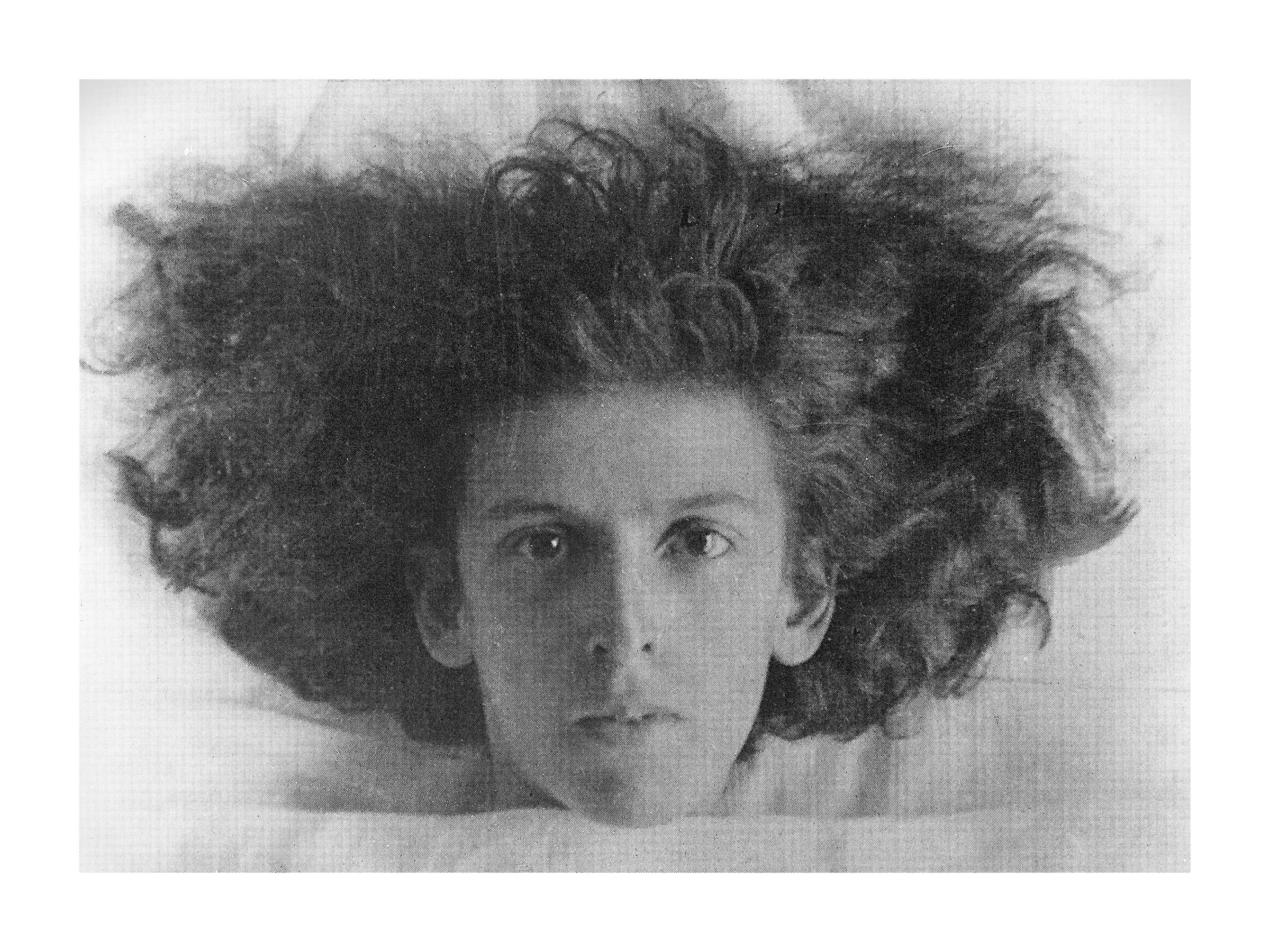
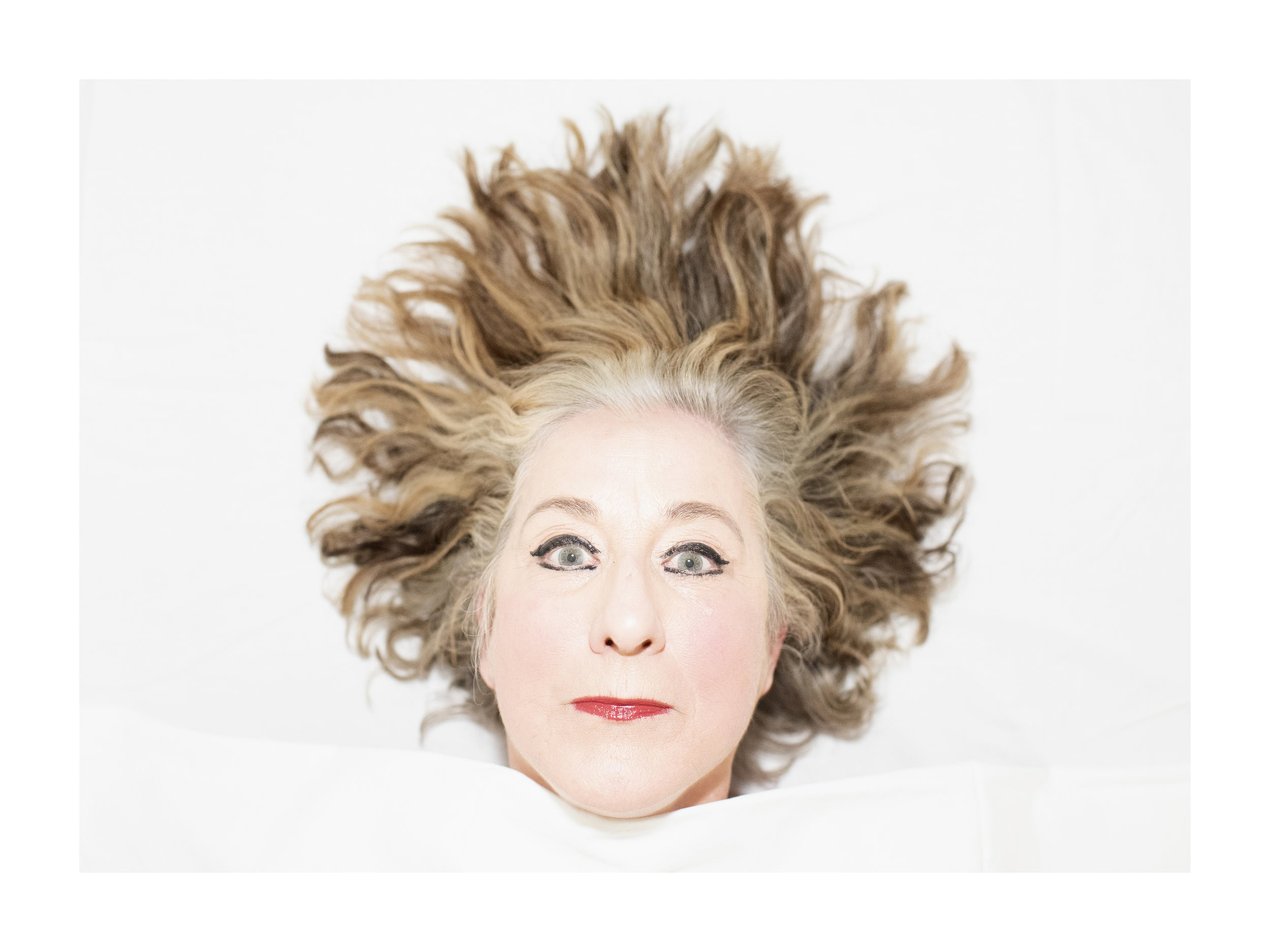
Luís Branco and I shot the above image in the Netherlands at Foundation OBRAS. We were referencing the above black-and-white portrait of Claude Cahun. Here, Cahun rests her head on a pillow, her hair billowing out around her face; she gazes, wide-eyed, directly toward the camera. The image was undoubtedly made in collaboration with Moore when Cahun was eighteen years old.

I was sixty-four when Luís and I reenacted this photograph more than 100 years later. As I lay on the pillow and performed for the camera, I pondered my life alongside Cahun’s—my teens and her teens, my twenties and her twenties, and onward into our thirties, forties, and fifties. Cahun died at the age of sixty. My performative practice with Luís Branco is both serious and playful, kindred to Cahun’s lifelong photographic practice with Marcel Moore. A transmutation occurs between my and Luís’s work and Marcel and Claude’s work. My reaction when I saw our images was, “Oh, my god, I look like Medusa!”

Under Cahun’s influence, I am compelled to delve into the ambiguities of my own identity, to explore definitions of gender and to examine the tropes of selfhood I inhabit. What is masculine and what is feminine? Are gender and sexuality performative? What lurks behind the masks we wear? Below are several of my favorite images of Cahun’s (and Moore’s). These images produced over Cahun’s lifetime and many more will serve as inspirations for my own embodiments and performative photographs.

Untitled, black-and-white photograph, Claude Cahun (with Marcel Moore), 1921.

Untitled, black-and-white photograph, Claude Cahun (with Marcel Moore), 1921.

Untitled, black-and-white photograph, Claude Cahun (with Marcel Moore), 1927.

Untitled, black-and-white photograph, Claude Cahun (with Marcel Moore), 1927.

Cahun’s images as a body builder are some of my favorites. Assemblage artist Jensina Endreson (check out her fabulous work at https://www.bustleworshipdesigns.com/ ) has been helping me with my body-builder costume, complete with a T-shirt like Cahun’s, embroidered with the text, “I’m in training. Don’t kiss me.”

Untitled, black-and-white photograph, Claude Cahun, 1927.

Cahun and Moore were associated with several avant-garde theater groups in Paris in the twenties. The image of Cahun as the Buddha is thought to document her involvement with the theater group Les Amis des Arts Esoteriques. Luís and I reincarnated this Buddha image in Holland in 2022 and some curious images emerged.

Claude Cahun Series (Buddha), color digital image, Sherry Wiggins and Luís Branco, 2022.

Claude Cahun Series (Buddha), color digital image, Sherry Wiggins and Luís Branco, 2022.

Que me veux tu? What do you want from me?,  black-and-white photograph, Claude Cahun (with Marcel Moore), 1927.

The composite photo above is one of Cahun’s few images with a title: Que me veux tu? What do you want from me?. The image and title reflect her lifelong questioning of self and identity in words and images.

Untitled, black-and-white photograph, Claude Cahun, 1929.

The image above documents Cahun’s performance as the Devil in a production of the medieval play The Mystery of Adam. I have enlisted seamstress Laura Simmons to make this fabulous art deco costume and Jamie to make the wings. Voilà!

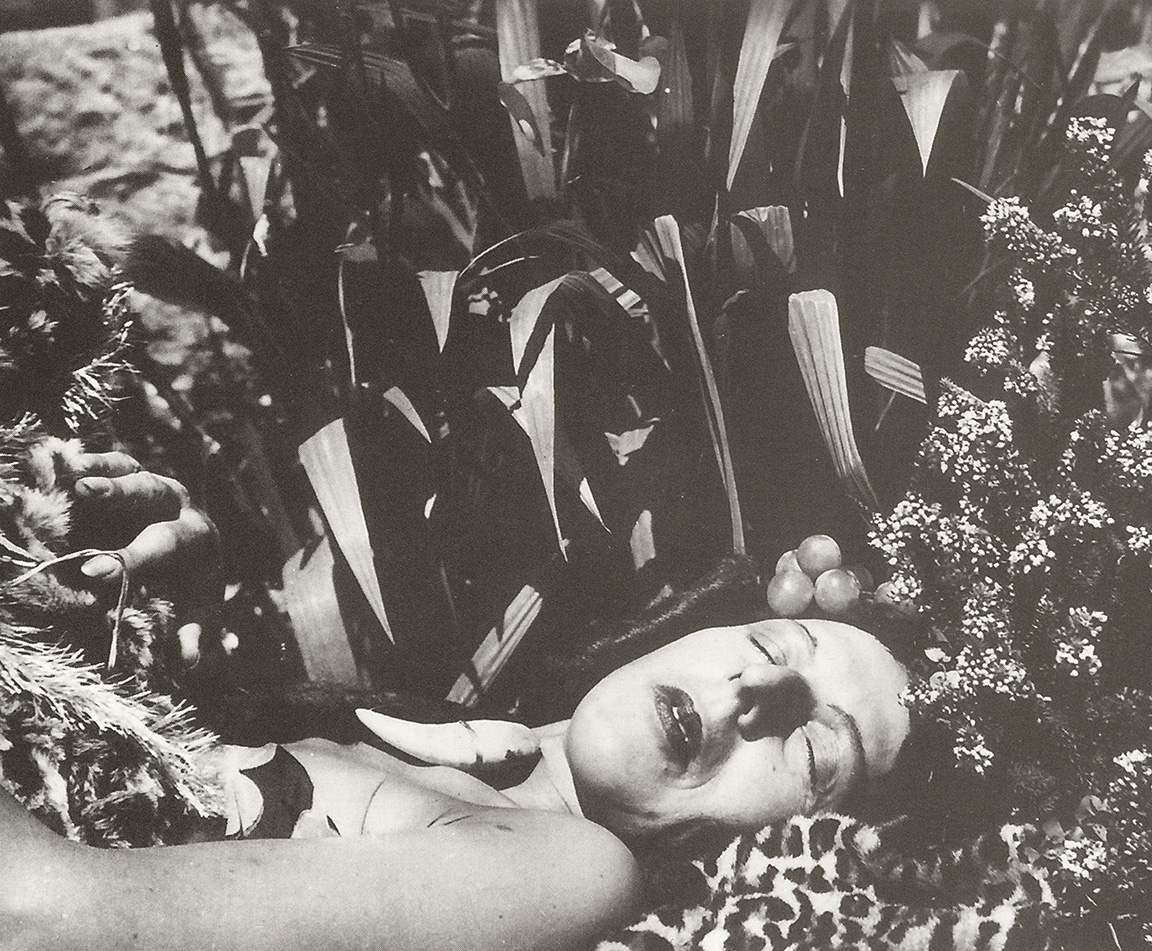
Untitled, black-and-white photograph, Claude Cahun (with Marcel Moore), 1932.

Many of Cahun and Moore’s images, performed in domestic settings, project the idea of serious play, which they regularly enacted in their photographic practice.

Untitled, black-and-white photograph, Claude Cahun (with Marcel Moore), 1938.

Untitled, black-and-white photograph, Claude Cahun (with Marcel Moore), 1938.

Untitled, black-and-white photograph, Claude Cahun (with Marcel Moore), 1939.

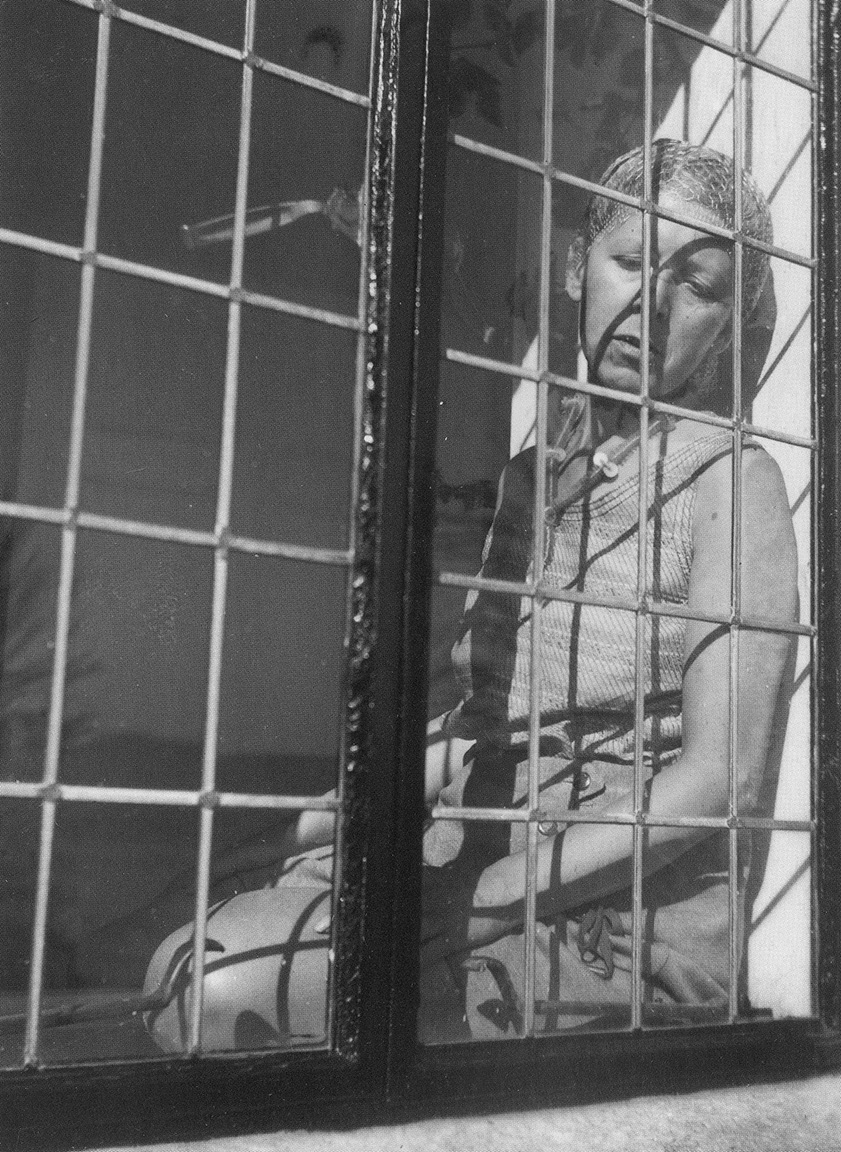
These images from the late thirties were taken after Cahun and Moore had moved permanently to Jersey island from Paris.

Untitled, black-and-white photograph, Claude Cahun (with Marcel Moore), May 1945.

The image above was taken days after Cahun and Moore were released from jail in Jersey in May of 1945. Cahun, ever resistant, bites down on the German Luftwaffe insignia. Fifty-one years old at the time, she appears much older. Few photographs have survived from the period during World War II, when Cahun and Moore were living under the occupation on Jersey and actively resisting the war and the occupation in covert actions. They were caught in 1944 and sentenced to death and were in jail for almost a year. Luckily, the war ended, and they were released. During their time in jail, their home was dismantled, their art and book collections stolen, their furniture possessed by the Germans. They lost so much. They gradually put their life and their home back together. Neither Claude nor Marcel ever returned to Paris—Claude’s health problems prohibited it.

Untitled, black-and-white photograph, Claude Cahun (with Marcel Moore), 1947.

“If there is horror, it is for those who speak indifferently of the next war. If there is hate, it is for hateful qualities, not nations. If there is love, it is because this alone kept me alive.” – Claude Cahun

Cahun and Moore’s artworks, photographs, writings, texts and memoirs have been collected and archived in the Jersey Heritage Museum in St. Helier, Jersey.

For more information on Cahun’s life and practice, you can read “A Brief Biography of Claude Cahun” posted on this blog:

I also recommend these two books:

Paper Bullets, Jeffrey H. Jackson. Chapel Hill: Algonquin Books, 2020.

Historian Jeffrey Jackson focuses primarily on Cahun and Moore’s anti-Nazi activities during World War II. He includes lots of interesting details about their life on Jersey island, their activism and imprisonment.

Exist Otherwise: The Life and Works of Claude Cahun, Jennifer L. Shaw. London: Reaktion Books, 2017.

Art Historian Jennifer Shaw has written a comprehensive treatise on Cahun and Moore’s lives and works. This is a great book.

Slide Show Side Show – posted in Boulder, CO Dec 27, 2024

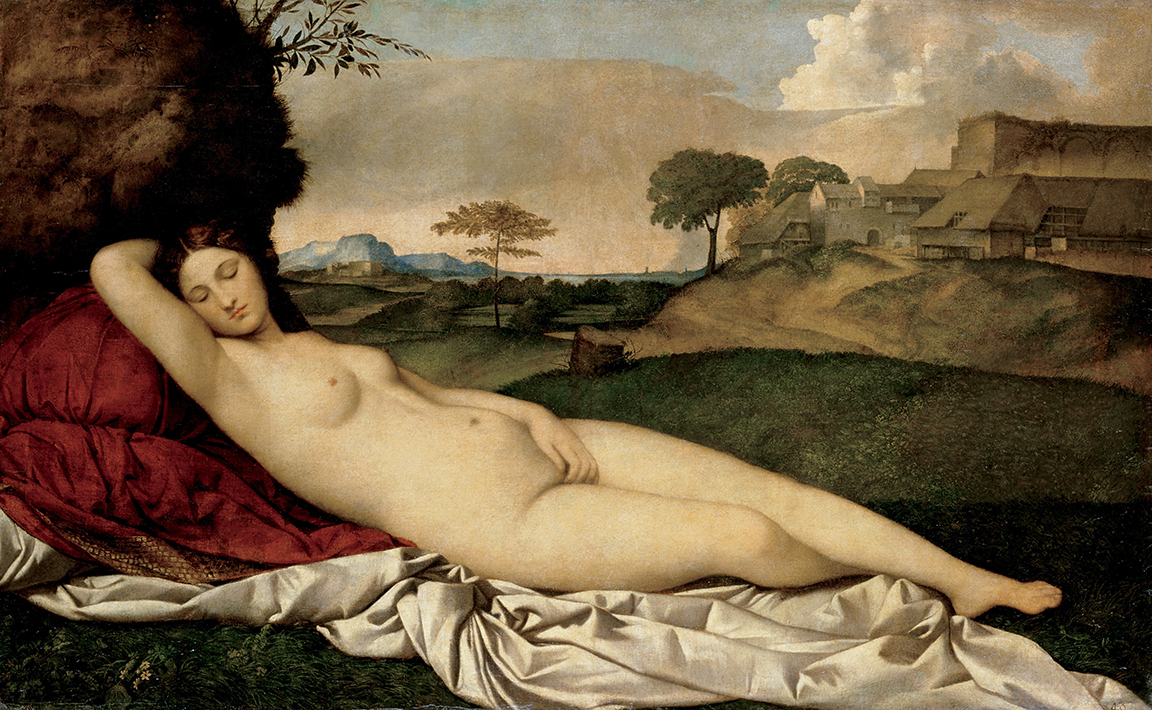
Sleeping Venus, presumably started by Giorgione and finished by Titian, c. 1510, Gemäldegalerie Alte Meister, Dresden, Germany.

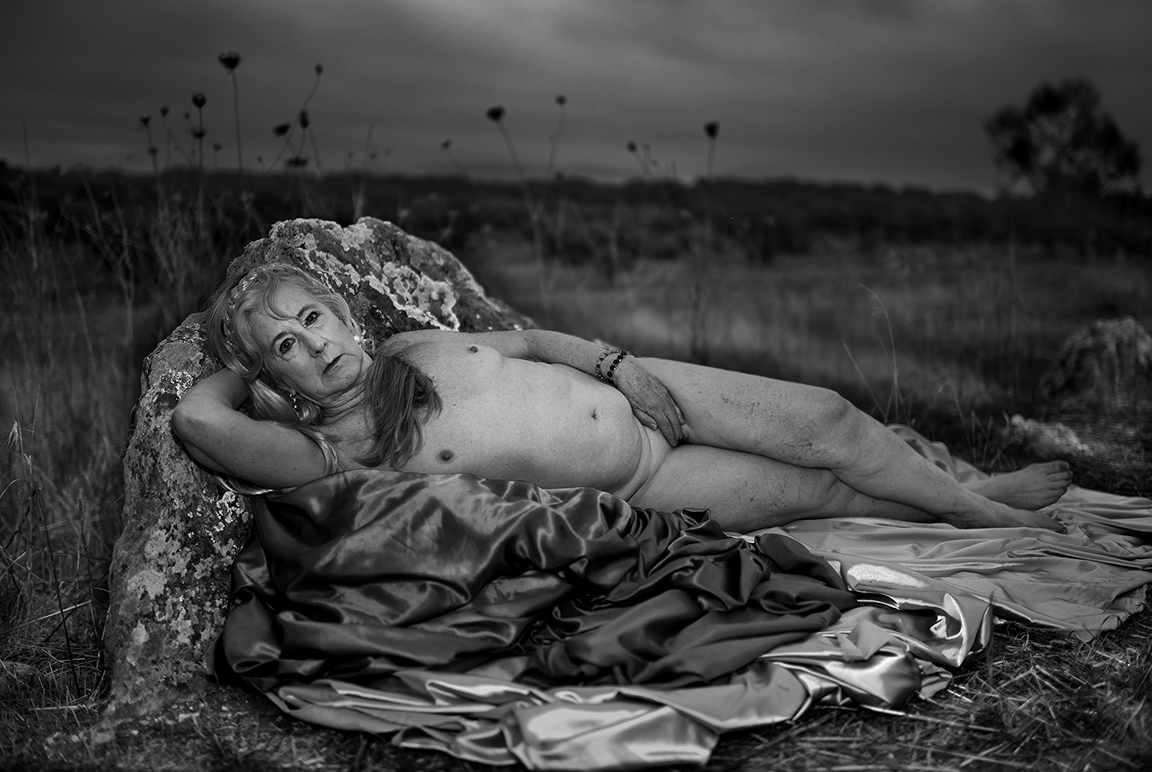
let’s shoot by the small rock

horizontal landscape womanscape

last light first light works better

Giorgione or was it Titian? What were you thinking?

red satin resting, arm akimbo

eyes closed eyes open

naked, nude except the wig

cover crotch with hand

is she playing, sleeping?

focused, the relationship understood

Aphrodite / Venus series, Sherry Wiggins and Luís Branco, 2024.

Aphrodite / Venus series, Sherry Wiggins and Luís Branco, 2024.

my angels / my goddesses arrive

the studio prepared, black cloth

the mirror, always the mirror

a blond but really silver

no butt crack

except for Eros / Cupid / Marta

the slim curves of their buttocks

my broad curving backside

blond Venus in the mirror

or is it Aphrodite?

why do they call her Venus?

Venus is also Ishtar’s star

this image is important to me

he shoots over and over

changing the lights, the lens, his distance

I look in the mirror back at him, the lens

Aphrodite / Venus series, Sherry Wiggins and Luís Branco, 2024.

Aphrodite / Venus series, Sherry Wiggins and Luís Branco, 2024.

it’s raining

we move to the casa

coffee, wine, special cheese

we try shooting in the small bedroom

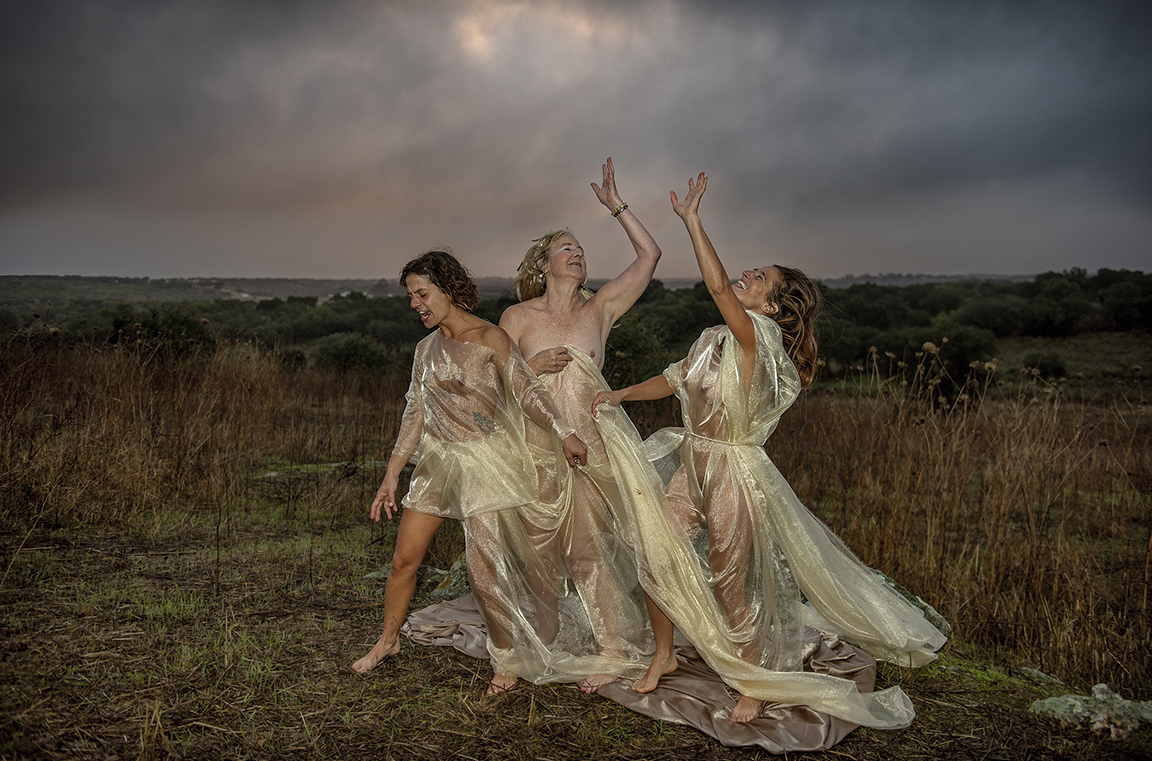
Aphrodite rising attended by the Horae,

it doesn’t really work

we end up together in the bed

enveloped by my goddesses

in the morning we return to the rock

we dance, sing, smoke cigarettes

he keeps shooting

maybe some good ones

the three goddesses

Aphrodite / Venus series, Sherry Wiggins and Luís Branco, 2024.

Aphrodite / Venus series, Sherry Wiggins and Luís Branco, 2024.

sun comes up, last shots

more coffee

my Horae / Angels / Goddesses depart

keep to the schedule

time for my other goddess Inanna / Ishtar

golden horns, the two lions, lapis necklace

Inanna / Ishtar series, Sherry Wiggins and Luís Branco, 2024.

early morning at Evoramonte

moon almost full

settling down

my lioness supports me

it’s fucking windy cold

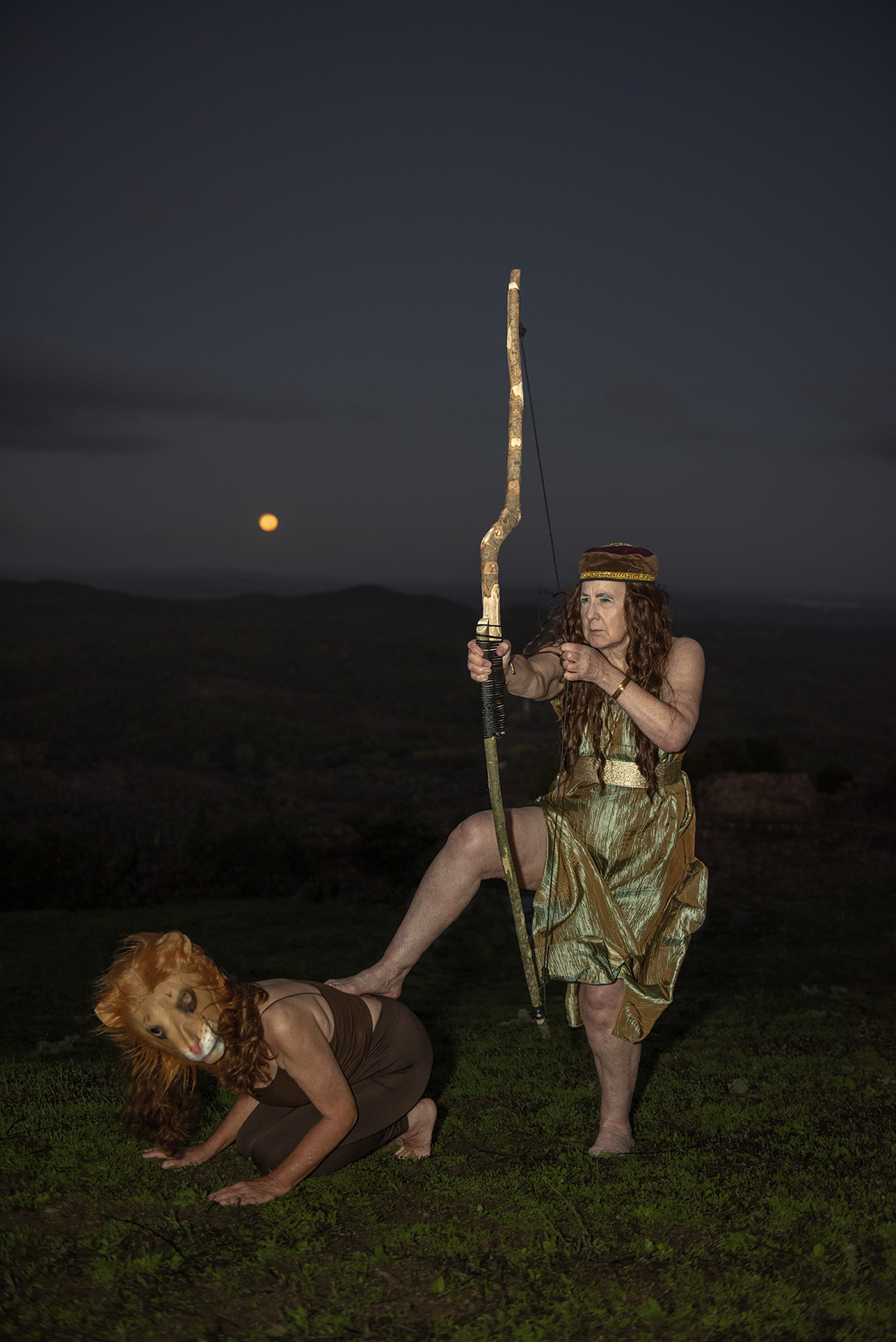
Inanna / Ishtar series, Sherry Wiggins and Luís Branco, 2024.

dawn arrives

a rainbow vista from the top of the mountain

my lioness near

I / Inanna / Ishtar stand strong

Inanna / Ishtar series, Sherry Wiggins and Luís Branco, 2024.

last night

in the studio

Ishtar with our golden girdle

Angels of Light on repeat

I hold my breasts

full frontal don’t move

I am the goddess

the lights the lens

a meditation…

Inanna / Ishtar series, Sherry Wiggins and Luís Branco, 2024.

Inanna / Ishtar series, Sherry Wiggins and Luís Branco, 2024.

I wrote the text above, “Slide Show Side Show,” after returning from the OBRAS Artist Residency in Portugal in late October. The text describes a bit of the process (which can be both improvisational and painstaking) that Luís Branco and I go through during our photoshoots–this last time with my heroines Aphrodite / Venus and Inanna / Ishtar. Marta Leon and Marta Carocinho stood by as Aphrodite / Venus’ Horae (goddesses of the seasons and of time). Wilma Geldof and Jacinta Ganso assisted as Inanna / Ishtar’s lionesses. After returning from Portugal, I let the work “rest” for several weeks. During the last part of November and early December I went through the editing process (with Luís’ help). I looked through the hundreds of images we shot to select the images we want to produce. Ron Landucci has done the final corrections to the images and is currently printing the proofs. I am very happy with this last body of work and I am now preparing to embody Claude Cahun in February at the La Napoule Art Foundation in France with Luís.

Wishing you the best for the New Year.

Naked and Adorned Part I : Inanna and Ishtar – posted in Boulder, CO Nov 8, 2024

WIP—Inanna / Ishtar series, color digital image, Sherry Wiggins and Luís Branco, October 2024.

I almost retitled this blog post  “F__K THE PATRIARCHY: Part I: Inanna and Ishtar and Part II: Aprhodite and Venus”. I am posting this after the election… but I decided to go with my original title “Naked and Adorned Parts I and II.  I’ve been home from Portugal for more than a week and I have been looking over the images Luís Branco and I produced during our residency at OBRAS. No final edits—just a quick look through and a consideration of my most recent heroines, Inanna and Ishtar, and my long-term heroine, Aphrodite, and her reincarnation as Venus (they are considered in Part II).

For the HEROINES project I have researched and embodied several ancient goddesses and made performative photographs with Luís over the last four years. These goddesses include the Greek goddess / enchantress / sorceress Circe, from Homer’s The Odyssey, with her tamed lions and the men she transformed into swine; Isis, the great Egyptian goddess of motherhood, fertility and magic; and Aphrodite, Greek goddess of love and sexuality and more …, who morphs into the Roman goddess Venus. These goddesses fascinate me for their special powers and independence and agency. They are all sexy, badass goddesses.

These goddesses of ancient times were also syncretic: They merged into one another and through one another across time, cultures, wars, land and water. Aphrodite, my original favorite goddess, has pointed me backward in time to her early predecessor / sister goddesses of love and sexuality (and much more …) in ancient Mesopotamia—Inanna and Ishtar.

My preparation for embodying all of these goddesses includes an exploration of thousands of years of representations, descriptions and depictions of them. I am not a historian, an academic or an archeologist, but I do my own intuitive investigations and excavations of these archetypal heroines.

In this current inquiry and recent embodiments, I have ventured to the East (in my mind and in my research) to the lands and cultures of ancient Mesopotamia, the Fertile Crescent, to find ancient Sumerian goddess Inanna and Akkadian / Babylonian goddess Ishtar. These two goddesses merged over a period of a few thousand years (ca. 4000 BCE to 500 BCE) and are, at times, indistinguishable. Artifacts, texts and poems represent these amazing and powerful goddesses of love, sexuality, war (and much more …). Studying these ancient goddesses has been a revelation. Patriarchal Western European history has largely ignored them.

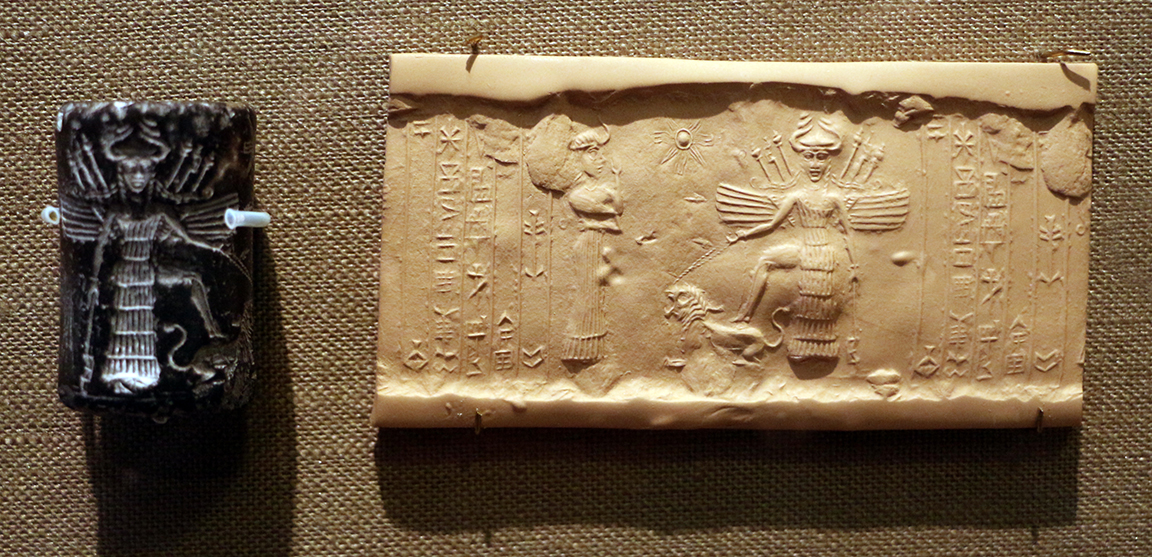
Radiant Inanna, cylinder seal, Mesopotamia, Akkadian period, ca. 2334 – 2154 BCE, h. 4 cm, d. 2 cm. The Oriental Institute Museum, University of Chicago.

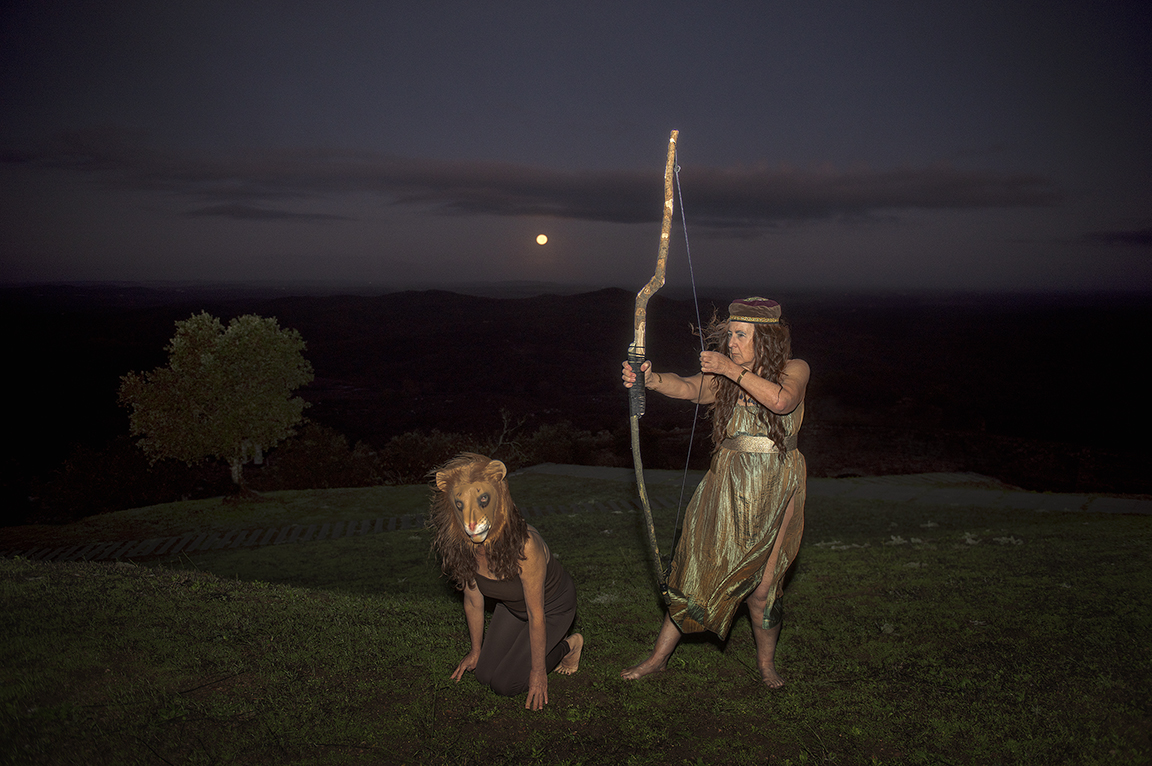
In the two images of the ancient cylinder seal terracotta plate above, Inanna / Ishtar stands triumphantly in full regalia with one foot upon the back of her roaring lion. She wears a headdress of multiple horns. Weapons issue from her shoulders, while enormous wings appear from behind her back, suggesting both her martial and supernatural nature. An eight-pointed star, emblem of her manifestation as Venus, the morning and evening star, appears in the sky beside her.

WIP—Inanna / Ishtar series, black-and-white digital image, Sherry Wiggins and Luís Branco, October 2024.

Known as the “Queen of Heaven and Earth,” Inanna is the goddess of love, war, fertility, political power, sex (and much more …). She was worshipped as early as 4000 BCE in Sumer in southern Mesopotamia. In later Babylonian culture (2000 BCE to 500 BCE), Inanna becomes Ishtar and represents many of the same attributes and mythoi and is represented in many poems and hymns.

Terracotta plaque showing the goddess Ishtar (Inanna), 19th – 17th century BCE, from Iraq. Pergamon Museum, Berlin, Germany.

On the terracotta plaque above, Ishtar / Inanna stands on the back of a lion. She holds a bow in her left hand and a crook or a sickle in her right. The symbol of the god Shamash (Utu) appears in the upper right corner. The scene seems to take place in mountainous terrain.

I constructed her gown and collected golden horns, a lapis necklace and a golden girdle for my embodiment of Inanna / Ishtar. My friend Antonio made a wooden bow for us. My lioness, Jacinta, accompanied Luís and me to the top of Evoramonte near dawn, just as the moon was setting.

WIP—Inanna / Ishtar series, color digital image, Sherry Wiggins and Luís Branco, October 2024.

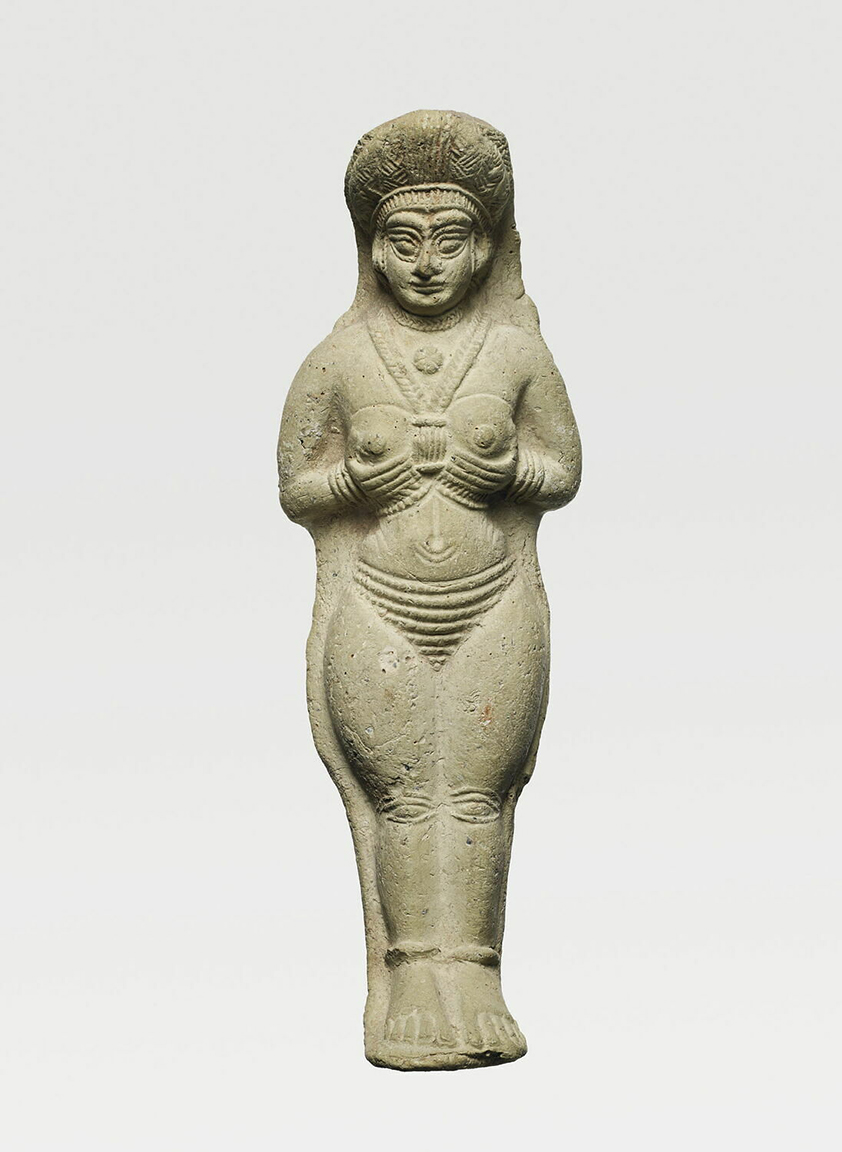
Both Inanna and Ishtar have been portrayed in various states of nakedness and adornment, all of which evoke their power and their sexuality. They are invincible goddesses and sexy, graced with elaborate crowns and jewels, often portrayed full-frontal in sculpture or other artifacts, whether nude or adorned. Their states of dress and undress reflect cultural ideas about female sexuality and female power, essentially equating the two. Which of course I love! Many Mesopotamian sculptures depict Inanna / Ishtar, as well as other women, holding their breasts—not as a statement of modesty, but, rather, referring to their potent and powerful sexuality.

Ishtar from Susa, 1500 – 1100 BCE. Louvre Museum, Paris, France.

WIP – Inanna / Ishtar series, color digital image, Sherry Wiggins and Luís Branco, October 2024.

In addition to sculptures and plaques, Inanna / Ishtar is depicted in texts and poems. I have been reading translations of these texts in Inanna, Queen of Heaven and Earth: Her Stories and Hymns from Sumer by Diane Wolkstein and Samuel Noah Kramer. “The Descent of Inanna” is the most famous text. Here, Inanna descends into the underworld through seven gates. At each gate, she must give up an article of clothing or an object that signifies one of her various powers—her horned crown, her scepter, her lapis jewelry, her robe. Finally, she is naked in the colorless underworld alongside her sister, Ereshkigal, who is the goddess of death and the underworld. Ultimately, Ereshkigal and the seven judges of the underworld kill Inanna. Her corpse is hung on a hook on the wall and left to decompose. Yet Inanna contrives a way to return to the living world: She consigns her husband, Dumuzi, the shepherd /king, and her faithful servant to spending half of every year in the underworld for eternity. Inanna is definitely a badass, but she has other sides as well; her sexual powers are prodigious.

Perhaps my favorite text about Inanna is the very sexy “The Courtship of Inanna and Dumuzi”:

Inanna spoke:

“What I tell you,

Let the singer weave into song.

What I tell you,

Let it flow from the ear to mouth,

Let it pass from old to young:

My vulva, the horn,

The Boat of Heaven,

Is full of eagerness like the young moon.

My untilled land lies fallow.

As for me, Inanna,

Who will plow my vulva?

Who will plow my high field?

Who will plow my wet ground?

As for me, the young woman,

Who will plow my vulva?

Who will station the ox there?

Who will plow my vulva?”

Dumuzi replied:

“Great Lady, the king will plow your vulva.

I, Dumuzi the King, will plow your vulva.”

Inanna:

“Then plow my vulva, man of my heart!

Plow my vulva!”

(From Inanna, Queen of Heaven and Earth: Her Stories and Hymns from Sumer, Diane Wolkstein and Samuel Noah Kramer, 1983, Harper Perennial: New York, NY, pp. 36 – 37.)

Terracotta Couple from Susa, 1500 – 1100 BCE. Louvre Museum, Paris, France.

Please read my blog post “Naked and Adorned Part II: Aphrodite and Venus” about our work made during the same time period at OBRAS, also part of the F__K the Patriarchy series…

Made in Portugal at the OBRAS Artist Residency – posted Sept 19, 2024 in Boulder, CO

 Woman Standing, Still, black-and-white digital image, Sherry Wiggins and Luís Filipe Branco, 2015.

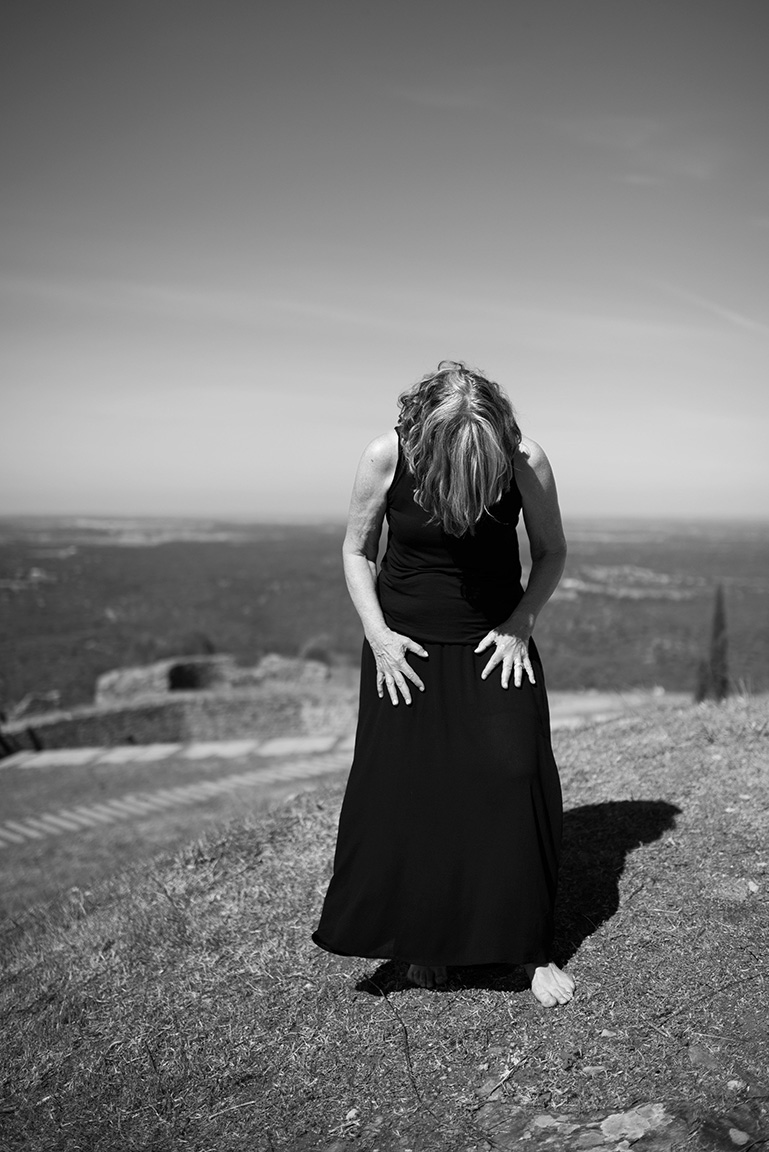
Woman Standing, Still, above, is one of my favorite images that I made with photographer Luís Branco during my first trip to Portugal and to the OBRAS Artist Residency in the fall of 2015.  She (I) stands with her feet planted firmly on the ground, on the mountain of Evoramonte, with the spacious sky surrounding her (me). She (I) is obviously an older woman and a strong matriarchal archetype.

I am preparing to return to Portugal in October, to the OBRAS Artist Residency near Evoramonte in the Alentejo region of Portugal. This place is very special to me, as are the people I have met at OBRAS, especially the residency’s founders, Carolien van der Laan and Ludger van der Eerden. I am feeling sentimental and grateful for the work I have accomplished with photographer Luís Branco over the last nine years at OBRAS. I am posting ten of my favorite images here, all of which were made at OBRAS and in nearby Evoramonte, and which convey the special affinity I have for this place. Luís and I have produced A LOT of work over the last several years at OBRAS and at other residencies and places in Portugal and Holland, and we have been showing our work in both Portugal and the US all along the way. You can see more of this work on my website.

It all began in the fall of 2015, when I traveled to Portugal and to OBRAS as a resident for the first time. At the time, I was studying the work of the fabulous Portuguese conceptual and performance artist Helena Almeida (1934 – 2018). Inspired by Almeida, my intention in 2015 was to make performative photographic artworks with myself as the subject. I asked Ludger and Carolien to introduce me to a photographer with whom I could work while I was at OBRAS. They introduced me to Luís Branco, and we began working together, in the studio, across the hills and fields surrounding OBRAS and in and around the nearby castle of Evoramonte. Woman Standing, Still, above, is (still) one of my favorite images from that first work period with Luís in 2015.

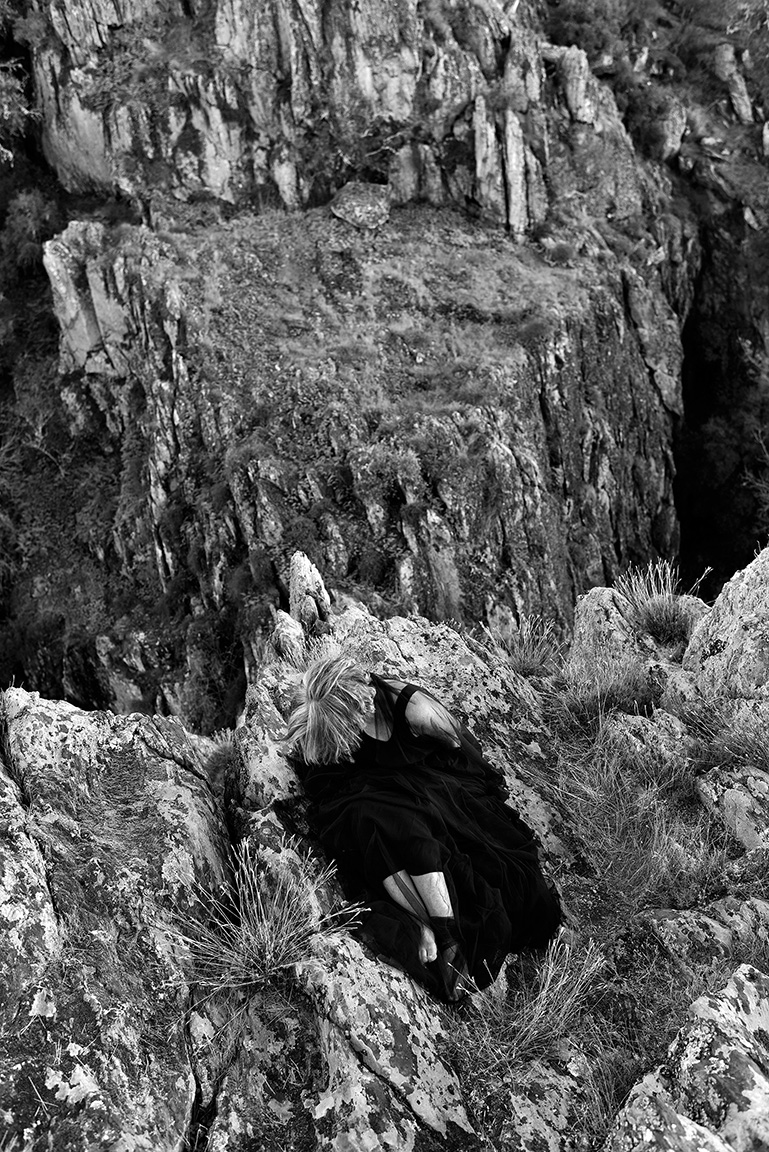
Woman in the Pego do Sino, black-and-white digital image, Sherry Wiggins and Luís Filipe Branco, 2016.

I returned to OBRAS in the fall of 2016 to work with Luís once again. We spent time in the Pego do Sino (Canyon of the Bells), a magical canyon near OBRAS. In Woman in the Pego do Sino, above, I am swathed in black gauzy fabric, almost hidden in the rocky landscape. The black form of my body appears like an entrance into the earth. During this residency, Carolien and Ludger offered to curate a show of Luís and my works to date in the beautiful palácio in the nearby town of Estremoz. Following is a seven minute video that we made with videographer Rui Fernandez about that exhibition, REENCONTRANDO-A / MEETING HER AGAIN: An exhibition of Sherry Wiggins with Luís Branco, which took place in early 2017:

In the fall of 2017, I returned to OBRAS to work with Luís in various land and waterscapes. We made many images at different sites in the Alentejo: in canyons, in rivers, in lakes and in dry reservoirs. The title of the image below, Encarnado, refers to multiple things in Portuguese. Encarnado literally means the color red, but it also refers to the incarnation of another being. We made this image in the bottom of Pego do Sino, the dwelling place of a fierce goddess/deusa, according to my Portuguese friends.

Encarnado, color digital image, Sherry Wiggins and Luís Filipe Branco, 2017.

Encarnado was in the exhibit “Delirium” curated by Mark Sink at Redline Contemporary Art Center, Denver, CO, 2019. (photo by Robert Kitilla)

I returned to OBRAS-Portugal in the spring of 2019 to work with Luís yet again. Below are just a few of my favorite images from that time. These works demonstrate our continued connection with the landscape near OBRAS.

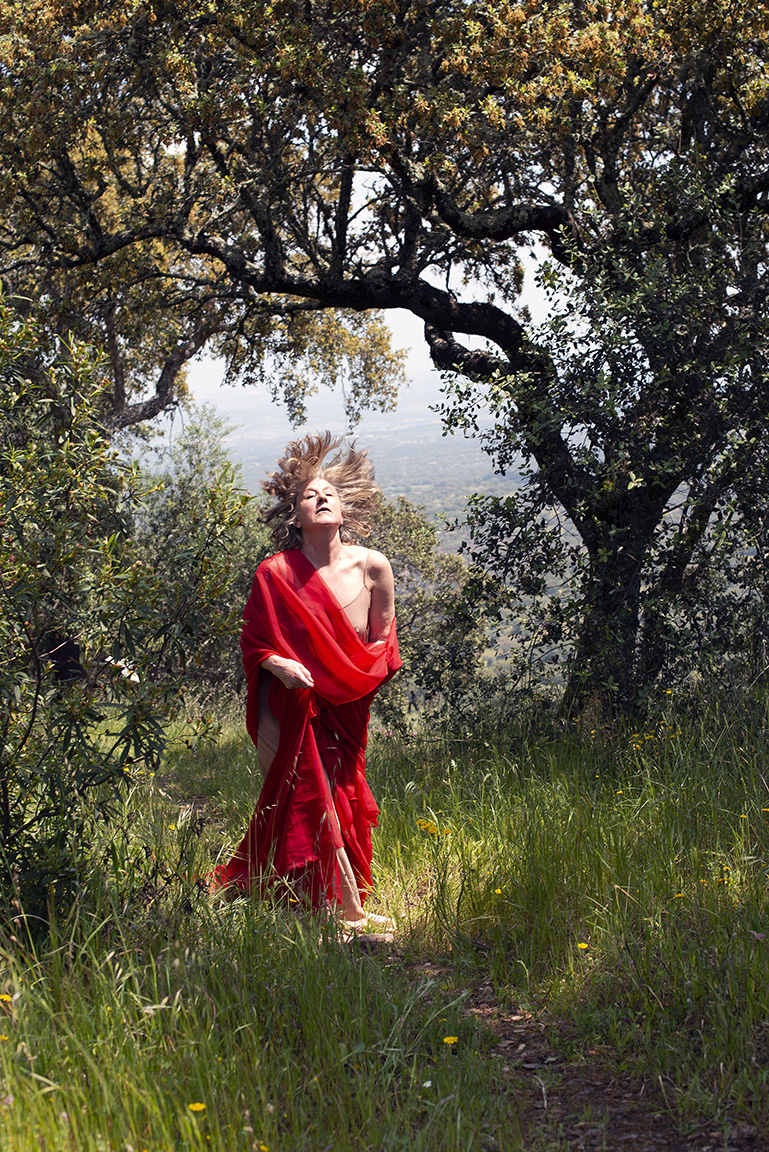
Woman, Rising, color digital image, Sherry Wiggins and Luís Filipe Branco, 2019.

Seat at Evoramonte, color digital image, Sherry Wiggins and Luís Filipe Branco, 2019.

I love Outside Woman, the black-and-white image below. Luís is shooting from inside the Casa Miradouro (the little house I stay in at OBRAS), and I am standing outside, swathed in a gauzy nude colored fabric, like a phantom goddess/ghost. The mountain of Evoramonte is visible in the background.

Outside Woman, black-and-white digital image, Sherry Wiggins and Luís Filipe Branco, 2019.

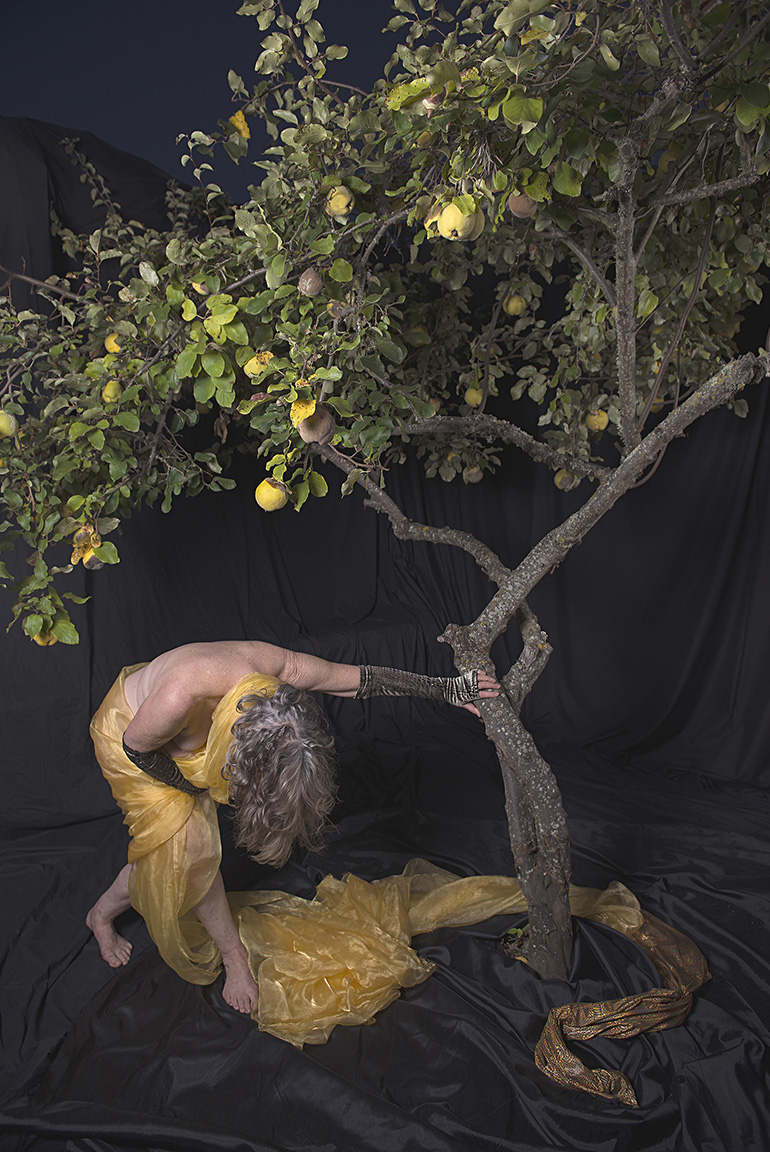
In 2021, Luís and I initiated our ongoing Heroines Project at OBRAS-Portugal. For this project, I have been researching and embodying various biblical, historic, literary and mythical female figures, and Luís has been photographing me. Our first heroines were the biblical figures Eve and Salome. Exit Paradise, below, was inspired by Eve’s banishment from paradise and includes a gorgeous marmeleira, or quince tree, which is located in the courtyard at OBRAS.

Exit Paradise I, color digital image, Sherry Wiggins and Luís Filipe Branco, 2021.

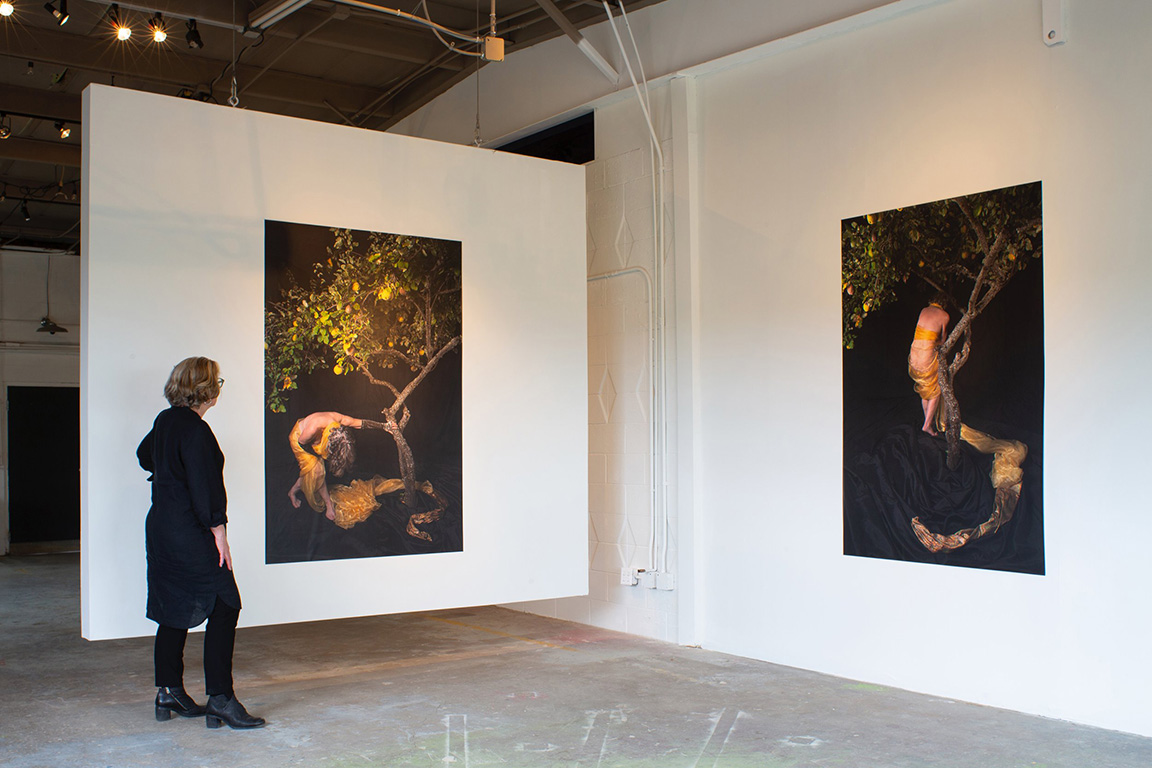
Exit Paradise I and II, installation at Seidel City, Boulder, CO, 2023. (photo by Robert Kitilla)

And I love the black-and-white image Salome at Sunset, below, with the mountain of Evoramonte in the background at sunset. These works, and many more, were shown in Boulder in 2023 as a part of the fabulous exhibit Exit Paradise at Seidel City.

Salome at Sunset II, black-and-white digital image, Sherry Wiggins and Luís Filipe Branco, 2021.

In spring of 2022, we put up The Mirror Between Us, a gorgeous exhibit in Evora, Portugal, curated by Ludger and Carolien. Margarida Branco and the municipality of Evora supported this exhibit, which was held in the beautiful Igreja de São Vicente in the center of Evora. This exhibit highlighted twenty-five performative photographs that Luís and I made in the Portuguese landscape between 2015 and 2019. The exhibit was originally scheduled for 2020 but was delayed due to covid. More than 4,000 people visited the exhibit over a two-month period. You can read about this exhibit and see the images on my blog:

https://sherrywigginsblog.com/2022/04/26/%EF%BF%BCwalk-through-the-exhibition-and-the-inauguration-of-the-mirror-between-us-at-the-igreja-de-sao-vicente-

Our work on the Heroines Project has progressed over the last few years at different locations in Portugal and Holland. In March of 2024, we were able to work for a few days at OBRAS-Portugal and at the Café O Emigrante in Evoramonte, and we shot some wonderful images of my heroine the Greek goddess Circe (from Homer’s The Odyssey) with several of our friends posing as Circe’s lioness companions and as Circe’s swine. In The Odyssey, Circe famously transforms Odysseus’s men into swine and later restores them to human form.

Circe and Her Companions, color digital image, Sherry Wiggins and Luís Filipe Branco, 2019.

Circe at the Bar, black-and-white digital image, Sherry Wiggins and Luís Filipe Branco, 2024.

As you can see, our work has become more theatrical with the Heroines Project. In October, Luís and I will be working at OBRAS-Portugal again. We will revisit my heroine Aphrodite, the goddess of love, beauty and sexuality (and more …). We will also represent the ancient Mesopotamian goddess Inanna/Ishtar (also a goddess of love, sexuality and war and more …). I am thrilled to be returning to OBRAS-Portugal, a place of incredible inspiration and productivity for me, and I am grateful for my creative partnership with photographer Luís Branco that emerged at OBRAS and continues to flourish.

The Idea and the Body of Mary Magdalene: inventing, reinventing, traversing sacred ground-posted in Portugal March 9, 2024

Work in progress: “My Mary Magdalene” series, Sherry Wiggins and Luís Filipe Branco, 2024.

I have been in Portugal for a week and a half, settling into the Cortiço Artist Residency and thinking about Mary Magdalene. I have started working with my creative partner, Luís Branco, on my embodiments and performative photographic work with Mary Magdalene. It takes some time, this process with my heroines—my research has gone on for several months. And now, the enactments/embodiments with Luís are coming forth. We have set up a photo studio and shot many images of this wondrous heroine this week. The image above is one of the best from this week. There will be more …

“Mary Magdalene in Ecstasy,” Artemisia Gentileschi, 1620-1625. private collection.

The painting above is by Artemisia Gentileschi and is one my favorite images of Mary Magdalene.

I have been studying images and ideas of Mary Magdalene, as represented by artists, scholars, feminists, and popes. I have looked at many paintings and images of her, and I have engaged with narratives in the New Testament and in the Gnostic gospels. I have explored the Gospel of Mary, an extracanonical text from the second century CE that was found in a cave in Egypt in the last 150 years. This is the only gospel named after a woman, and it is named for Mary Magdalene. It is a stunning depiction and explanation of the spiritual understanding of Mary Magdalene in relationship to her teacher, Jesus. I am a neophyte when it comes to the subject of Christianity, so forgive my ignorance; I have delved into this subject from Mary Magdalene’s point of view. I realize I am traversing sacred and complicated ground here. Mary Magdalene, as a figure and a metaphor, is a huge subject, considering the history, the mythology and the misogyny that surround her. She is my most complex heroine to date.

Baroque painter Artemisia Gentileschi (1593 – 1656) is known for inserting her own image into paintings of her heroines, many of them biblical figures. She made several paintings of the Magdalene. In Gentileschi’s painting above, MM is depicted in a state of spiritual and physical rapture. Can we have both at the same time? This is the paradox and the beauty of the idea of Mary Magdalene. Her body is our body—her neck, her hair, her spirit. (Though in Western art she is almost always depicted as a beautiful, young, white woman). Portrayals of her are contradictory: a saint cloaked in red, a bare-breasted penitent, a contemplative beauty, an ascetic covered in hair and carried by angels. She has been revered and scandalized and depicted in multiple incarnations throughout time.

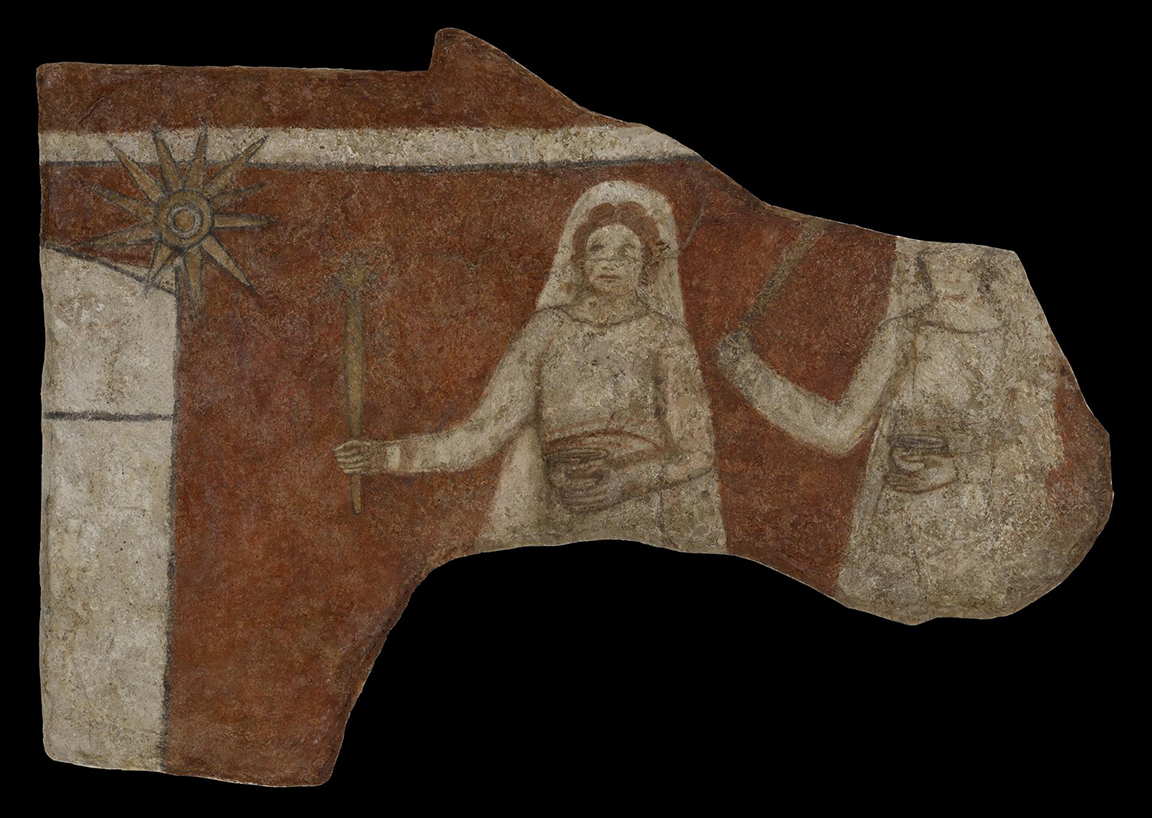
“Baptistry wall painting: Procession of Women,” 240-45 CE, Dura-Europos, Yale University Art Gallery.

Above is one of the first known depictions of Mary Magdalene, found in one of the world’s earliest house-churches in Dura-Europos in modern-day Syria. We (secular historians, biblical scholars and the rest of us) don’t know much about Mary Magdalene nor much about the early history of Christianity or Jesus. There is no written history from the early days. Biblical scholars and historians think MM was a real historical figure (as was Jesus) living in Galilee in ancient Judea in the first part of the millennium, when Judea was under Roman occupation. The New Testament gospels—Matthew, Mark, Luke and John—mention Mary Magdalene more than any of the other women who followed and surrounded Jesus. She is said to have been present at Jesus’s crucifixion (notice her in red in Masaccio’s painting below with the Virgin Mary on the right and St. John on the left). Magdalene is said to have witnessed his burial and was perhaps one of the first to have witnessed his resurrection. The canonical gospels were probably written in the first hundred years after Christ’s death and were most likely rewritten again and again, so their historical accuracy has been disputed over the centuries.

“Crucifixion,” Masaccio, 1426, Capodimonte Museum.

We don’t really know what the name Mary Magdalene signifies. There were many Marys (Miriam in ancient Hebrew) surrounding Jesus in the gospels and in real life during this period. The term “magdala” means tower; it was also the name of a fishing village located on the west side of the Sea of Galilee, where Jesus was teaching. Mary Magdalene was not associated with any man—neither a father nor a husband (which almost all women were in the patriarchal society of the time). One of the gospels tell us that Jesus cast “seven demons” out of her. Jesus was known as a healer, an exorcist of sorts. This idea of MM’s “demons” has been used over time to portray her as a former prostitute or adulterous woman. However, these kinds of healings were supposedly practiced by Jesus as a form of psychological and physical healing. It is said that Mary Magdalene became a hands-on healer herself as one of Jesus’s disciples. Magdalene was most often pictured with an unguent bottle or jar, representing the oil and herbs used for many things, including healing and caring for the body after death. Mary and the other women who accompanied her to Jesus’s tomb after his burial sought to anoint him with these special herbs and unguents.

“Mary Magdalene as Melancholy,” Artemisia Gentileschi, 1622 -1625, Museo Soumaya, Mexico City.

Above is another painting of Mary Magdalene by Artemisia Gentileschi. It serves as a symbol of melancholy. What was Mary Magdalene healed from? Artemisia (and I) can relate to this feminine/feminist “melancholy” and the expelling of it. In this painting, a downcast Mary Magdalene is draped in loose, beautiful fabrics; her soft, gold-tinged hair (it is always about the hair with MM) falls over her shoulder and winds around her fingers. In the gospels, MM and other women disciples or followers of Jesus, are described as “out of their resources,” implying that these women were in possession of wealth that they shared with Jesus and his followers. MM is often portrayed (especially in the Renaissance and Baroque periods) in beautiful garments with a mirror, a skull and a candle, representing the shedding of vanity, acknowledgement of the transitoriness of life, and the search for spiritual awakening. French Baroque painter George de La Tour (1593 – 1692) painted several series of the Magdalene in deep contemplation with a mirror, a skull and a candle. I particularly love the painting below, which Luís and I have used as an entryway to our work with Mary Magdalene.  You can see our interpretation of George de La Tour’s painting below. The first image on the blog has some of the melancholy expressed in Gentilieschi’s painting.

“The Penitent Magdalene,” George de La Tour, 1640, The Met collection.

Work in progress: “My Mary Magdalene” series, Sherry Wiggins and Luís Filipe Branco, 2024.

What happened to Mary Magdalene after Jesus’s crucifixion (and resurrection) is unclear. She was called “the apostle to the apostles,” which means that she was charged with spreading the “word” of Jesus, as were the other apostles (there were no written texts by Jesus). This might also signify that MM had experienced and understood some deeper teachings from Jesus. The term “apostle” means disciple and follower; it also signifies a duty as an evangelist or proselytizer to spread the word. Many stories detail the Magdalene leaving Judea and going to Ephesus, to Rome, and to France (there is a very detailed story/myth (held deeply by many) about MM going to France). She performed miracles, taught and later lived in a cave and meditated for many years. Her “relics” are worshipped all over the Mediterranean and beyond. She is worshipped and sanctified in many Eastern and Western Christian traditions. Perhaps she did get in a boat and teach and practice after Jesus’s death. Most secular historians hypothesize that she stayed in Galilee, where she taught and preached. These early years were dangerous times for Christians, and I imagine they were even more dangerous for a female spiritual teacher.

The erroneous or unfounded idea that Mary Magdalene was a reformed prostitute or an adulterous woman before meeting and being healed by Jesus was introduced into church doctrine in 591 by Pope Gregory. He conflated many of the women named Mary and unnamed women from the gospels. This idea held for hundreds of years, and Mary Magdalene became a figure and a symbol of penitence from then onward to saintliness.

Innumerable paintings of the repentant Magdalene emerge during the Renaissance, and usually involve her boobs as well as lots of hair. She is often cast in nature, or in the mythical cave that she was said to dwell in in France, according to one of the many stories/inventions of MM. The Italian Renaissance painter Titian (1488 – 1576) created several paintings of the penitent Magdalene during his lifetime, the first one, in 1531, with a lot of hair barely covering her breasts. The last one, in 1560, included less hair and partially covered breasts. An unguent bottle appears in the lower left corner of both paintings. The skull appears only in the later painting.

“Penitent Magdalene,” Titian, 1531. Palazzo Pitti collection, Firenze.

“Penitent Magdalene,” Titian, 1560. Hermitage Museum collection, St. Petersburg.

The Renaissance produced many images of Mary Magdalene with her breasts revealed (got to love the Renaissance). The painting below verges on campy porn. It was perhaps painted by Giampietrino (1495 – 1549), who was a student of Leonardo da Vinci’s, though some think this painting is by Leonardo himself.

“Mary Magdalene,” Giampietrino, 1515, private collection.

And I love the image below by French Baroque artist Simon Vouet (1590 – 1659) of Mary Magdalene carried by angels.

“Mary Magdalene Carried by Angels,” Simon Vouet, Musée des Beaux Arts, Besancon France.

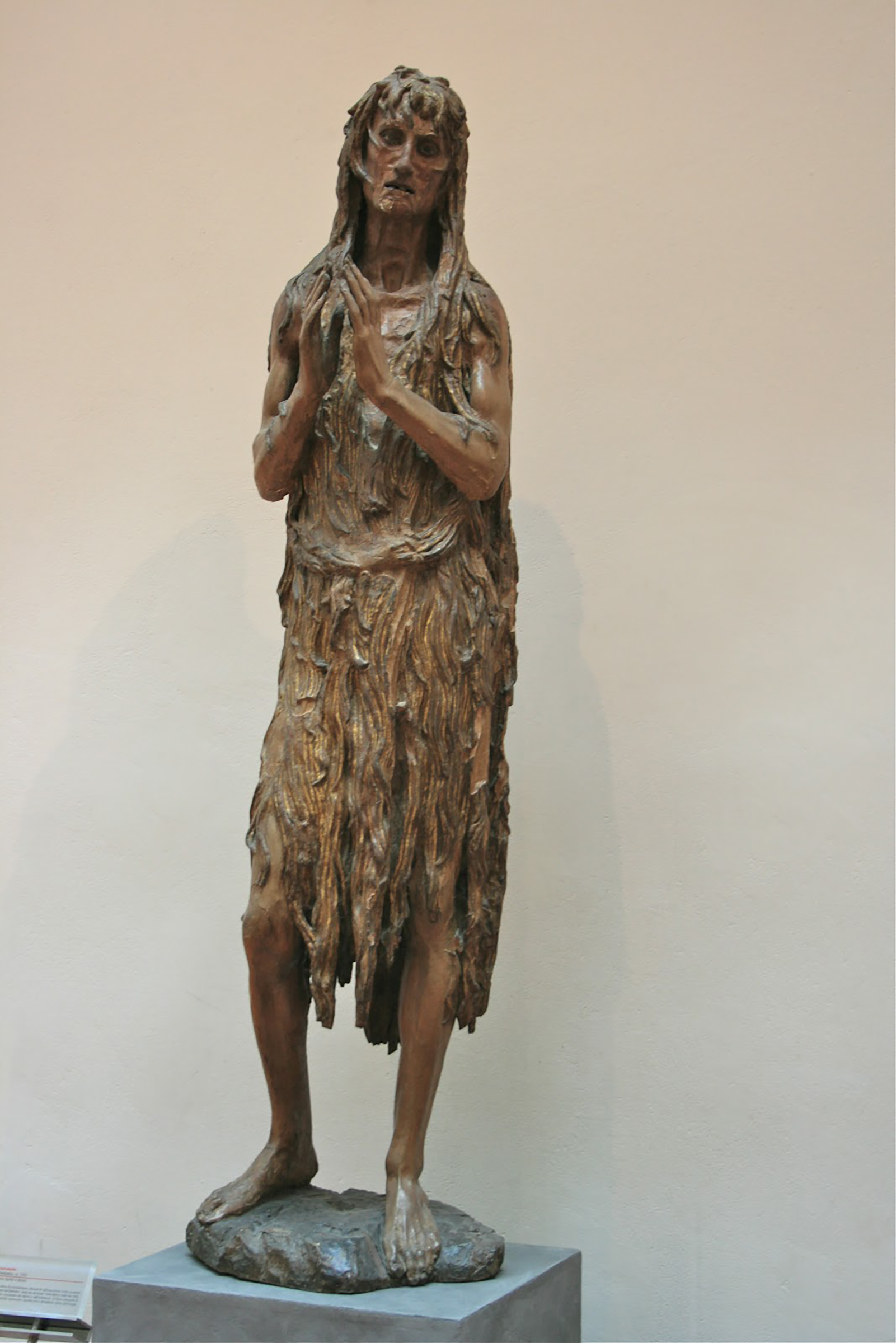
I am not clear on when Mary Magdalene was declared a saint (or how this works ?). During the medieval period she was a big deal and her iconic images from this time are many and beautiful. We also see the “hairy Mary” images, where Mary Magdalene is conflated with the “Mary from Egypt” who was also a supposed repentant sinner who went into the desert and lived in a hair garment or a coat of her own hair. Notice the bottle of unguent in the images, the halo, the hair coat, the life stories of Mary Magdalene, Donatello’s magnificent wooden sculpture and finally Lady Gaga as Mary Magdalene. So many Marys …

“Saint Mary Magdalene,” Paolo Veneziano, c. 1325 – 30.

“Maddalena penitente e otto storie della sua vita, Maestro della Maddalena, c. 1280 – 85, Galleria dell’Accademia, Firenze.

Penitent Magdalene,” Donatello, c. 1440, Museo dell Opera del Duomo, Firenze.

“Lady Gaga’s Mary Magdalene,” I am not sure where I found this image, but I love it.

A few of my recommended sources:

“Mary Magdalene: A Visual History,” Apostolos-Cappadona, Diane, 2023, Bloomsbury Academic, London.

“Mary Magdalene: Truth and Myth,” Haskins, Susan, (new edition 2007), Random House, UK.

I will be working over the next two and a half weeks in Portugal on both my heroines Mary Magdalene and the goddess Circe with photographer Luís Branco. I wrote about Circe on my previous blog post.

the snake, a wig, boobs and bad makeup: my Cleopatra series—posted July 10, 2023 in Boulder, CO

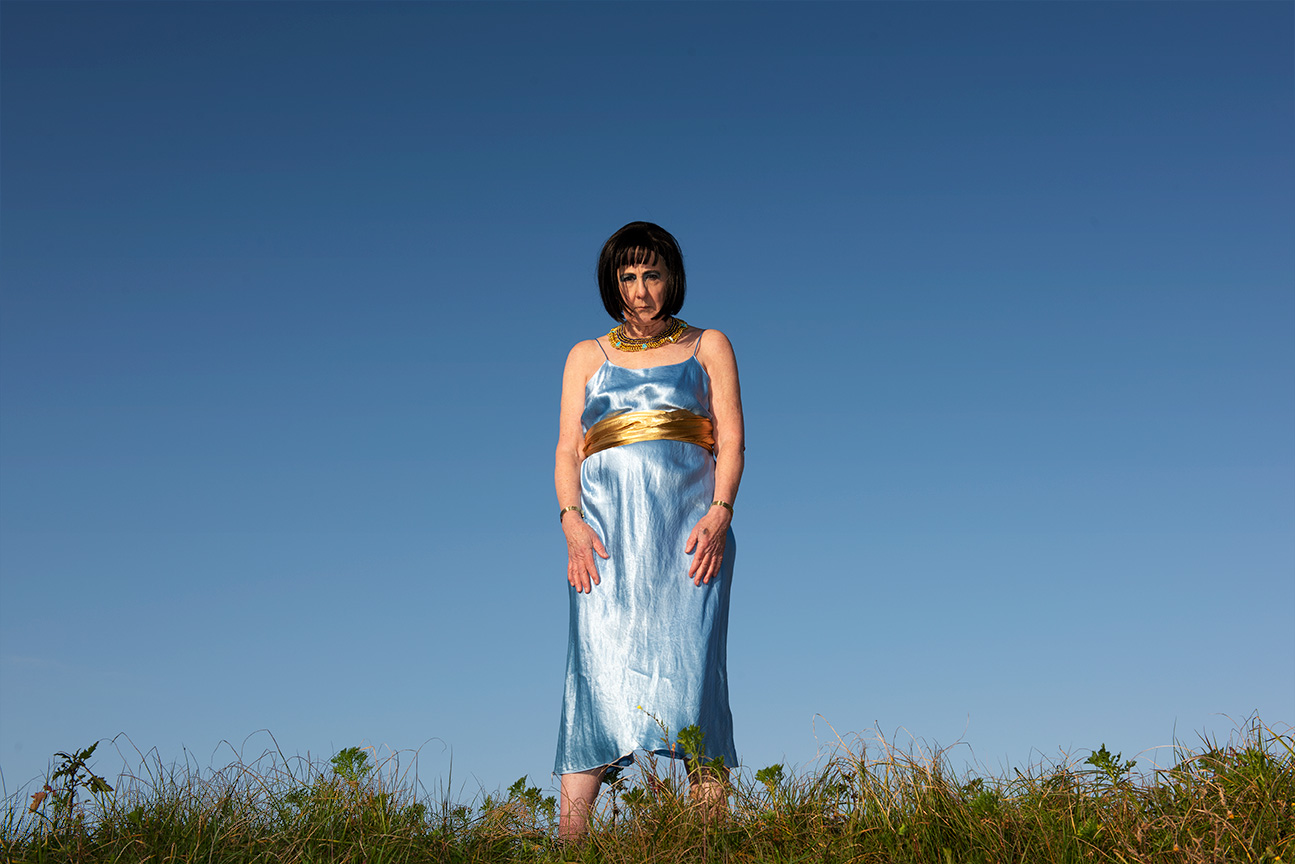
my Cleopatra (with a snake and a cigarette), Sherry Wiggins and Luís Filipe Branco, 2023

There is truthiness in the image above titled “my Cleopatra (with a snake and a cigarette).” Photographer Luís Branco and I made this image in the first few days of our time at the Cortiço Artist Residency in Montemor-o-Novo, Portugal in February this year. I like that Cleopatra is sitting with me. My Cleopatra stares out at the camera / Luís / the viewer and she (me) appears undaunted and complicit; she assents to being seen and photographed.  We hold a cigarette in one hand and a snake, entangled with our jewelry, in the other. Our boobs are obscured,  but we wouldn’t care if they were bared.
This image reveals something about my process and practice with my various heroines. These iconic and ancient women—Eve, Salome, Helen of Troy, Sappho, Cleopatra, the great goddess Isis—they enter my body and mind. Together we reimagine and reinvent our histories. We think about our accomplishments, children, lost lovers, the ghosts of our past lives. Luís Branco helps to push and pull me and them across the boundaries of time and place and captures the images in rapid fire.

I realize that I am treading on controversial territory, joining  my sixty-something-year-old-white-lady face and body with the infamous Queen Cleopatra VII (the last queen of the Ptolemaic Dynasty in ancient Egypt). Issues of racism, sexism, misogyny and nationalism are at play, as are the inherent problems with the ways her story has been told (until recently, mostly by white men). Cleopatra has been my most difficult heroine to date and I puzzle with why.

I found an essay “Disorienting Cleopatra: A Modern Trope of Identity,” by scholar Ella Shohat, that helps me think about my art practice with Cleopatra in a new way. Here is a brief but pithy excerpt from Shohat’s essay:

“Engaging with the subject of Cleopatra almost necessarily entails addressing the question of image making and visual representation. For millennia, her story of love and death, of power and sexuality, of domination and subordination, and of the imperial intercourse between Greek, Egyptian, and Roman civilization has excited the popular imagination, triggering passionate opinions about her identity. The historical and the fantastical have mutually nourished each other. The uncertainty about her looks, meanwhile, has allowed each generation to shape her image in the form of its desire. Each age, one might say, has it’s own Cleopatra, to the point that one can study the thoughts and discourses of an epoch through its Cleopatra fantasies. The ancient queen therefore constitutes more than a historical figure who can be relegated to the domain of archaeology and Egyptology; rather, she allegorizes highly charged issues having to do with sexuality, gender, race, and nation, issues that reach far beyond the geocultural space of her times.”

Right on… and for me I would add “age” to Shohat’s “issues having to do with sexuality, gender, race and nation.” So what does Cleopatra have to say to me? How does this monumental figure meld with me? And what are my Cleopatra fantasies?

my Cleopatra (blue sky), Sherry Wiggins and Luís Filipe Branco, 2023

One of my Cleopatra fantasies arrived on the hillside at Montemor-o-Novo. The sky above was brilliant blue and the earth lush green below. My Cleopatra has a 1960s cinematic glamour in these images. I am not sure if the wig works, but the “real” Cleopatra and other ancient Egyptian royalty wore wigs, as did Elizabeth Taylor in the lavish 1963 film Cleopatra. These images convey my Cleopatra’s bravery, confidence, fierceness and sensuality.

my Cleopatra (in the grass), Sherry Wiggins and Luís Filipe Branco, 2023

my Cleopatra (drama queen), Sherry Wiggins and Luís Filipe Branco, 2023

It was Luís’s idea to shoot my Cleopatra in the café in Montemor early in the morning. I call these images in the café the “my Cleopatra (morning in Montemor) series.” It was near the time of carnival in Portugal so the other clientele in the café were okay with our occupation of the space. The harsh fluorescent lighting shines on my Cleopatra. We are world-weary—we are having a coffee, a beer, a cigarette, a break. We are isolated and alone in the café, though others are present—most notably, a world-weary man whose gaze is as diffuse as ours is direct. We are well aware of our own objectification / subjectification in relationship with the camera.

my Cleopatra (morning in Montemor) series, Sherry Wiggins and Luís Filipe Branco, 2023

my Cleopatra (morning in Montemor) series, Sherry Wiggins and Luís Filipe Branco, 2023

my Cleopatra (morning in Montemor) series, Sherry Wiggins and Luís Filipe Branco, 2023

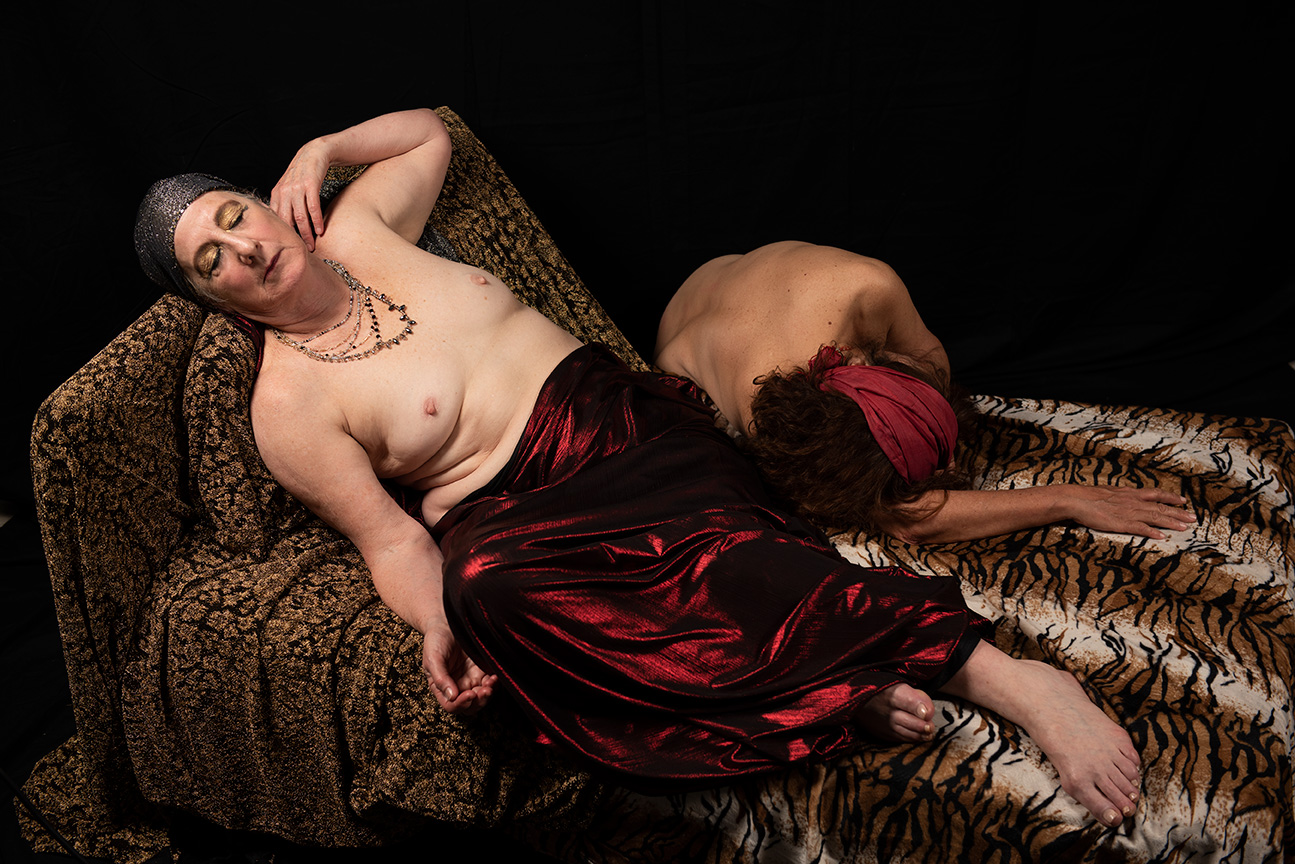
We shot the below images of my Cleopatra immersed in the landscape near the clothesline on the grounds of the Cortiço Artist Residency. I took off the wig but kept the wig “grip” on my head. These images invoke the “drag” quality of my embodiments with Cleopatra. The bad makeup, the elaborate jewelry and the golden gown contrast with the simple and mundane quality of the clothesline and the surrounding landscape. I love the fake tiger-skin blanket. Both humor and a tragic quality pervade these images of “my Cleopatra (clothesline drag-queen).” And, yes, a woman can be a drag-queen.

my Cleopatra (clothesline drag-queen) series, Sherry Wiggins and Luís Filipe Branco, 2023

my Cleopatra (clothesline drag-queen) series, Sherry Wiggins and Luís Filipe Branco, 2023

my Cleopatra (clothesline drag-queen) series, Sherry Wiggins and Luís Filipe Branco, 2023

I wanted to create another historical painting re-enactment, like the ones Luís and I have created with other heroines. We were inspired by the 1796 painting “Death of Cleopatra” by French painter Jean-Baptiste Regnault. Cleopatra’s death is a subject that has been represented in paintings, films, plays and more. Cleopatra committed suicide in August of 30 BC as the Roman general Octavian arrived in Alexandria with the goal of capturing and killing his political rival, Mark Antony, Cleopatra’s husband. Octavian sought to wrest control of the Egyptian empire from Cleopatra and Antony. There are differing stories of how Cleopatra took her own life.  Some say it was by the bite of a venomous snake, others say she took some kind of poison. I wrote a blog post about the subject of her death and how it has been represented and most likely misrepresented. Here is the link: https://sherrywigginsblog.com/2023/01/22/the-death-of-cleopatra-posted-january-22nd-2023-in-boulder-co/

The Death of Cleopatra, Jean-Baptist Regnault, 1796

Luís and I set up a photoshoot to create our own version of Cleopatra’s death inspired by the Regnault painting. I wanted to play with the overwrought orientalist drama and beauty that Regnault’s painting portrays. In the painting Cleopatra is shown with her two maidservants. We found a model, a friend of a friend, who was willing to work with us and act as Cleopatra’s maid servant. I embedded my Cleopatra’s body into this scene. Luís shot hundreds of images. In the end, we chose one image that Luís and I are both happy with. I call it “my Cleopatra (for Regnault).”  This was a new way of working for me (with a model or another subject), and I think it was quite successful.

my Cleopatra (for Regnault), Sherry Wiggins and Luís Filipe Branco, 2023

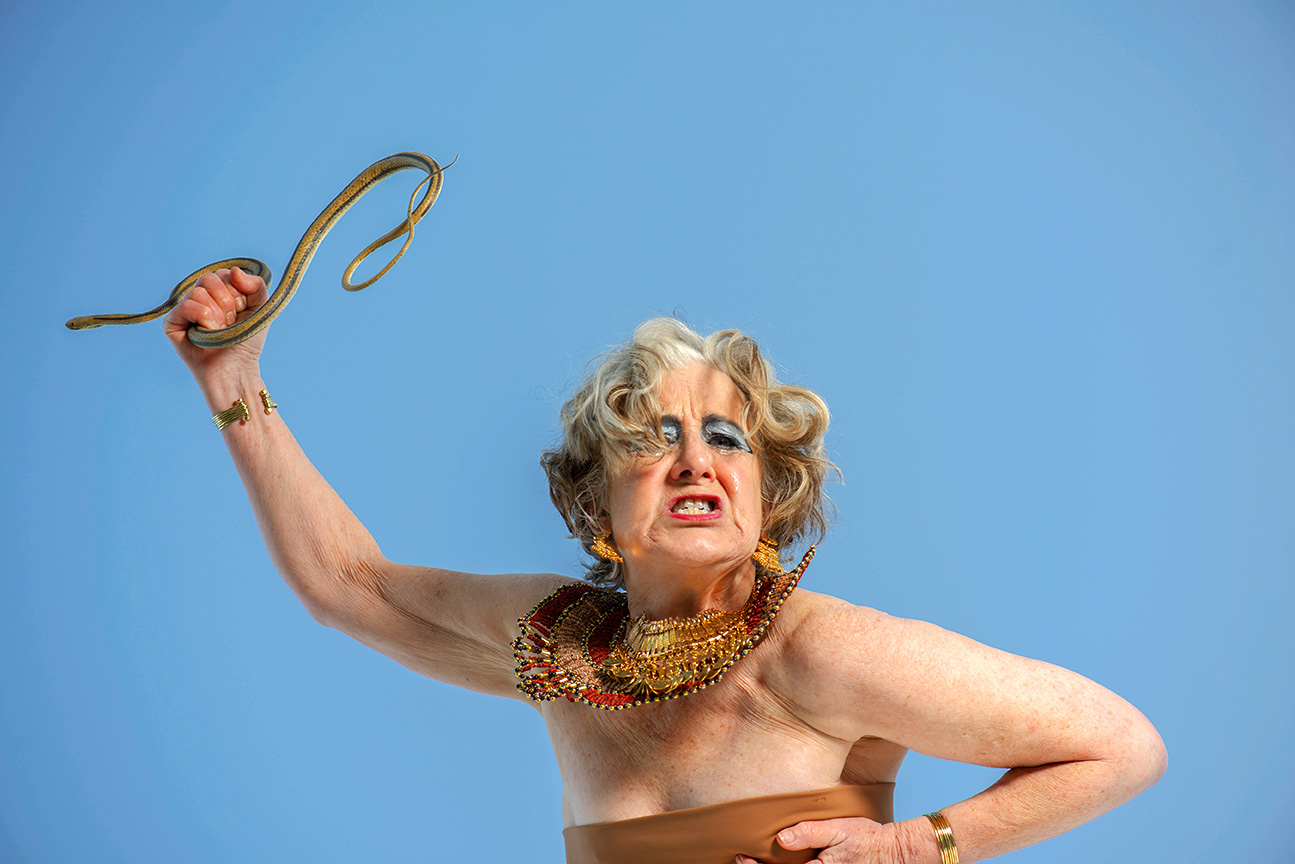
Artifice, improvisation and sometimes magic mingle in my work with Luís. This last series is the “my Cleopatra (snake wrangler) series.”  We were shooting my Cleopatra on the upper terrace of the house at Cortiço. Luís was shooting me from the ground floor below. I was wearing my over-the-top Cleopatra makeup and jewelry, and I had the snake. We were fooling around with perspective; I was hanging over the terrace wall and Luís was lying on the ground below. The perspective (and gravity and age) makes my face and skin and jewelry hang and droop and dangle. My Cleopatra appears both glamorous and grotesque, sexy and silly, strong and vulnerable. My fantasy here is that my Cleopatra has beaten the odds and has lived to a ripe old age. Of course, we are still surrounded by the danger (the snake) of being misunderstood and misrepresented.

my Cleopatra (snake wrangler) series, Sherry Wiggins and Luís Filipe Branco, 2023

my Cleopatra (snake wrangler) series, Sherry Wiggins and Luís Filipe Branco, 2023

my Cleopatra (snake wrangler) series, Sherry Wiggins and Luís Filipe Branco, 2023

Sappho – The Misunderstood – posted in Boulder, CO November 14th 2022

All images: WIP Sappho Series – Sherry Wiggins and Luis Filipe Branco, 2022

I have been editing the images I made in Holland in October with Luis Branco.

And I have been thinking about you Sappho, the feeling of you, my feelings for you, embodying you . . .

Claude Cahun led me to you— your words, your songs, the fragments. Cahun called you “Sappho The Misunderstood” in her essay on you in their 1925 “Heroines” text.

I have been contemplating the rumors, the conjecture and the fictional histories written about you. These unaccountable stories about you have been going on for more than two thousand years.

Did you love women, did you love men, did you jump off the Leucadian Cliff because the beautiful boatman Phaon jilted you? Well of course you loved women and you loved men and you went for that young Phaon. But I don’t believe for a minute that you would jump  . . .

When I was shooting with Luis in the autumn landscape in Holland your words were kind of everywhere for me.  This is fragment 168 C – translated by Anne Carson in “If Not Winter-Fragments of Sappho.”

                                    spangled is

              the earth with her crowns

But the beauty, the colors, the roses, It can get a little overly romanticized with you. I like this one (I know I am overdoing the cigarette shots):

This following song/ fragment could have been written about any of your lovers or any of mine  . . . 

Sappho # 3 – Anne Carson’s translation “If Not, Winter – Fragments of Sappho.”

] to give

] yet of the glorious

] of the beautiful and good, you

            ] of pain.            ] me

] blame

] swollen

] you take your fill. For [ my thinking

] not thus

] is arranged

] nor

all night long ] I am aware

                           ] of evildoing

                        ]

                        ] other

                        ] minds

                        ] blessed ones

                        ]

                        ]

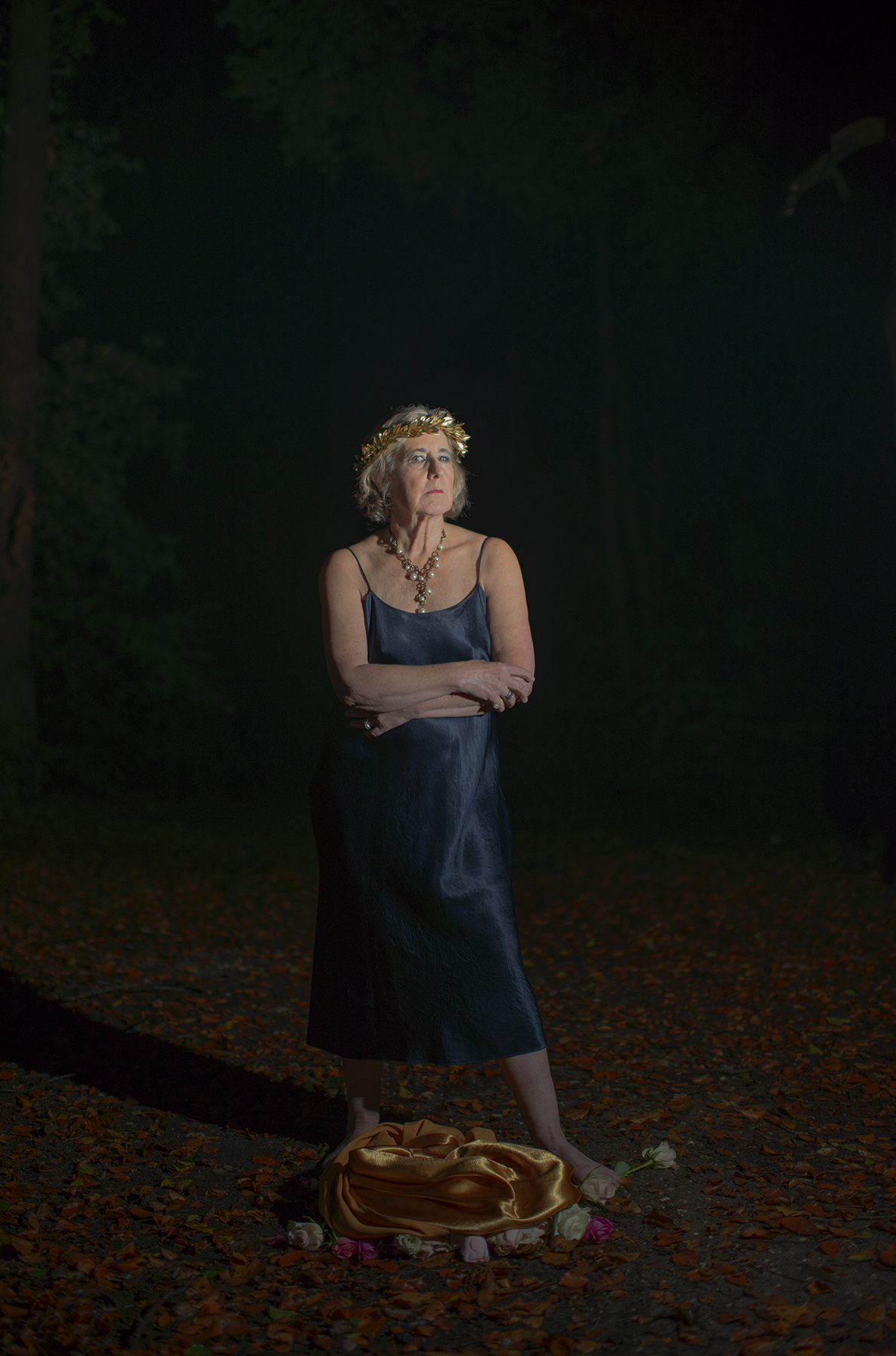
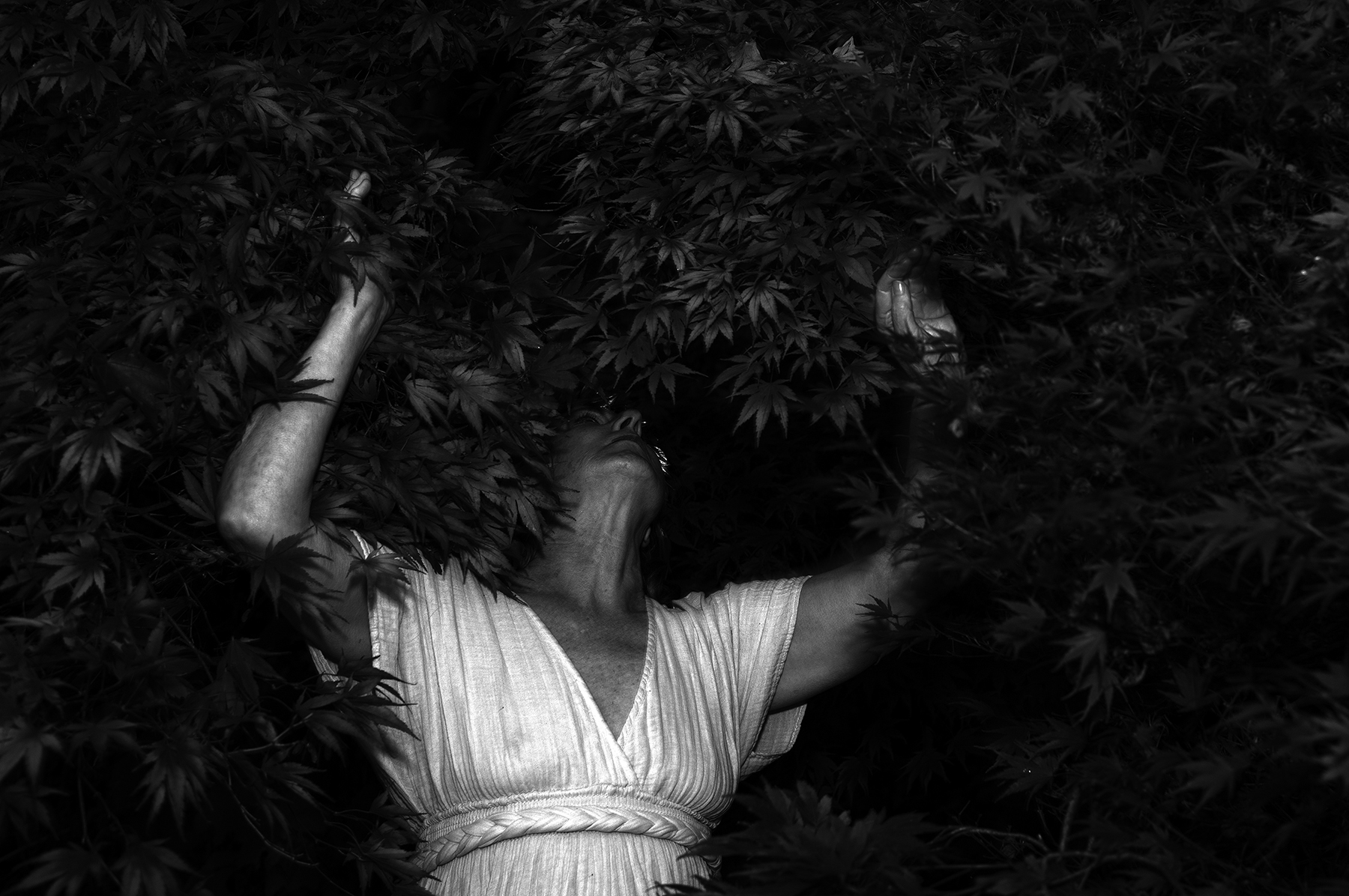
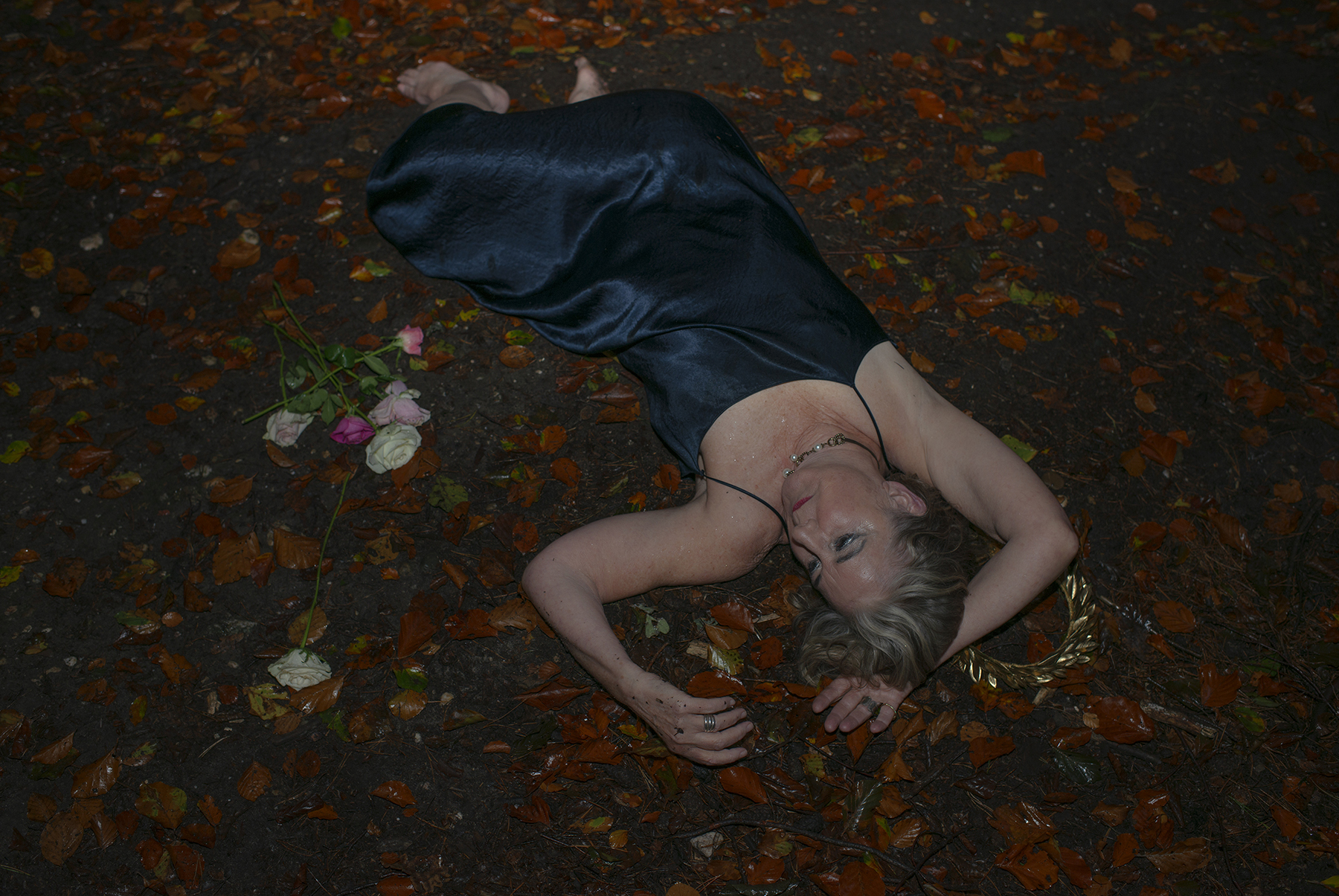
We did a series in the nighttime woods. I can’t decide between these two:

To read more about Sappho, her songs and her various histories and portrayals you can read my previous blog posts:

The Sadistic Judith? – posted in Boulder, CO November 14, 2022

All images: WIP Judith Series – Sherry Wiggins and Luis Filipe Branco, 2022

I have been editing the images I made with Luis Branco in Holland in October.

The night that Judith took the head of Holofernes began with a feast. Holofernes got very drunk.

There are many readings of Judith’s story: that Judith was doing “God’s will” to protect her people with her own hand; or that she was/ is a feminist super heroine taking revenge on the evil general Holofernes (or even for all woman against all men who have abused them); or as Claude Cahun portrayed Judith in her 1925 essay as “The Sadistic Judith.” I see all of these readings in my performance of Judith. The revenge angle or the “me too” angle is the most compelling to me.

“The Sadistic Judith”  is the 1925 essay by Claude Cahun’s in their Heroines text. Here Judith describes the fictional general Holofernes:

“ We have to believe that he despises women, and doesn’t hide it (after all, he himself says so); that he is coarse, as only a warrior can be. After he kissed his slave, he would furtively wipe his lips. He doesn’t remove his garments for fear of soiling his body more than absolutely necessary. During nights of love, his boots are stained with the crimson in which he wallows, symbolically dyed with the red poison of his victims, tracking everywhere, according to the season, the dust or mud of the roads, or worse. But as the cock crows, he has his bath, sends the girl away—and has the sheets changed (blood clotted on silk sheets).”
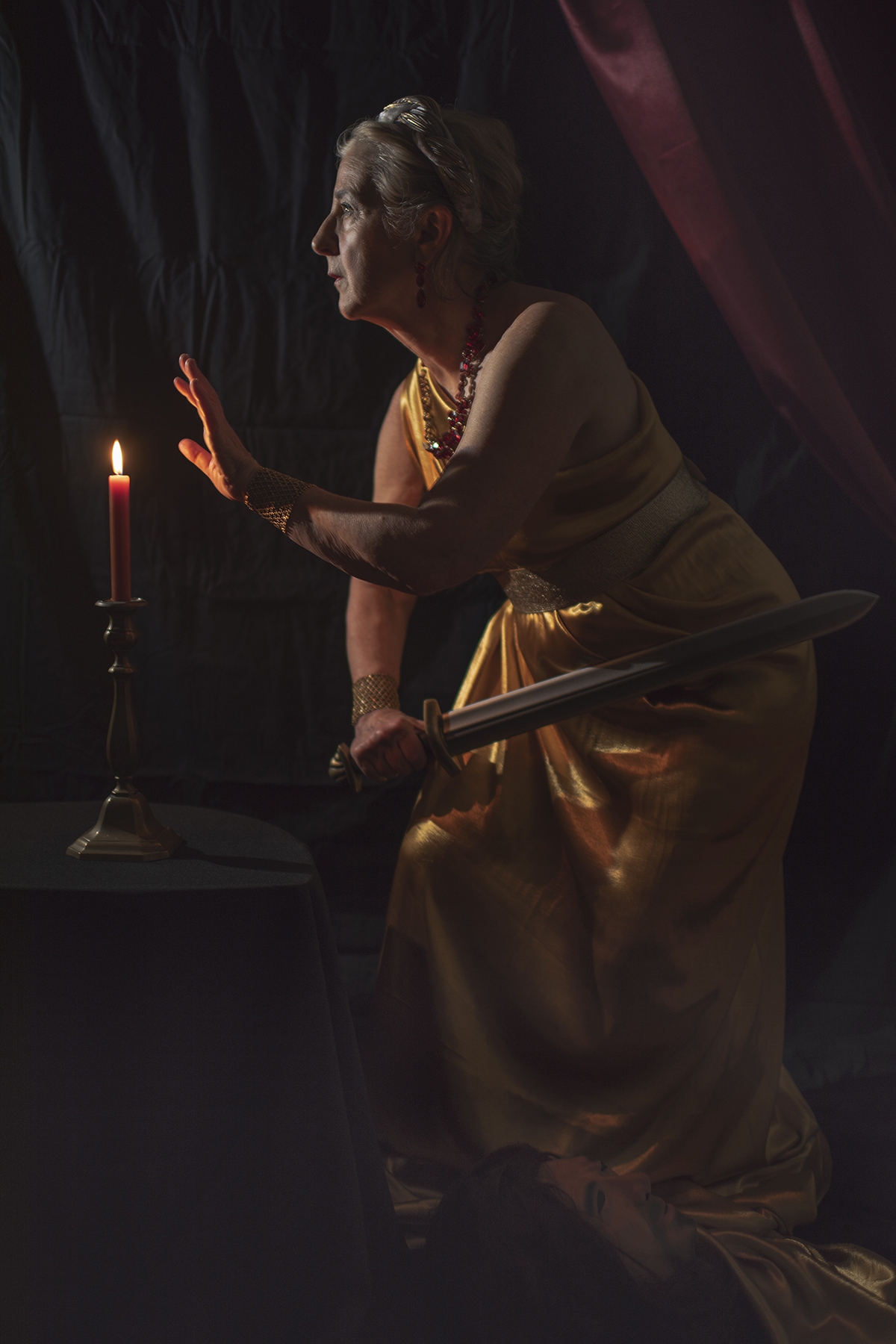
Here are a few of my representations / embodiments / drag portrayals of Judith after the slaying of Holofernes. This first one is after one of Artemisia Gentileschi’s Judith paintings.

This next one is after Jan Massys 1543 painting.

And this is after Giorgione’s 1504 painting. And the next three images show Judith’s ambivalence and horror the “morning after” after the act.

You can read my previous blog post with the stories and representations of Judith that I was thinking about before (and during) my own performances of Judith:

Looking Back – The Helen Series, posted in Boulder, Colorado July 17, 2022

WIP – The Helen Series, Sherry Wiggins and Luís Filipe Branco, 2022

“Was this the face that launched a thousand ships / and burnt the topless towers of Ilium?” Christopher Marlowe, Doctor Faustus, 1592

I have been editing the works I accomplished in April with my collaborator Luís Branco in northern Portugal. I had rented a stone house with a waterfall, a swimming pool, and a beautiful garden. My intent was to embody Helen; Beautiful Helen, Helen of Troy, Helen of Sparta—my own interpretation of this mythical woman with a contemporary 66 year-old feminist bent. I had done my research on Helen ahead of time. I had read much of the text and mythos surrounding Helen, and I had looked at how Helen has been “painted” over time.
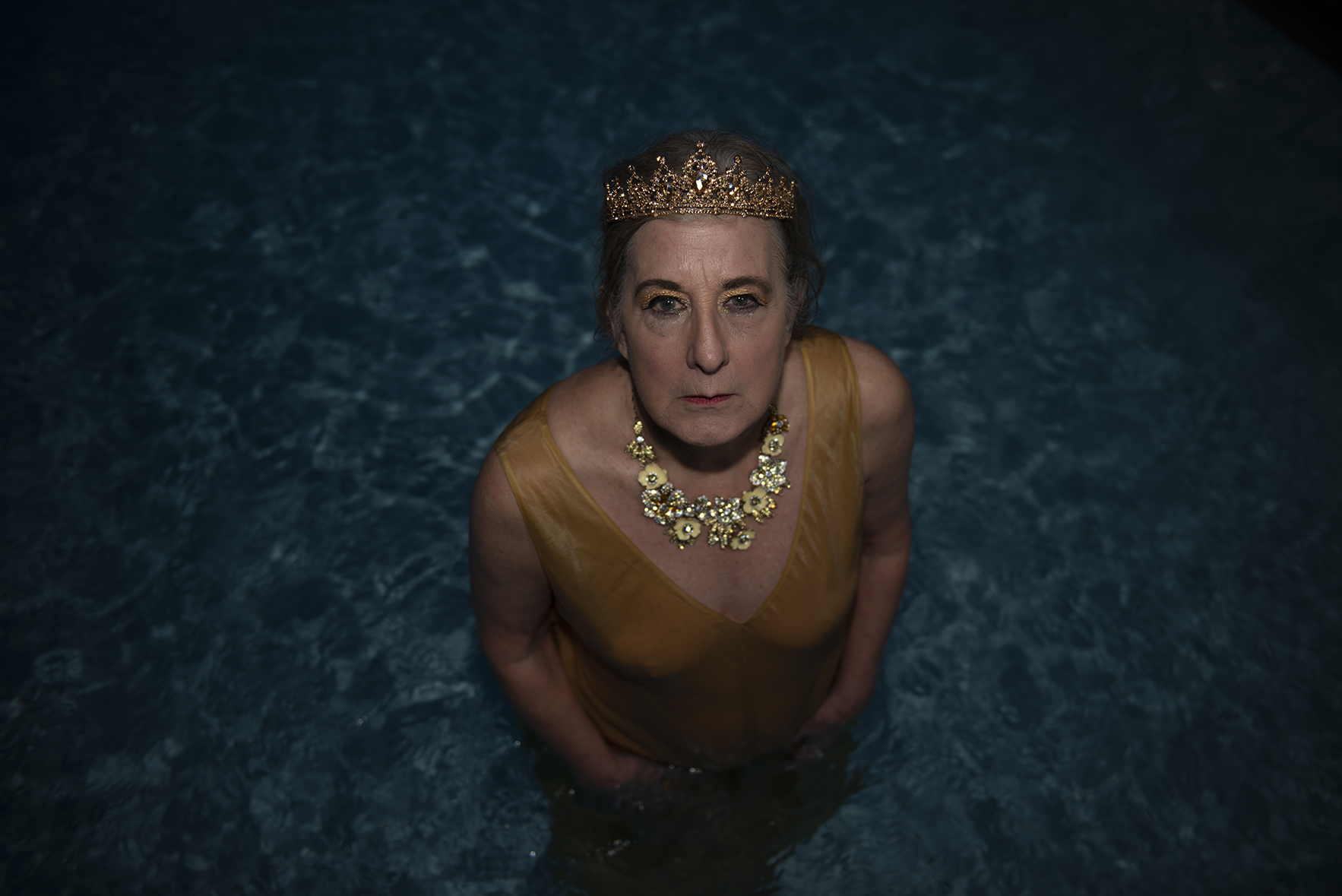
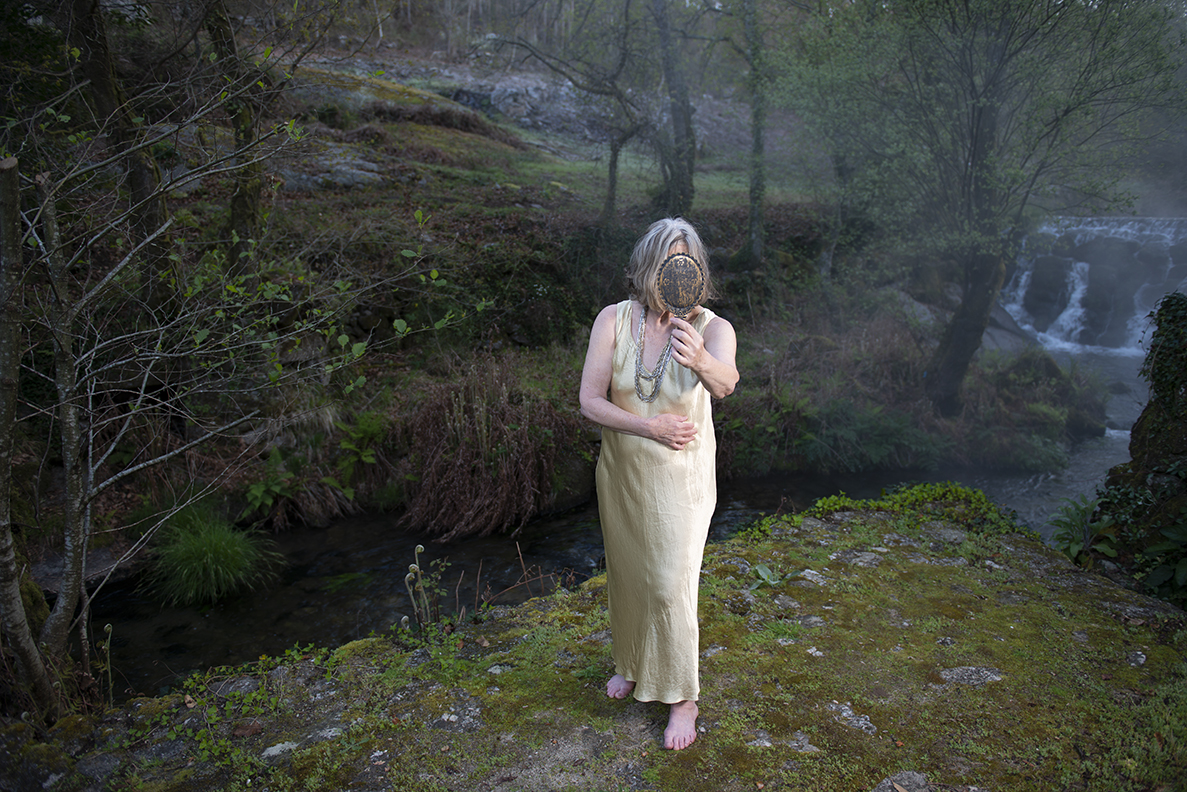
I began with this question – how would Helen look back on her fabled life and her epic reputation, as an older woman, when all was said and done?

WIP –  The Helen Series, Sherry Wiggins and Luís Filipe Branco, 2022

WIP –  The Helen Series, Sherry Wiggins and Luís Filipe Branco, 2022

Did she fall in love and lust with the sexy Trojan prince, Paris, and leave her husband King Menelaus to sail off for Troy? This would imply a certain amount of agency on her part, which I am all for. Or did Paris abduct her— initiating a violent journey and her long captivity in Troy?

The Loves of Paris and Helen, c. 1788, Jacques-Louis David

As either a ravishing seductress or a gorgeous victim, Helen has been blamed for the devastation and destruction of the Trojan War. Euripides, in his play titled Helen, portrays her as both a phantom temptress and a loyal wife. According to him (and others too) the Helen who stayed in Troy during those ten long years of the Trojan War was an eidolon / a ghost. And, while the ghost or the phantom of Helen was in Troy wed to Paris, the “real” Helen was waylaid in Egypt and remained a steadfast wife to Menelaus.

Helen at the Scaean Gate, c. 1888, Gustave Moreau

I love this Gustave Moreau image above of Helen at the main gate of Troy. Of all the Helens in all the stories, I relate most to this eidolon Helen, this doppelganger of Helen and these images below were inspired by her and by Moreau’s painting . . .

WIP –  The Helen Series, Sherry Wiggins and Luís Filipe Branco, 2022

WIP –  The Helen Series, Sherry Wiggins and Luís Filipe Branco, 2022

Then there are the “recovery” stories of Helen (whether she is the real Helen or the ghost of Helen) from the burning ruins of Troy by Menelaus. Euripides describes this reclaiming of Helen in the aftermath of the war in the play titled Andromache. Lord Peleus insults Menelaus thus:

“When you took Troy you failed to put your wife to death, though you had her in your power—on the contrary, when you looked at her breast, you threw away your sword and accepted her kiss, caressing the traitorous bitch, you miserable wretch, born slave to lust.”

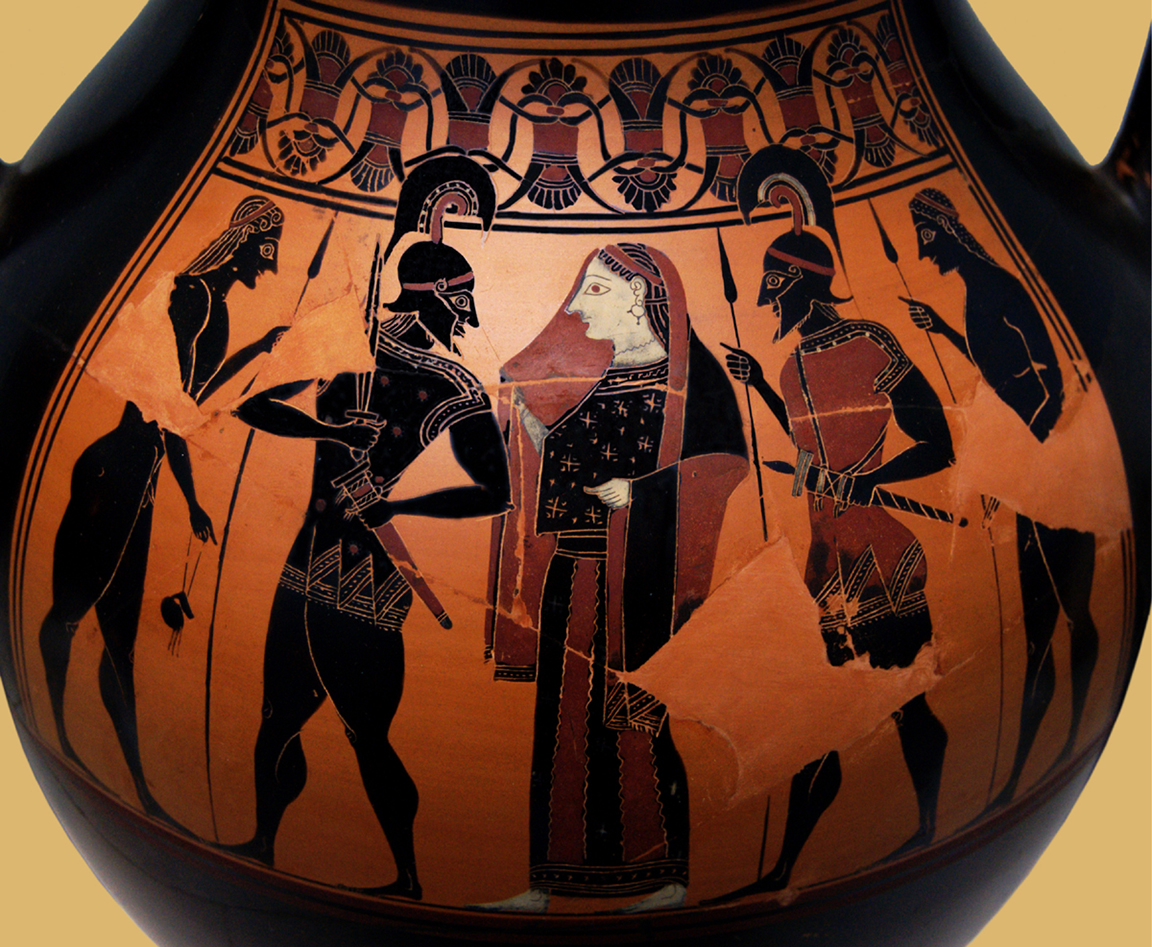
Attic black-figure amphora, ca. 550 BC. by the Amasis Painter depicting the Recovery of Helen by Menelaus. Now in the Staatliche Antikensammlungen

The beautiful amphora above displays one of the earliest figurative depictions of Helen of Troy as she is being led back to the ship with Menelaus after the Greeks conquer Troy.

Helena and Menelaos, Johann Heinrich Wilhelm Tischbein, 1816.

The “recovery” story is reenacted in Dutch painter Johann Tischbein’s painting above. Notice the dropped sword of Menelaus and Helen’s lightly draped and beautiful breasts. Menelaus intended to slay her for her infidelity but was so struck by her beauty (and her boobs) that he took her back to Sparta.

In any case, Helen does survive the Trojan war and, according to Homer in the Iliad, she returns to Sparta to live a harmonious life with Menelaus. I find this story line hard to believe. In another account by Euripides Helen is flown to Olympus by the gods after the war to live out her life as an immortal. This must have been the story line for Gustave Moreau’s Helen Glorified below.

Helen Glorified, c. 1896, Gustave Moreau

Whether Helen is portrayed as a shameless queen, a brilliant specter or a virtuous wife—she has been constituted and reconstituted as a figment of patriarchal perception throughout millennia. If I were Helen (or her doppelganger) after all these journeys, wars, husbands – I would be exhausted . . . and want to live out the remainder of my life in a quiet fashion alone by the pool in Sparta (or wherever).

WIP –  The Helen Series, Sherry Wiggins and Luís Filipe Branco, 2022

The image below is perhaps my favorite of The Helen Series.

WIP –  The Helen Series, Sherry Wiggins and Luís Filipe Branco, 2022