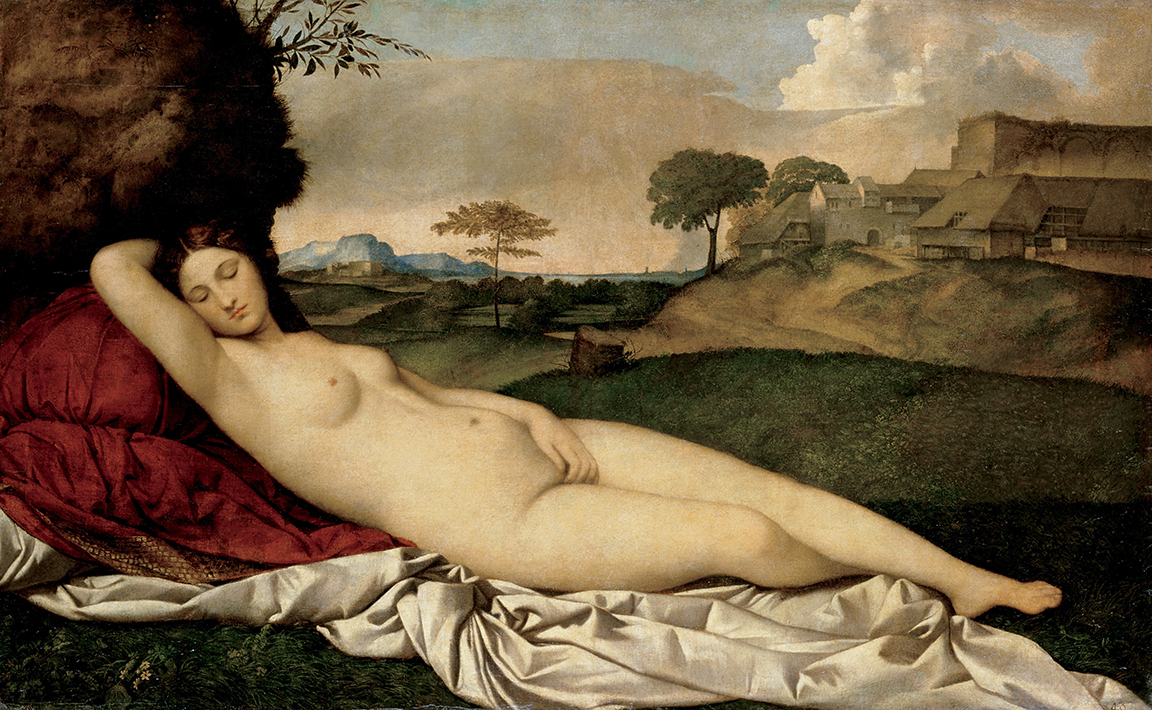
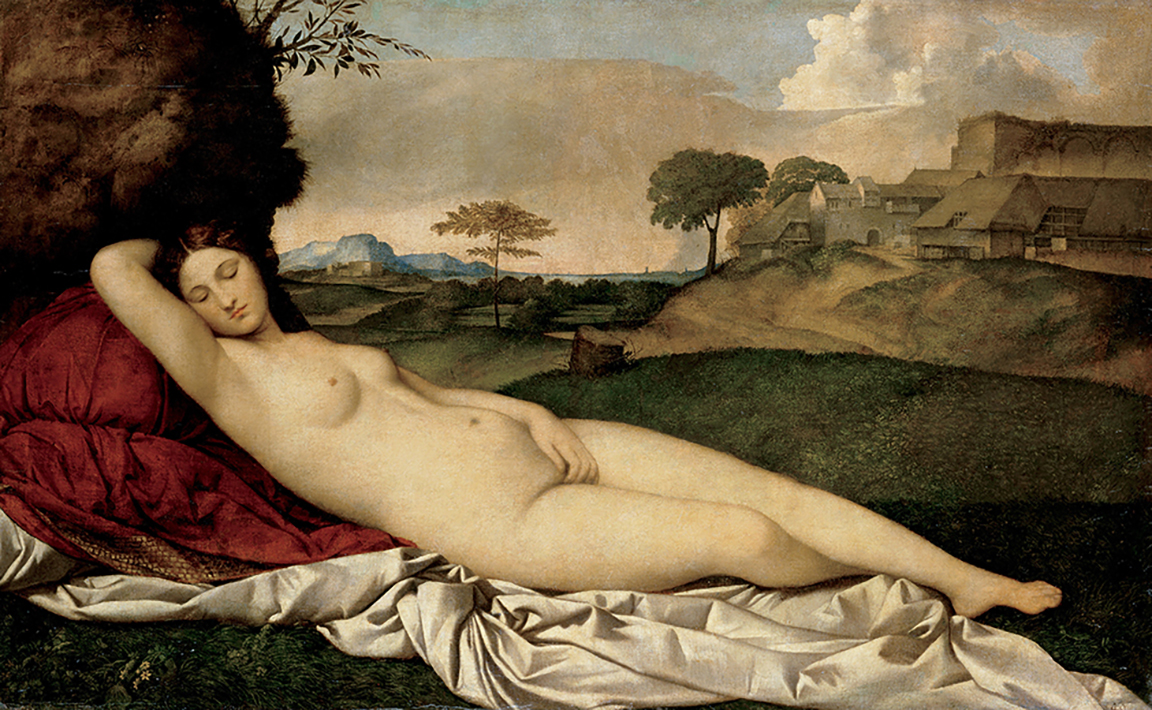
Sleeping Venus, presumably started by Giorgione and finished by Titian, c. 1510, Gemäldegalerie Alte Meister, Dresden, Germany.
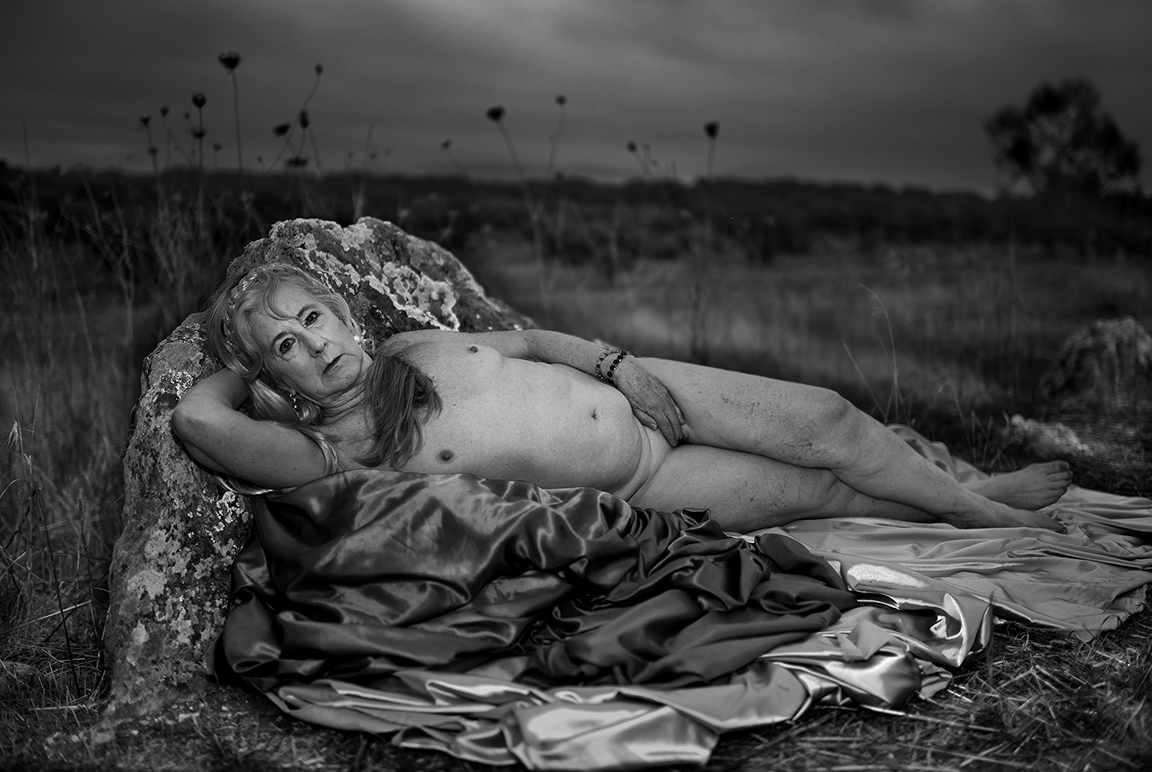
let’s shoot by the small rock
horizontal landscape womanscape
last light first light works better
Giorgione or was it Titian? What were you thinking?
red satin resting, arm akimbo
eyes closed eyes open
naked, nude except the wig
cover crotch with hand
is she playing, sleeping?
focused, the relationship understood
Aphrodite / Venus series, Sherry Wiggins and Luís Branco, 2024.
Aphrodite / Venus series, Sherry Wiggins and Luís Branco, 2024.
my angels / my goddesses arrive
the studio prepared, black cloth
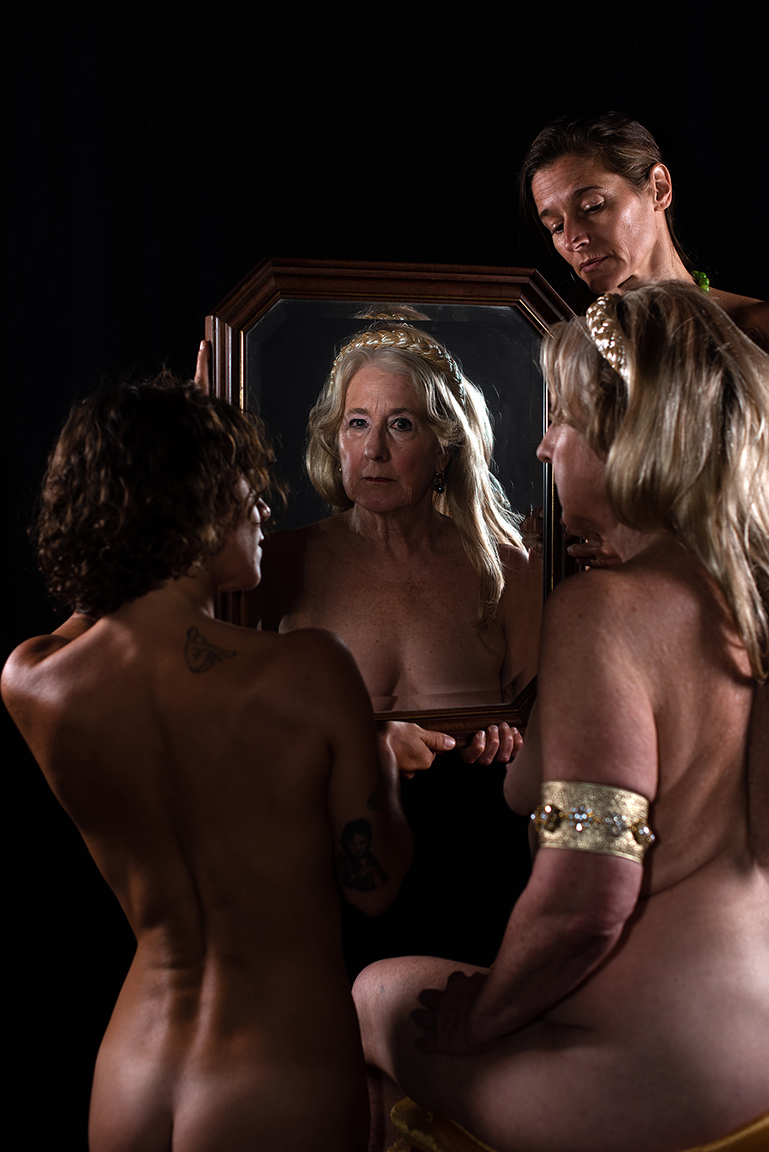
the mirror, always the mirror
a blond but really silver
no butt crack
except for Eros / Cupid / Marta
the slim curves of their buttocks
my broad curving backside
blond Venus in the mirror
or is it Aphrodite?
why do they call her Venus?
Venus is also Ishtar’s star
this image is important to me
he shoots over and over
changing the lights, the lens, his distance
I look in the mirror back at him, the lens
Aphrodite / Venus series, Sherry Wiggins and Luís Branco, 2024.
Aphrodite / Venus series, Sherry Wiggins and Luís Branco, 2024.
it’s raining
we move to the casa
coffee, wine, special cheese
we try shooting in the small bedroom
Aphrodite rising attended by the Horae,
it doesn’t really work
we end up together in the bed
enveloped by my goddesses
in the morning we return to the rock
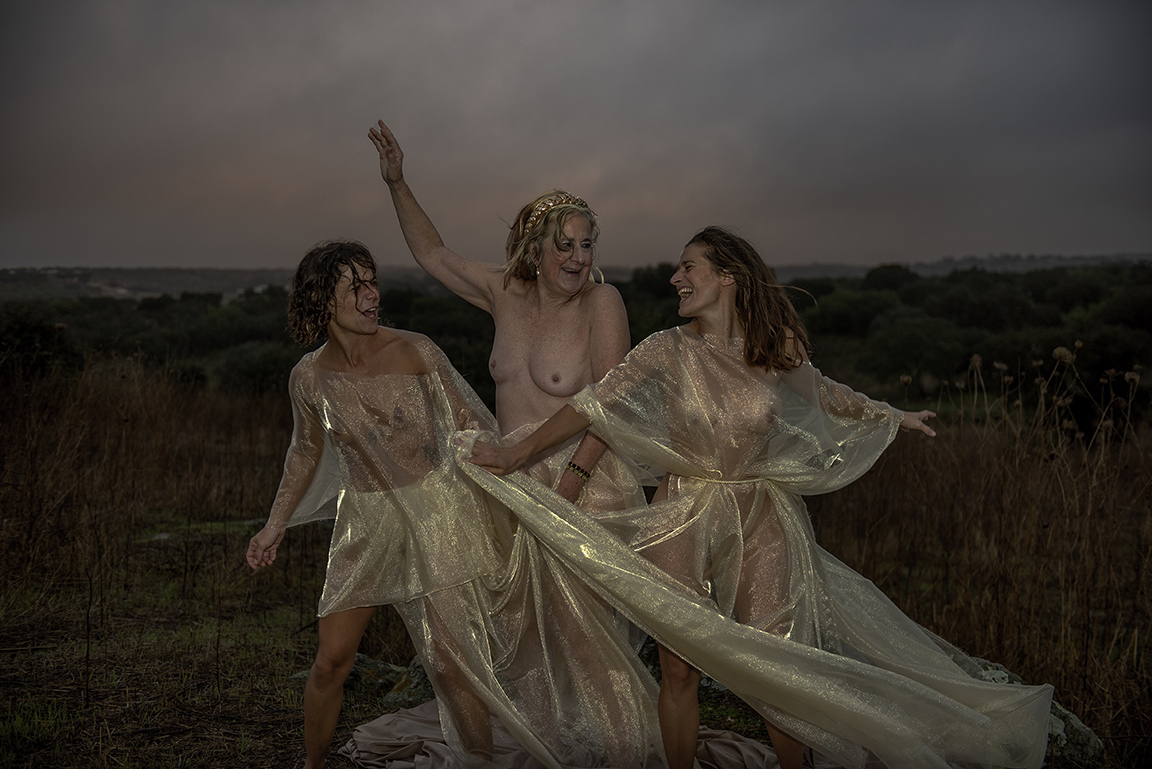
we dance, sing, smoke cigarettes
he keeps shooting
maybe some good ones
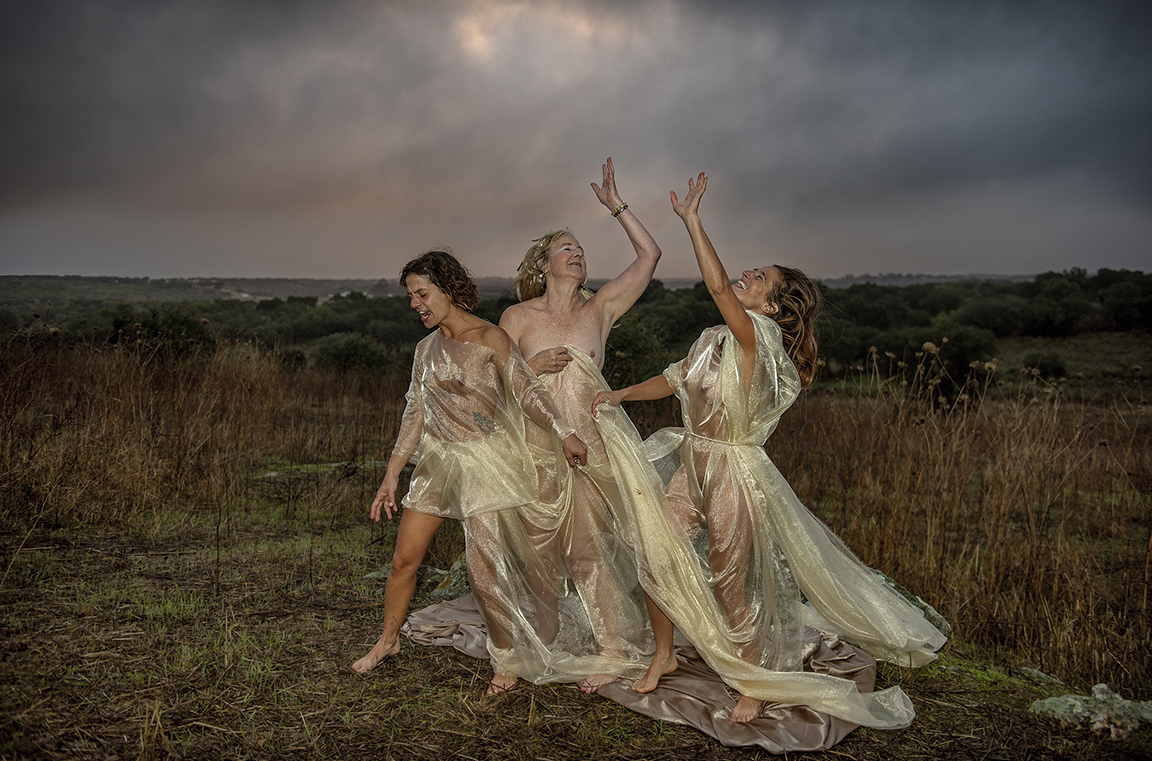
the three goddesses
Aphrodite / Venus series, Sherry Wiggins and Luís Branco, 2024.
Aphrodite / Venus series, Sherry Wiggins and Luís Branco, 2024.
sun comes up, last shots
more coffee
my Horae / Angels / Goddesses depart
keep to the schedule
time for my other goddess Inanna / Ishtar
golden horns, the two lions, lapis necklace
Inanna / Ishtar series, Sherry Wiggins and Luís Branco, 2024.
early morning at Evoramonte
moon almost full
settling down
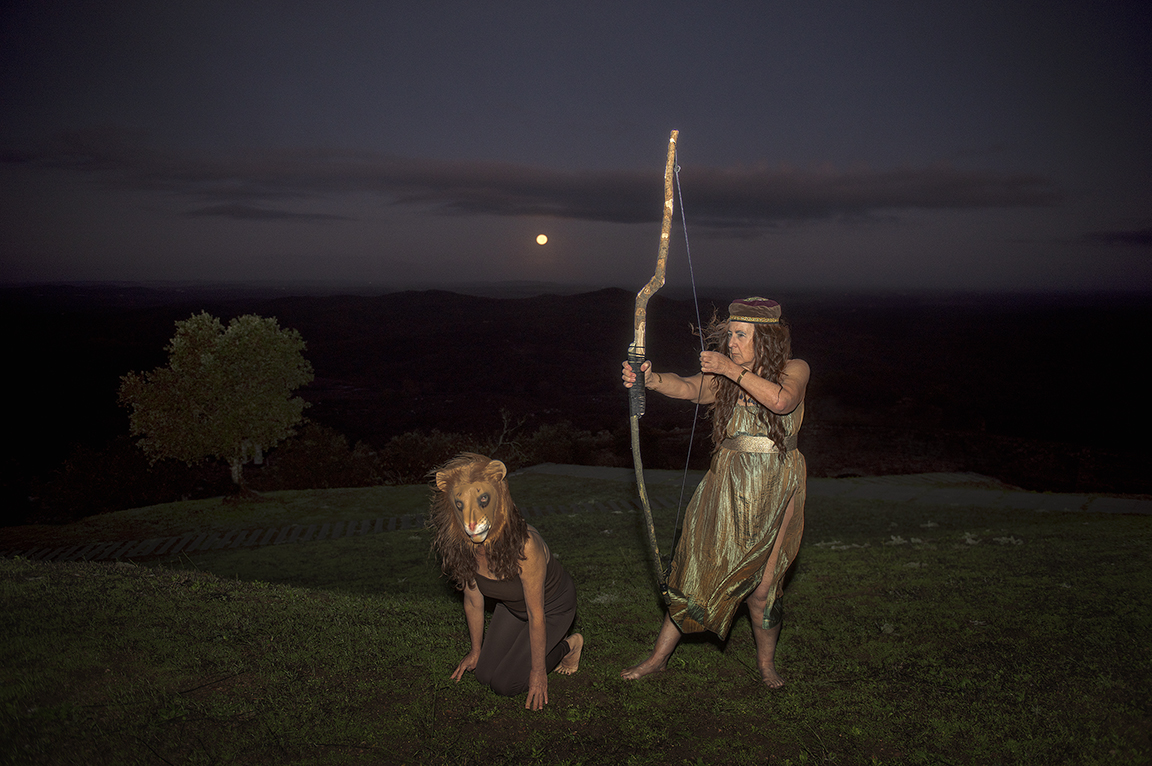
my lioness supports me
it’s fucking windy cold
Inanna / Ishtar series, Sherry Wiggins and Luís Branco, 2024.
dawn arrives
a rainbow vista from the top of the mountain
my lioness near
I / Inanna / Ishtar stand strong
Inanna / Ishtar series, Sherry Wiggins and Luís Branco, 2024.
last night
in the studio
Ishtar with our golden girdle
Angels of Light on repeat
I hold my breasts
full frontal don’t move
I am the goddess
the lights the lens
a meditation…
Inanna / Ishtar series, Sherry Wiggins and Luís Branco, 2024.
Inanna / Ishtar series, Sherry Wiggins and Luís Branco, 2024.
I wrote the text above, “Slide Show Side Show,” after returning from the OBRAS Artist Residency in Portugal in late October. The text describes a bit of the process (which can be both improvisational and painstaking) that Luís Branco and I go through during our photoshoots–this last time with my heroines Aphrodite / Venus and Inanna / Ishtar. Marta Leon and Marta Carocinho stood by as Aphrodite / Venus’ Horae (goddesses of the seasons and of time). Wilma Geldof and Jacinta Ganso assisted as Inanna / Ishtar’s lionesses. After returning from Portugal, I let the work “rest” for several weeks. During the last part of November and early December I went through the editing process (with Luís’ help). I looked through the hundreds of images we shot to select the images we want to produce. Ron Landucci has done the final corrections to the images and is currently printing the proofs. I am very happy with this last body of work and I am now preparing to embody Claude Cahun in February at the La Napoule Art Foundation in France with Luís.
The Birth of Venus, Alexandre Cabanel, 1863, Musée d’Orsay, Paris, France.
The 19th century painting above of the birth of Venus by Cabanel in the Musée d’Orsay is monumental, 7 1/2 feet wide. I have not reincarnated this painting (yet). I know it is sexist but still fabulous. I am moving all around in time and geography from ancient Sumer and Babylonia (with the goddesses Inanna and Ishtar) to ancient Greece and the island of Cyprus, sometime around 1000 to 800 BCE, when the Greek goddess Aphrodite rose out of the Mediterranean as a fully formed and most beautiful goddess. Aphrodite, the goddess of beauty, love (ALL LOVE), passion, pleasure (and much more …), has been a favorite goddess of mine for years. She is a primal goddess. I choose the story of her birth out of the sea as portrayed in Hesiod’s Theogony (written 8th – 7th century BCE), and I have written about it on my blog. Here is an excerpt:
“This is quite the elemental image and idea—beautiful Aphrodite emerges fully formed, born of Ouranus’s castrated giant genitals. The ‘foam’ from which Aphrodite arises is the semen of her father, Ouranus the god of the Sky. Her half-brother Chronos is the perpetrator of this heinous deed, castrating his own father at the bequest of his Mother Earth (Gaia). Aphrodite is gestated in this matrix / fluid of her father’s testes. She arises from the sea foam / seminal fluid with her two companions: Eros, the primordial god of Love and Sex, and Himeros, god of uncontrollable and ravishing Desire. One of Aphrodite’s Greek names is Philommedes which means both ‘genital loving’ and ‘smile loving.’”
So-called “Ludovisi Throne,” Thasian marble, Greek artwork, ca. 460 BC (authenticity disputed). Museo Nationale Romano of Palazzo Altemps, Rome.
The ancient sculpture above (perhaps) presents Aphrodite rising from the sea, this time assisted by the Horae, goddesses of time and the seasons who are said to have been the first to dress and adorn Aphrodite.
My goddesses met Luís and me at OBRAS a few weeks ago to assist us. Here are two of our early-morning shots. We danced, sang and smoked cigarettes, the fun goddesses.
Works in Progress – Aphrodite and the Horae series, color digital images, Sherry Wiggins and Luís Branco, October 2024.
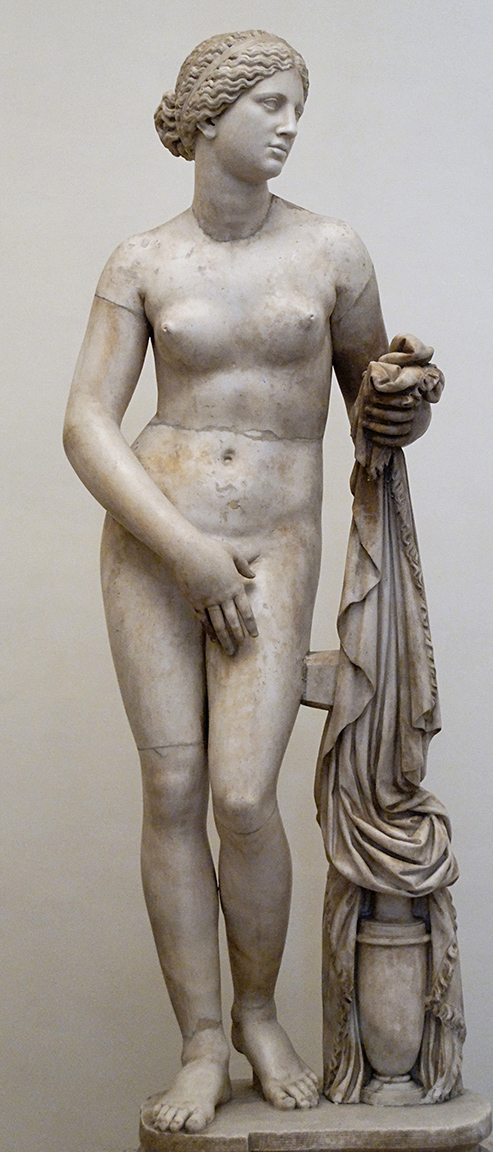
Cnidus Aphrodite, Roman copy after a Greek original of the 4th century BCE, marble. Original elements: torso and thighs; restored elements: head, arms, legs and support (drapery and jug). Museo Nazionale Romano di Palazzo Altemps, Rome.
While the Horae were the first to dress Aphrodite, the famed Greek sculptor Praxiteles (ca. 300 BCE) was the first to (almost) fully undress her. The Cnidus Aphrodite, also known as the Aphrodite of Knidos, above is one of the many Roman copies of the original statue made by Praxiteles around 350 BCE. Praxiteles’s sculpture of Aphrodite was the first fully nude Greek sculpture of a woman (or a goddess). Greek artists had been making nude sculptures of men for centuries before. This Aphrodite is monumental—more than six feet tall—and it was reproduced and copied for many centuries all over the Mediterranean and beyond in different sizes and shapes. Copies of this statue and its kin are displayed in museums and collections all over the world. This sculpture also marks the invention of the Venus Pudica gesture, where the figure covers her pubic area with her hand (apparently a gesture of modesty). This gesture has appeared throughout time in paintings and sculptures. Does it suggest modesty? Or is it an alluring gesture, a sign of welcome? This representation diverges markedly from the representations of our proud Mesopotamian goddesses of love and sexuality (and much more …) Inanna and Ishtar.
“Men say that there are two unrepresentable things: death and the feminine sex.” (Hélène Cixous, 1978: 255)
“‘Alas! alas! Where did Praxiteles see me naked?’, Aphrodite is said to have exclaimed upon seeing her own image in Knidos. In antiquity just as today Praxiteles’ Knidian Aphrodite was celebrated as the first realistic depiction of the nude female body. It was this particular Aphrodite statue that first presented to us the ‘Classical female beauty’ or the aesthetically ideal form of the female body. Indeed, the image of nude Aphrodite has become equated with high art, and seen as a sign for aesthetics not only for ancient Greece but also for the rest of Western art and culture. This archetype of femininity has become so ingrained in Western aesthetics that it has been placed in the position of a paradigm against which images from earlier and later periods and cultures are evaluated with regard to the degree that they approach, resemble, or fail to follow this ideal.”
(From Women of Babylon: Gender and Representation in Mesopotamia by Zainab Bahrani,from the chapter “That Obscure Object of Desire: Nudity, fetishism, and the female body,” pg. 70)
Jumping forward to the Renaissance, the many paintings and representations of Aphrodite and Venus were influenced by Greek and Roman ideals and representations of the goddess and of the female nude. It was a Western European sexist racist fad that has lasted about 600 years and counting.
Sleeping Venus, perhaps begun by Giorgione and finished by Titian, ca. 1510. Gemäldegalerie Alte Meister, Dresden, Germany.
The “Sleeping Venus” is believed to have been started by Giorgione at the end of his life and completed by Titian. The landscape is very Titianesque. This was apparently the first reclining nude of the Renaissance, and it launched the genre of the semi-erotic mythological pastoral. Venus is apparently unaware of our gaze. Again, is she modestly covering herself, or is she stroking herself??
Works in Progress – Venus series, color digital images, Sherry Wiggins and Luís Branco, October 2024.
Luís and I made a series of images of Venus in the landscape at OBRAS-Portugal a few weeks ago, with the reclining nude (and the rock!). I haven’t chosen final versions (of any of our recent images). I like the crouching Venus above or maybe she’s a cougar Venus.
Venus in Front of the Mirror, Peter Paul Rubens, 1614-1615. Liechtenstein. The Princely Collection.
The Rubens painting above, “Venus in Front of the Mirror,” portrays a seventeenth-century Western European sensibility surrounding sex, gender, race and power. The very blond and white Venus is flanked by a black female servant, who tends her golden tresses, and Cupid, who holds up her mirror. The goddess of love and sexuality looks outward from the mirror, very much aware of the viewers who gaze upon her. Her power rests in her recognition of her own beauty and sexuality and the effect of both upon the viewer.
I both love and question Rubens’s “Venus in Front of the Mirror,” as it relates to the HEROINES project and my work in general. For months before leaving for Portugal, I had envisioned myself embodying this same Venus in a performative photograph. I bought a blond wig, and I arranged to have my friends / models / goddesses from the Cortiço Artist Residency come work with Luís and me at OBRAS to create this image. When I first arrived at OBRAS several weeks ago, I ventured to the Saturday market in Estremoz and found an almost-perfect antique mirror. I imagined myself looking out of the mirror of Venus, my late-sixty-something-year-old body (and face) exposed. In so doing, I am reflecting upon the ways in which women’s sexuality has been represented (and misrepresented) over time and how my own sexuality and body consciousness are expressed. Making this image was and is empowering. It’s also a little scary to expose myself in all these nude images. My friends and models, Marta and Marta, my beautiful (younger) goddesses, support me in my vulnerability. This is both a technical image and a poetic image. Luís did a beautiful job with the lighting and the composition.
WIP – Venus in Front of the Mirror, color digital image, Sherry Wiggins and Luís Branco, October 2024.
I am back at home now and posting this after the election. I have been writing and thinking about these goddesses and female power and our bodies and ALL of our rights that are now in great peril. F__K THE PATRIARCHY. We must mobilize, be warriors for the rights of ALL people.
This conversation with curator and writer Cydney Payton took place in relationship to the exhibit On Sappho, Helen and Aphrodite, an exhibition of performative photographs I produced in collaboration with photographer Luís Filipe Branco. The exhibit will be on view at Michael Warren Contemporary in Denver, Colorado October 31st to December 2nd 2023. The opening reception is November 2nd from 5 to 8pm and an artist talk will take place November 18th from 10:30 to noon.
CP: Congratulations on your show, On Sappho, Helen and Aphrodite, at Michael Warren Contemporary.
SW: Thank you. I’m excited to talk with you about it!
CP: To frame our conversation, you have been engaging with other artists’ images and practices as a modality of self-exploration for more than a decade. You referred to your practice as performative but also as embodying and enacting.
SW: I am compelled to study the lives and work of women. In doing so, I have found a kind of courage and sense of self-power. That has led me to create an artistic practice that is more performance based.
The women I study become the subjects of various projects and bodies of work. The photographs document my artistic process and the practice itself; the photographs are also the intended result. While I am performing, I envision the poses to be a photographic work. Yes, enactment and embodiment—the terms you mention—are definitely the terms that describe this work.
The beauty of performative art for me has been that my body can exist in different environments. Somehow those environments—sites, places, atmospheres—come to represent the women I am thinking about and making work about. That process is empathic, yet it exists because I have excavated and studied their lives and work. Until recently, most of those women were artists. Now, I am working with a broader representation of historical and feminine voices in creating the Heroines Project.
CP: You are very process driven in your artistic practice. You make a lot of images.
SW: The work is created through in-depth research, editing, and post-production of thousands of images. Each image goes through the processes of the performative act, lens and shutter, preproduction on a digital screen/film, printing, and, finally, exhibited object.
But in the end, I am forever an installation artist. Thus, the final narrative of an exhibition arrives because I care about the spatial dynamics between the audience and the art. An exhibition offers a liminal plane where the viewer and the object—the concept and the artist—participate. In the case of On Sappho, Helen and Aphrodite, I hope to create a way of confronting volumes of history largely written by men.
Sappho’s Crown, 22 x 33,” 2022
CP: The exhibition insists upon directness of viewership. We cannot look away. We are obligated to make comparisons, historical and contemporary, among these three iconic representations of the feminine. Sappho is the first heroine you bring into view. Her words, from the few remaining papyrus fragments, are sprinkled throughout the installation in excerpts taken from translations by Diane Raynor and poet Anne Carson. These traces of Sappho, which have survived over centuries, to be investigated, translated, and (re)interpreted, anchor the show.
SW: I investigate women, both fictional and real, such as Sappho. She was a real person; we know that because we have her words. Helen and Aphrodite are mythical and archetypal figures, but for me Sappho has an artist’s voice. As I delved into the translations of her texts, which were originally songs meant to be performed and sung and accompanied by dancers and instrumentation, I found her to be so modern. And her subjectivity feminist and feminine. She is speaking from 2,800 years ago, and, even so, the work resonates with me as being in the present moment.
In Poem #58, which is also called “The Old Age Poem,” Sappho speaks to me as an artist very directly, as she speaks about herself at an older age. In truth, I am inserting myself into the lives and stories of these heroines from my position as a sixty-something-year-old woman.
CP: Even though your photographs present a type of romanticism in tone and composition, there is a feminist message about love in the work that pervades the exhibition.
SW: Love means many things. Gender might be implicit, but it is also fluid. Though Aphrodite was not seen as a supporter of lesbianism in the ancient Greek world, maybe because it’s mostly stuff written by men, she should be seen as totally supportive of all forms of love (and sexuality, too). I love this line that Aphrodite speaks to Sappho: “Who, O Sappho, is wronging you? For if she flees, soon she will pursue. If she refuses gifts, rather will she give them. If she does not love, soon she will love, even unwillingly.”
CP: Beautiful.
SW: There is this complexity of love, the giving and receiving, the joy and the loss, in the poem. I just love this advice from Aphrodite. And Sappho loves Aphrodite—she’s her main goddess, and she speaks with her a lot.
Aphrodite with Roses I, 30 x 20,” 2022
CP: The photographs also contain an abundance of symbolism, for example roses in the images of Aphrodite. For Aphrodite, you looked to the Pre-Raphaelite painting Venus Verticordia by Dante Gabriel Rossetti. The painting is of a beautiful young woman with an apple and a dart. In your diptych, Aphrodite with Roses, you present us with an apple and a bouquet of red roses against a figure on a proverbial bed of roses.
Venus Verticordia, 32 x 26,” Dante Gabriel Rossetti, 1864
SW: I was riffing on Venus Verticordia. I don’t expect the viewer to make that connection, but roses do serve as a backdrop in both the painting and in the diptych. The roses are brought forward to perhaps deliver other meanings. Both Venus and Aphrodite are usually represented as beautiful and sometimes sexy young maidens. Rossetti’s painting sort of morphed into the work in the moments when photographer Luís Branco and I were making these pictures. I had an idea of where I wanted to go. We set up the photo shoot toward that idea. Even so, every photograph has its own performative life, such as it did with creating Aphrodite. The image is obviously me, an older woman, and you see all the wrinkles on my neck and face.
Aphrodite with Roses II, 30 x 20,” 2022
CP: Your decolletage.
SW: My decolletage. And my breast is exposed, as Venus’s is in the painting. The work is compressed and cropped, cut off, and presented larger-than-life size. The face and the boob and the arms, the roses, everything operates against a natural sense of scale.
CP: Rossetti’s version was also the first time that he painted a nude figure. He, too, compressed and zoomed in to create an artificial reality that reads more intimate and sexualized. His other images were more full-bodied and fully clothed. There is a mirror between your image and Rossetti’s image as far as being on the heterosexual edge of desirability; it’s almost camp.
SW: After making and producing these photographs, I looked up who Venus Verticordia was in Roman mythology. I discovered that she was a goddess who protected young women and older matrons from their own sexual appetites. This is the opposite of what my Aphrodite and the Greek Aphrodite are all about. I am inserting myself into Rossetti’s view but as this older woman who is sexualized through my autonomy of choice. I’m in a bed of roses as an older woman, not as a subject posed against roses to suggest a social norm of idealized beauty. My Aphrodite is one of generosity. She is for ALL love.
CP: Is Aphrodite your main goddess?
SW: I’ve always thought it was Aphrodite. As I learn more and more about her, I do adore her. But she is kind of tricky too. She actually put Helen in a bad position. It was Aphrodite who made a promise to Paris. In the Judgment of Paris Aphrodite tells Paris that if he gives her the golden apple and deems her the most beautiful goddess over Hera and Athena, she will give him the most beautiful woman in the world, Helen of Sparta. That was a little presumptuous, her doing that to Helen!
CP: Venus Verticordia also means “changes of the heart.” That could be one way of looking at Helen After Troy. The image presents us with a Helen full of regret, after the war, abduction, kidnapping (or elopement) with Paris. We all know about Helen from history, certainly the Odyssey and the Iliad, but you have augmented that reading with something new.
Helen After Troy, 33 x 22,” 2022
SW: We shot that photograph in March. We were shooting Helen with her gown and crown and jewels in the swimming pool. When I got out of the pool, it was dark and I was cold. We can see how miserable I was. That’s when Luís said, “Just one more shot.” I was like, “You know, Luís, I am fucking cold.”
Later, when I saw the proofs for the image, I thought, well here’s Helen after Troy. In the ancient story, Helen comes home from Troy with her husband, King Menelaus of Sparta. After the fall of Troy, he had been meaning to kill her when he captured her, but he couldn’t because she was so beautiful (and her breasts!). According to the Odyssey, he brings her home and they have a nice life in the palace in Sparta, entertaining guests with lavish parties.
And, who really believes that? How could she have gone through the torture of the ten-year war in Troy with thousands of Greeks and Trojans dying, purportedly because of her, and just go home and have a nice life in the palace? I thought this is what she really would have looked like. She would look like a drowned rat, a drowned queen. Helen After Troy is one of my favorite images in the show.
CP: Helen After Troy brings us to an alternative ending of what has been known. You point us there through the meta structure of your work. For example, Sappho’s poems reference both Aphrodite and Helen. And, when we take in the larger view, we can see you enacting Sappho, Helen, and Aphrodite in the context of the twentieth-century artist/performer Claude Cahun. How has Claude Cahun influenced this body of work?
SW: As you know, from the artist’s book THE UNKNOWN HEROINE that you and I worked on, Claude Cahun is the artist who has been influencing my work for a while now. Cahun was incredibly well educated. Her grandmother taught her ancient Greek, so she understood the breadth of history and classical literature. She was both a performance artist and an imagemaker who used herself in her photographs. Helen and Sappho came to me originally from Cahun, from her Heroines text, where she writes about fifteen women, mythical, real and fictional. She portrays Sappho in her short essay, written to be performed as a monologue, as Sappho the Misunderstood. And Helen is Helen the Rebel.
CP: Your photograph Sappho the Misunderstood is a parallel of Helen After Troy. Both figures step out of the darkness; neither is idealized. Even with the theatrical lighting, we can penetrate the deeper questions about Helen and Sappho. With Sappho, we sense all that ambiguity around her identity and life.
SW: Sappho is misunderstood on all these levels—her sexual preferences, whether she loves men, whether she loves women, whether she loves both. These are things that have been discussed throughout the ages. And then all the mythology of her jumping off the Leucadian cliff. Sapphic lore tells us that later in life, she was in love with Phaon, a young ferryman, who ditched her for a younger woman. Supposedly, she was so upset she jumped off the Leucadian cliff.
CP: You disagree with this?
SW: Sappho would not be undone by Phaon’s betrayal. She was way too conversant with the fickle ways of love.
Sappho the Misunderstood, 33 x 22,” 2022
CP: The photograph suggests a defiance, as if she’s looking back at us across the ages. It is a tantalizing expression of a mystery that will never be solved.
SW: Yeah, I like that image a lot, too.
CP: Maybe this is the moment to ask: How does your feminist perspective inform your collaboration with Luís Branco as far as process and vision?
SW: When Luís and I work together, it’s like making a film. Beforehand, part of the research might be reading Sappho’s work, reading what historians and critics have thought about Sappho’s work, and studying paintings that have been made of Sappho through the ages. I also bring props, makeup, and outfits. We find sites, sometimes we create a staged setting. For Sappho, Helen and Aphrodite we worked outdoors in different locations in Holland and in Portugal.
It takes me a while to get into character. Part of the process becomes interacting in different spaces at different times—early morning, day, and night. What happens emerges from the connection to the site, the materials, the research, and the collaboration. In the process I do not camouflage my sixty-something-year-old persona. I attempt to embody these female icons from the truth of my body. Luís is very good at pushing me into character. We do literally take hundreds and hundreds of images to find those that are just right.
CP: There are many artists who are working with identity, such as Cindy Sherman, who take their own pictures. You know how to take pictures. What does Luís’s perspective bring to the work that you couldn’t do on your own?
SW: Our interaction, the collaboration, we call it a push-pull. He is, in essence, the viewer. People have asked why I don’t work with a female photographer. The fact that he is a man creates a kind of friction. Sometimes friction, sometimes seduction, that goes back and forth. For example, with the making of Helen After Troy, he saw what was possible.
CP: He brings an objectivity to the moment that you could not.
You describe it as cinematic or filmic, which sits within the language of moviemaking. Is that a more important language for you now than the language of performance? Have you crossed over from thinking about visual art into thinking more about the cinematic nature of visual art?
SW: I’m not trained as a performer—that’s something that’s just happened through this process, happened more and more. Taking on these big-time heroines, I must rise to be Aphrodite, to be Helen of Troy. I would say, there is this cinematic quality to the images because they are photographs. On Instagram these images operate in the public melee of social media. But when I exhibit them in a gallery, the physicality of the images allows people to really respond. The response is not just older women saying, “Wow, this is really cool!” Younger women, older men, queer people, respond. Everybody has a mother or a sister or a lover or whatever. I’m your everyday girl, but …
CP: There is a kind of surrogacy in the visual plane that you can step into.
SW: People see me not just as Helen but as me, the sixty-eight-year-old artist-performer woman who is not afraid to be seen.
Helen’s Eidolon, 30 x 20,” 2022
The exhibit On Sappho, Helen and Aphrodite will be on view October 31st to December 2nd 2023 at Michael Warren Contemporary in Denver, Colorado. https://www.michaelwarrencontemporary.com/
The opening reception is Thursday November 2nd from 5 to 8pm and the artist talk will be Saturday November 18th from 10:30am to noon. There is a concurrent exhibition of Ann Marie Auricchio’s work. Gallery hours are Tuesday to Saturday 11am to 5pm.
All images are from the My Aphrodite series, Sherry Wiggins and Luís Filipe Branco, 2022
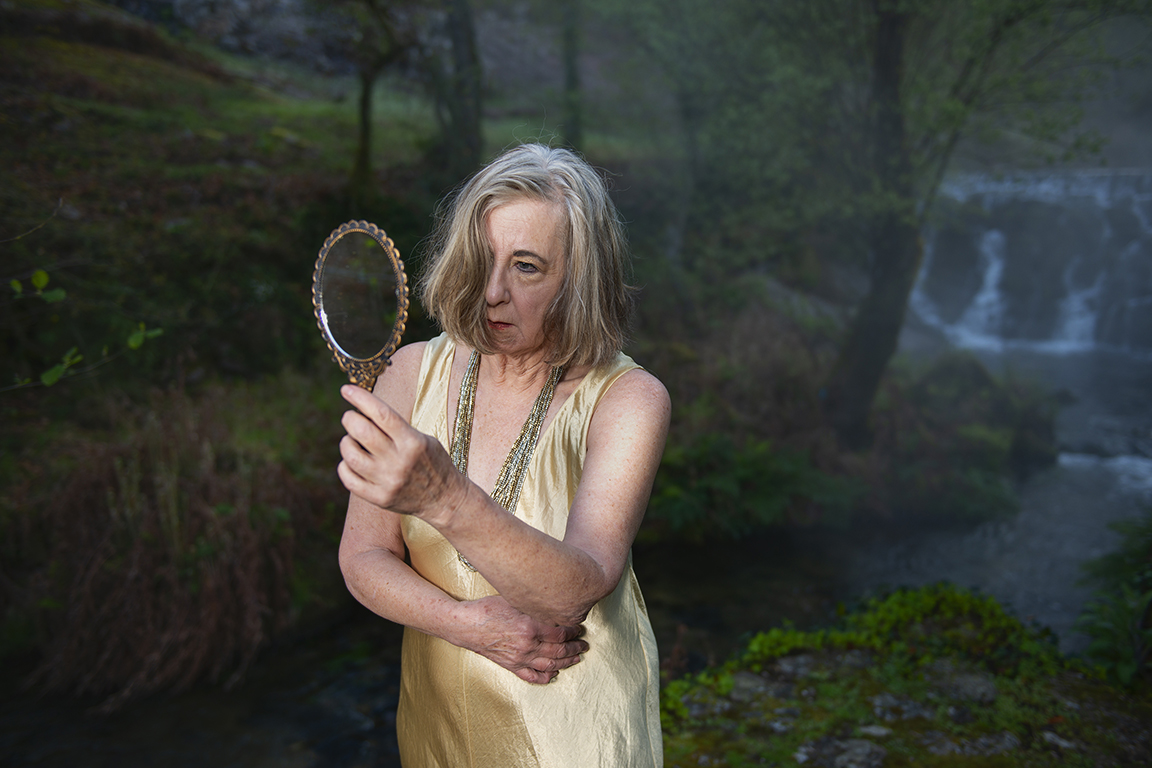
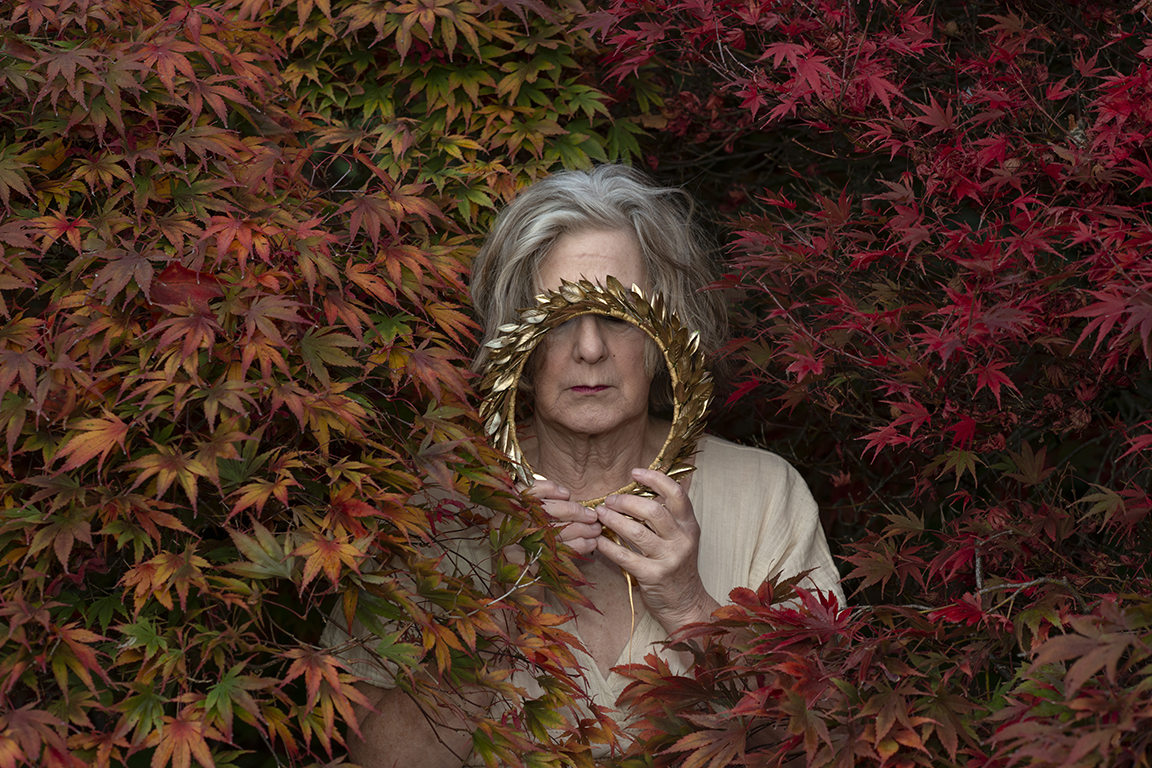
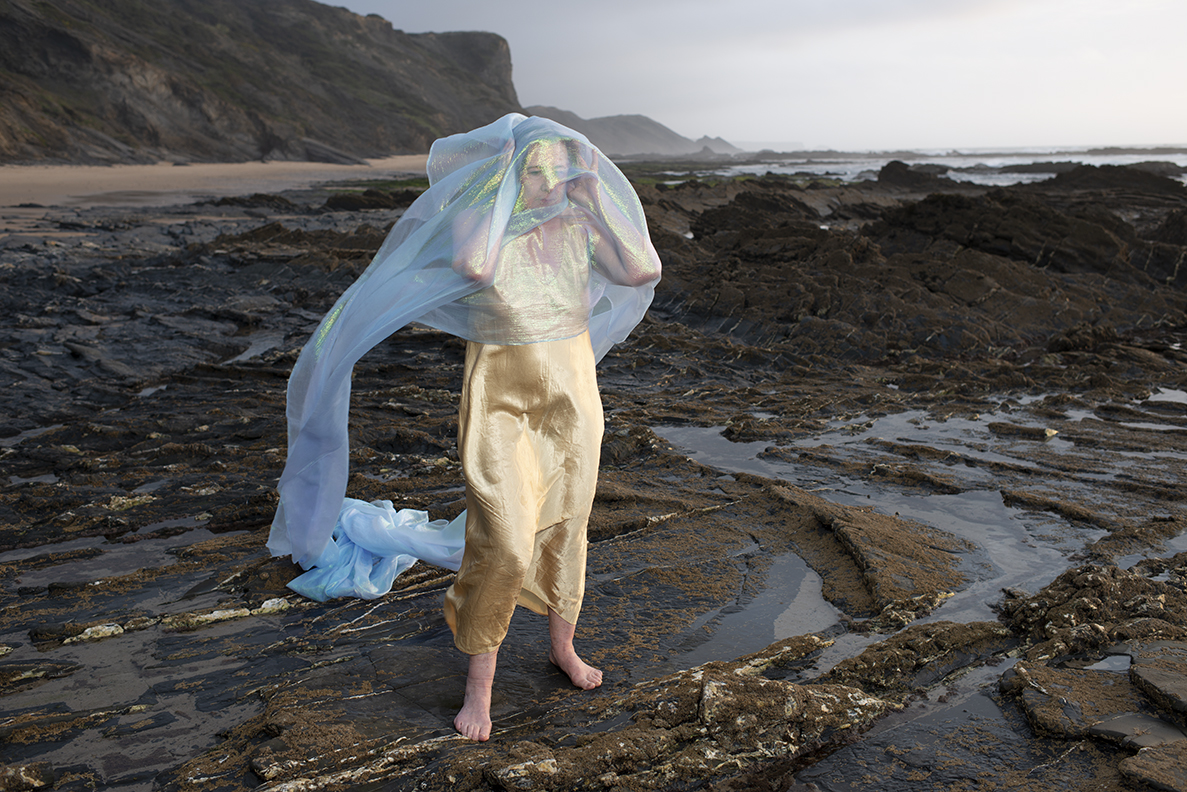
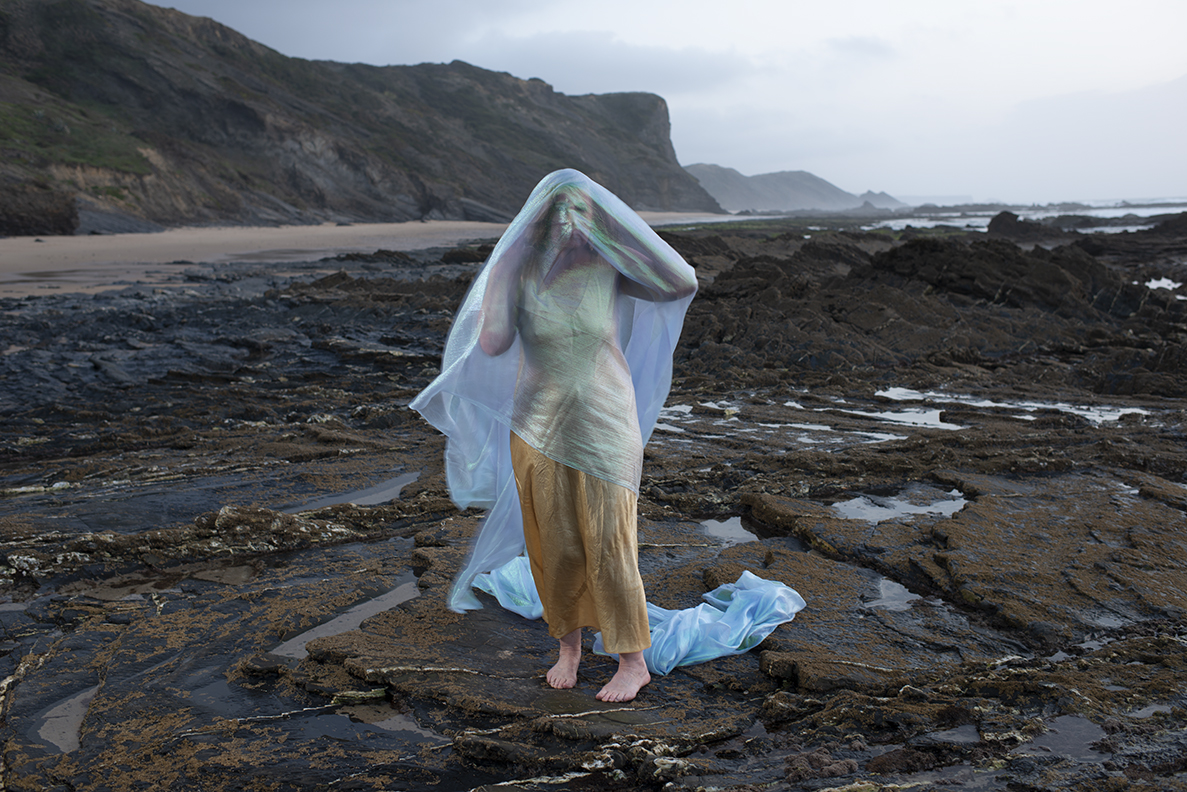
I have been looking, sorting, making sense of and editing the MANY images that I took with Luis Branco on the Costa Vicentina in Portugal at the end of March. It is good to let the images breath . . . you become attached to the images when you first shoot them and look through them. The shooting process was arduous . . . Luis and I worked many days clambering down the cliffs on the Costa Vicentina—shooting hundreds of images on the beautiful beaches at first light and at last light. And the ocean at the Costa Vicentina is almost too gorgeous, too vast, too poetic— it was overwhelming. I also had to figure out the right fabric (it was the cheesy diaphanous blue fabric I bought at Joanne’s on a whim), the right dress, the right make-up (but not too much) and most of all the right Aphrodite Attitude.
And then I just had to let go of the concepts, the ideas . . . and I had to take on a “what the f…” attitude with confidence. I was embodying the immortal goddess in my 66 year-old mortal form. And Luis had to get every shot . . .
This all came together during our last photoshoot in the evening light at the Praia da Carreagem—My Aphrodite emerged. These are my favorite images from that last photoshoot and from the whole week of shooting on the Costa Vicentina. These are the My Aphrodite images.
I am happy with these images (I need to get some processing and printing done) and Luis wants to convert some of the images to black and white. I will go on to sort and edit the series we shot of Helen of Troy and Sparta in Northern Portugal in April. And I am looking forward to researching and enacting more of My Heroines (Sappho, the Virgin Mary? And many more…) Happy Summer!!














 sherrywigginsblog