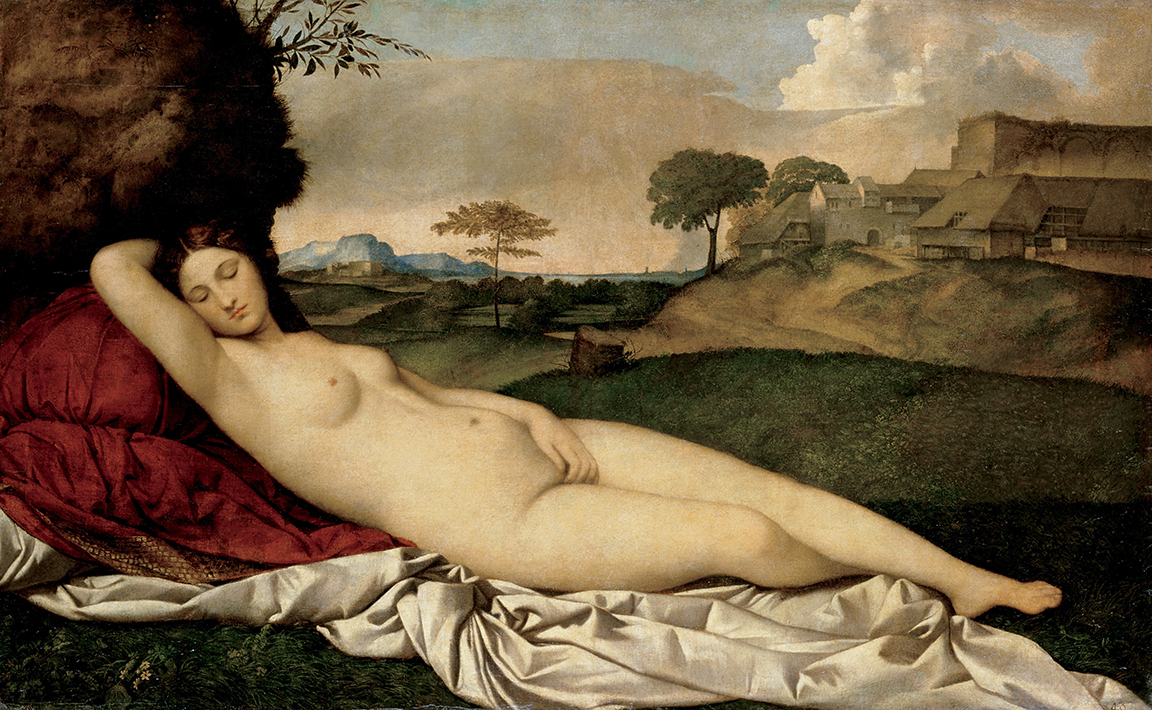
Sleeping Venus, presumably started by Giorgione and finished by Titian, c. 1510, Gemäldegalerie Alte Meister, Dresden, Germany.
let’s shoot by the small rock
horizontal landscape womanscape
last light first light works better
Giorgione or was it Titian? What were you thinking?
red satin resting, arm akimbo
eyes closed eyes open
naked, nude except the wig
cover crotch with hand
is she playing, sleeping?
focused, the relationship understood
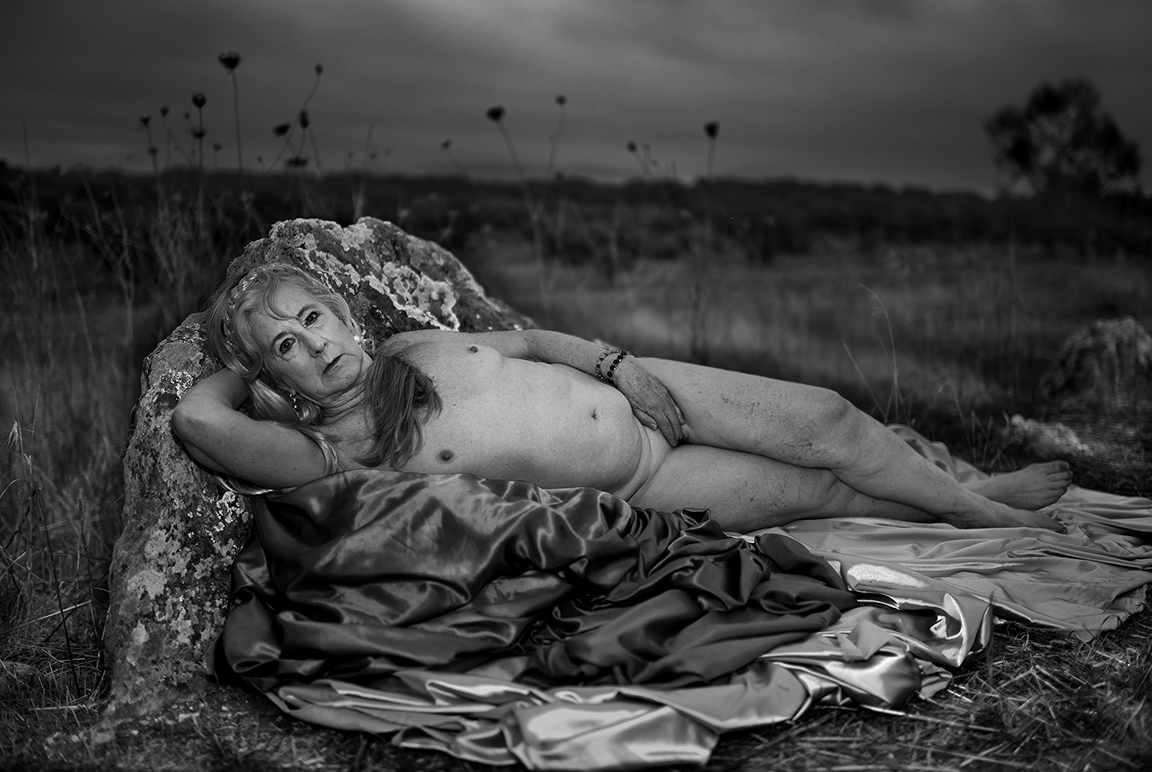
Aphrodite / Venus series, Sherry Wiggins and Luís Branco, 2024.
Aphrodite / Venus series, Sherry Wiggins and Luís Branco, 2024.
my angels / my goddesses arrive
the studio prepared, black cloth
the mirror, always the mirror
a blond but really silver
no butt crack
except for Eros / Cupid / Marta
the slim curves of their buttocks
my broad curving backside
blond Venus in the mirror
or is it Aphrodite?
why do they call her Venus?
Venus is also Ishtar’s star
this image is important to me
he shoots over and over
changing the lights, the lens, his distance
I look in the mirror back at him, the lens
Aphrodite / Venus series, Sherry Wiggins and Luís Branco, 2024.
Aphrodite / Venus series, Sherry Wiggins and Luís Branco, 2024.
it’s raining
we move to the casa
coffee, wine, special cheese
we try shooting in the small bedroom
Aphrodite rising attended by the Horae,
it doesn’t really work
we end up together in the bed
enveloped by my goddesses
in the morning we return to the rock
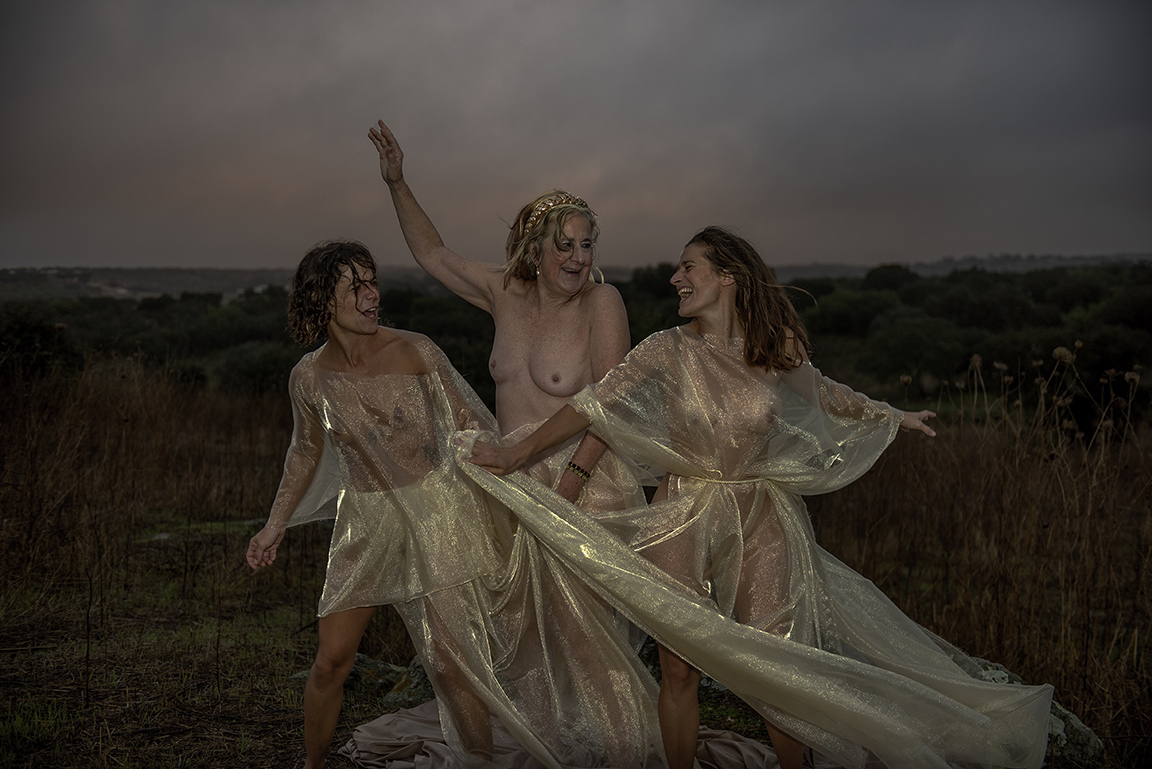
we dance, sing, smoke cigarettes
he keeps shooting
maybe some good ones
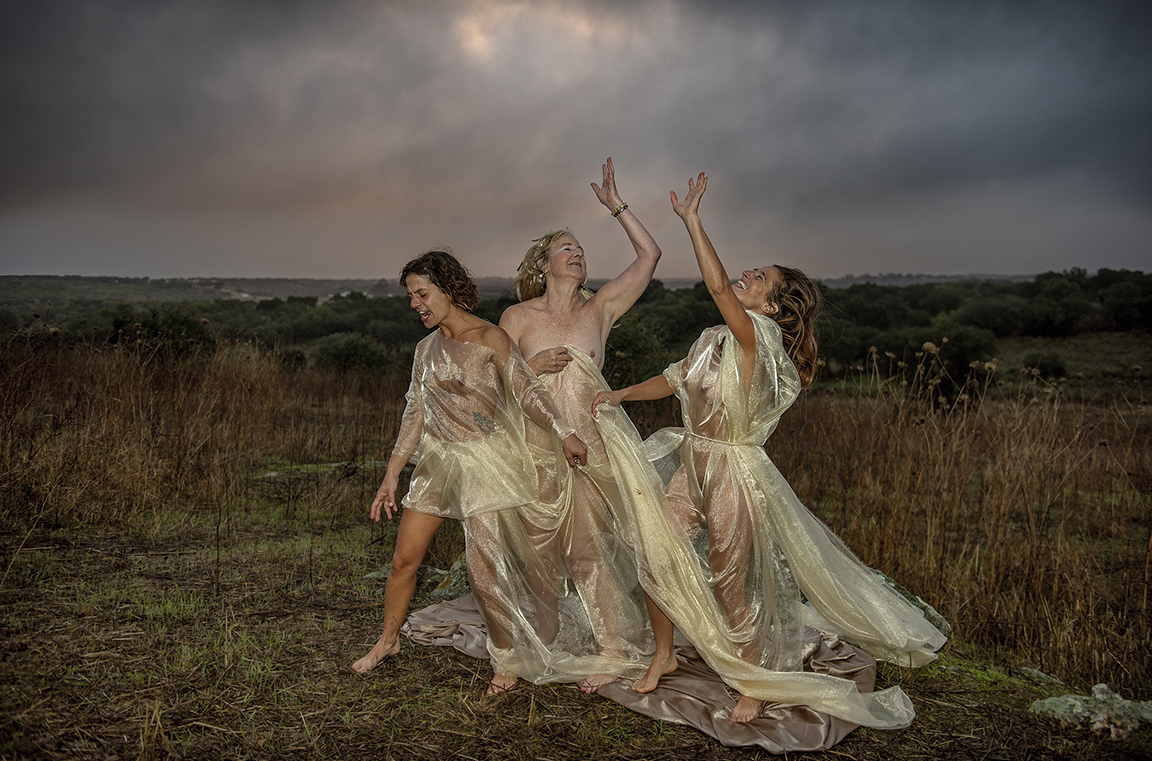
the three goddesses
Aphrodite / Venus series, Sherry Wiggins and Luís Branco, 2024.
Aphrodite / Venus series, Sherry Wiggins and Luís Branco, 2024.
sun comes up, last shots
more coffee
my Horae / Angels / Goddesses depart
keep to the schedule
time for my other goddess Inanna / Ishtar
golden horns, the two lions, lapis necklace
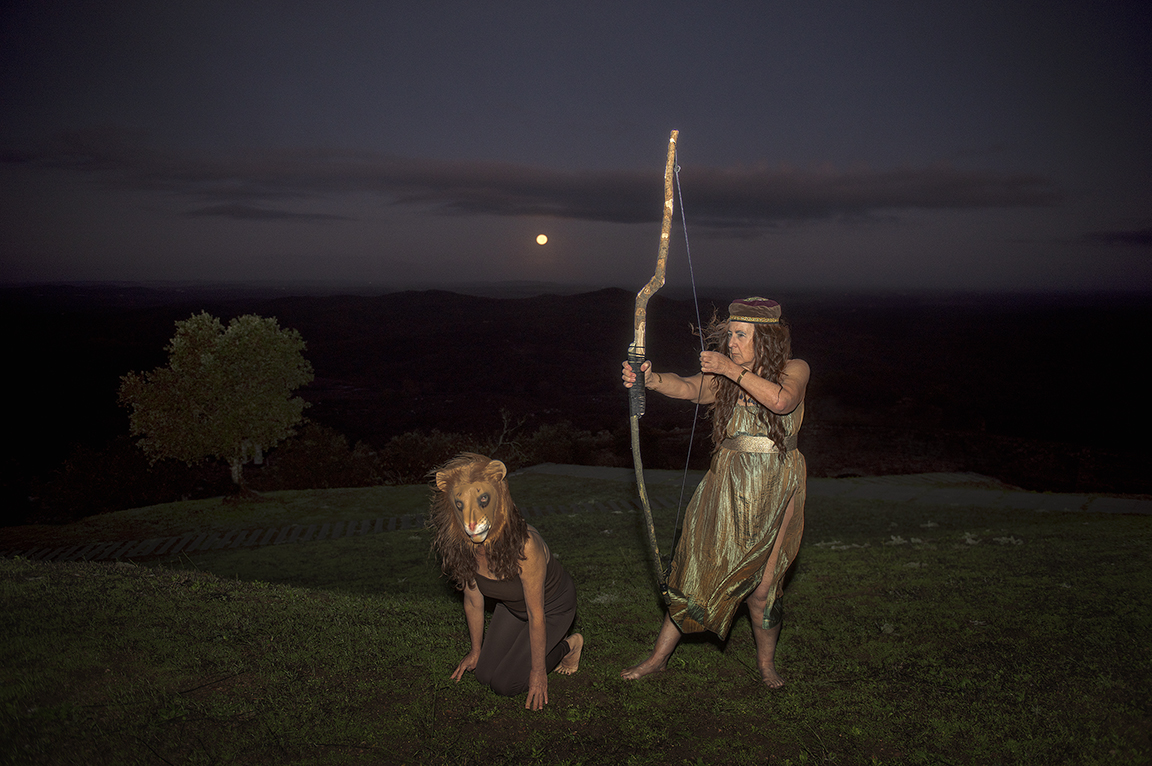
Inanna / Ishtar series, Sherry Wiggins and Luís Branco, 2024.
early morning at Evoramonte
moon almost full
settling down
my lioness supports me
it’s fucking windy cold
Inanna / Ishtar series, Sherry Wiggins and Luís Branco, 2024.
dawn arrives
a rainbow vista from the top of the mountain
my lioness near
I / Inanna / Ishtar stand strong
Inanna / Ishtar series, Sherry Wiggins and Luís Branco, 2024.
last night
in the studio
Ishtar with our golden girdle
Angels of Light on repeat
I hold my breasts
full frontal don’t move
I am the goddess
the lights the lens
a meditation…
Inanna / Ishtar series, Sherry Wiggins and Luís Branco, 2024.
Inanna / Ishtar series, Sherry Wiggins and Luís Branco, 2024.
I wrote the text above, “Slide Show Side Show,” after returning from the OBRAS Artist Residency in Portugal in late October. The text describes a bit of the process (which can be both improvisational and painstaking) that Luís Branco and I go through during our photoshoots–this last time with my heroines Aphrodite / Venus and Inanna / Ishtar. Marta Leon and Marta Carocinho stood by as Aphrodite / Venus’ Horae (goddesses of the seasons and of time). Wilma Geldof and Jacinta Ganso assisted as Inanna / Ishtar’s lionesses. After returning from Portugal, I let the work “rest” for several weeks. During the last part of November and early December I went through the editing process (with Luís’ help). I looked through the hundreds of images we shot to select the images we want to produce. Ron Landucci has done the final corrections to the images and is currently printing the proofs. I am very happy with this last body of work and I am now preparing to embody Claude Cahun in February at the La Napoule Art Foundation in France with Luís.
The Birth of Venus, Alexandre Cabanel, 1863, Musée d’Orsay, Paris, France.
The 19th century painting above of the birth of Venus by Cabanel in the Musée d’Orsay is monumental, 7 1/2 feet wide. I have not reincarnated this painting (yet). I know it is sexist but still fabulous. I am moving all around in time and geography from ancient Sumer and Babylonia (with the goddesses Inanna and Ishtar) to ancient Greece and the island of Cyprus, sometime around 1000 to 800 BCE, when the Greek goddess Aphrodite rose out of the Mediterranean as a fully formed and most beautiful goddess. Aphrodite, the goddess of beauty, love (ALL LOVE), passion, pleasure (and much more …), has been a favorite goddess of mine for years. She is a primal goddess. I choose the story of her birth out of the sea as portrayed in Hesiod’s Theogony (written 8th – 7th century BCE), and I have written about it on my blog. Here is an excerpt:
“This is quite the elemental image and idea—beautiful Aphrodite emerges fully formed, born of Ouranus’s castrated giant genitals. The ‘foam’ from which Aphrodite arises is the semen of her father, Ouranus the god of the Sky. Her half-brother Chronos is the perpetrator of this heinous deed, castrating his own father at the bequest of his Mother Earth (Gaia). Aphrodite is gestated in this matrix / fluid of her father’s testes. She arises from the sea foam / seminal fluid with her two companions: Eros, the primordial god of Love and Sex, and Himeros, god of uncontrollable and ravishing Desire. One of Aphrodite’s Greek names is Philommedes which means both ‘genital loving’ and ‘smile loving.’”
So-called “Ludovisi Throne,” Thasian marble, Greek artwork, ca. 460 BC (authenticity disputed). Museo Nationale Romano of Palazzo Altemps, Rome.
The ancient sculpture above (perhaps) presents Aphrodite rising from the sea, this time assisted by the Horae, goddesses of time and the seasons who are said to have been the first to dress and adorn Aphrodite.
My goddesses met Luís and me at OBRAS a few weeks ago to assist us. Here are two of our early-morning shots. We danced, sang and smoked cigarettes, the fun goddesses.
Works in Progress – Aphrodite and the Horae series, color digital images, Sherry Wiggins and Luís Branco, October 2024.
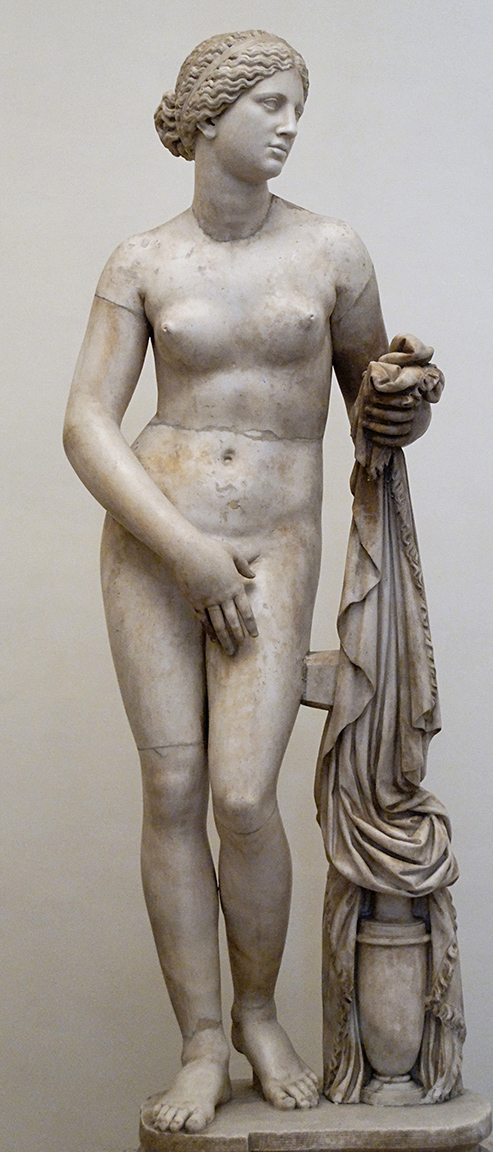
Cnidus Aphrodite, Roman copy after a Greek original of the 4th century BCE, marble. Original elements: torso and thighs; restored elements: head, arms, legs and support (drapery and jug). Museo Nazionale Romano di Palazzo Altemps, Rome.
While the Horae were the first to dress Aphrodite, the famed Greek sculptor Praxiteles (ca. 300 BCE) was the first to (almost) fully undress her. The Cnidus Aphrodite, also known as the Aphrodite of Knidos, above is one of the many Roman copies of the original statue made by Praxiteles around 350 BCE. Praxiteles’s sculpture of Aphrodite was the first fully nude Greek sculpture of a woman (or a goddess). Greek artists had been making nude sculptures of men for centuries before. This Aphrodite is monumental—more than six feet tall—and it was reproduced and copied for many centuries all over the Mediterranean and beyond in different sizes and shapes. Copies of this statue and its kin are displayed in museums and collections all over the world. This sculpture also marks the invention of the Venus Pudica gesture, where the figure covers her pubic area with her hand (apparently a gesture of modesty). This gesture has appeared throughout time in paintings and sculptures. Does it suggest modesty? Or is it an alluring gesture, a sign of welcome? This representation diverges markedly from the representations of our proud Mesopotamian goddesses of love and sexuality (and much more …) Inanna and Ishtar.
“Men say that there are two unrepresentable things: death and the feminine sex.” (Hélène Cixous, 1978: 255)
“‘Alas! alas! Where did Praxiteles see me naked?’, Aphrodite is said to have exclaimed upon seeing her own image in Knidos. In antiquity just as today Praxiteles’ Knidian Aphrodite was celebrated as the first realistic depiction of the nude female body. It was this particular Aphrodite statue that first presented to us the ‘Classical female beauty’ or the aesthetically ideal form of the female body. Indeed, the image of nude Aphrodite has become equated with high art, and seen as a sign for aesthetics not only for ancient Greece but also for the rest of Western art and culture. This archetype of femininity has become so ingrained in Western aesthetics that it has been placed in the position of a paradigm against which images from earlier and later periods and cultures are evaluated with regard to the degree that they approach, resemble, or fail to follow this ideal.”
(From Women of Babylon: Gender and Representation in Mesopotamia by Zainab Bahrani,from the chapter “That Obscure Object of Desire: Nudity, fetishism, and the female body,” pg. 70)
Jumping forward to the Renaissance, the many paintings and representations of Aphrodite and Venus were influenced by Greek and Roman ideals and representations of the goddess and of the female nude. It was a Western European sexist racist fad that has lasted about 600 years and counting.
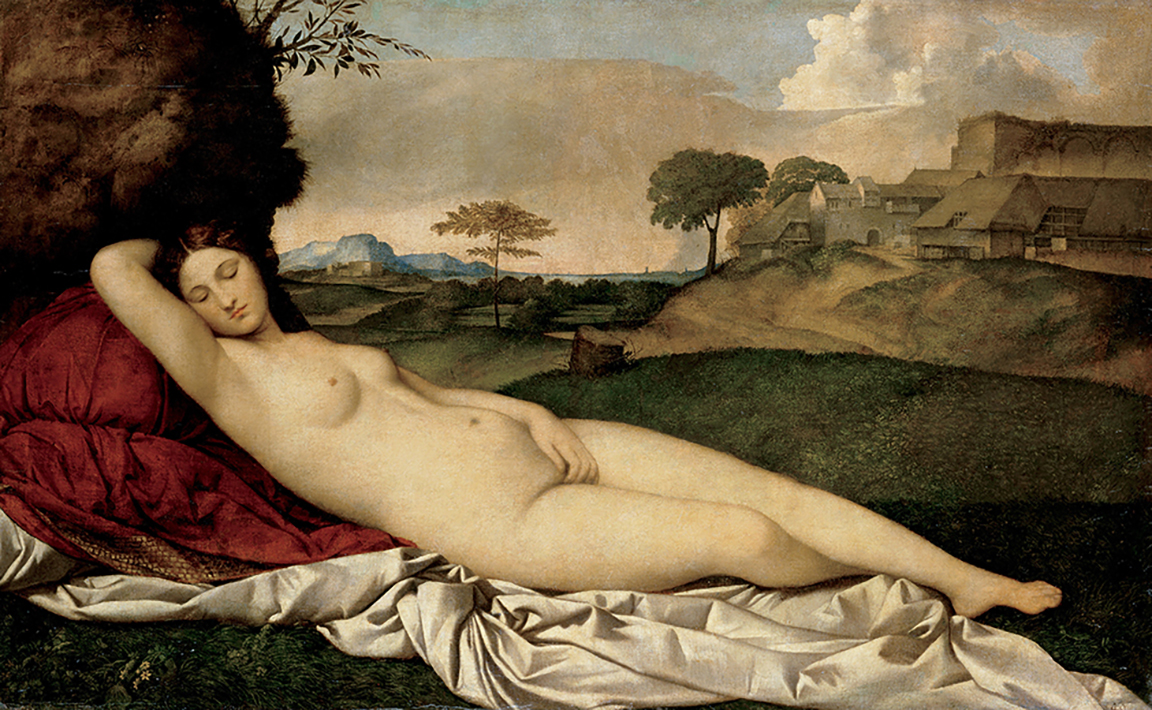
Sleeping Venus, perhaps begun by Giorgione and finished by Titian, ca. 1510. Gemäldegalerie Alte Meister, Dresden, Germany.
The “Sleeping Venus” is believed to have been started by Giorgione at the end of his life and completed by Titian. The landscape is very Titianesque. This was apparently the first reclining nude of the Renaissance, and it launched the genre of the semi-erotic mythological pastoral. Venus is apparently unaware of our gaze. Again, is she modestly covering herself, or is she stroking herself??
Works in Progress – Venus series, color digital images, Sherry Wiggins and Luís Branco, October 2024.
Luís and I made a series of images of Venus in the landscape at OBRAS-Portugal a few weeks ago, with the reclining nude (and the rock!). I haven’t chosen final versions (of any of our recent images). I like the crouching Venus above or maybe she’s a cougar Venus.
Venus in Front of the Mirror, Peter Paul Rubens, 1614-1615. Liechtenstein. The Princely Collection.
The Rubens painting above, “Venus in Front of the Mirror,” portrays a seventeenth-century Western European sensibility surrounding sex, gender, race and power. The very blond and white Venus is flanked by a black female servant, who tends her golden tresses, and Cupid, who holds up her mirror. The goddess of love and sexuality looks outward from the mirror, very much aware of the viewers who gaze upon her. Her power rests in her recognition of her own beauty and sexuality and the effect of both upon the viewer.
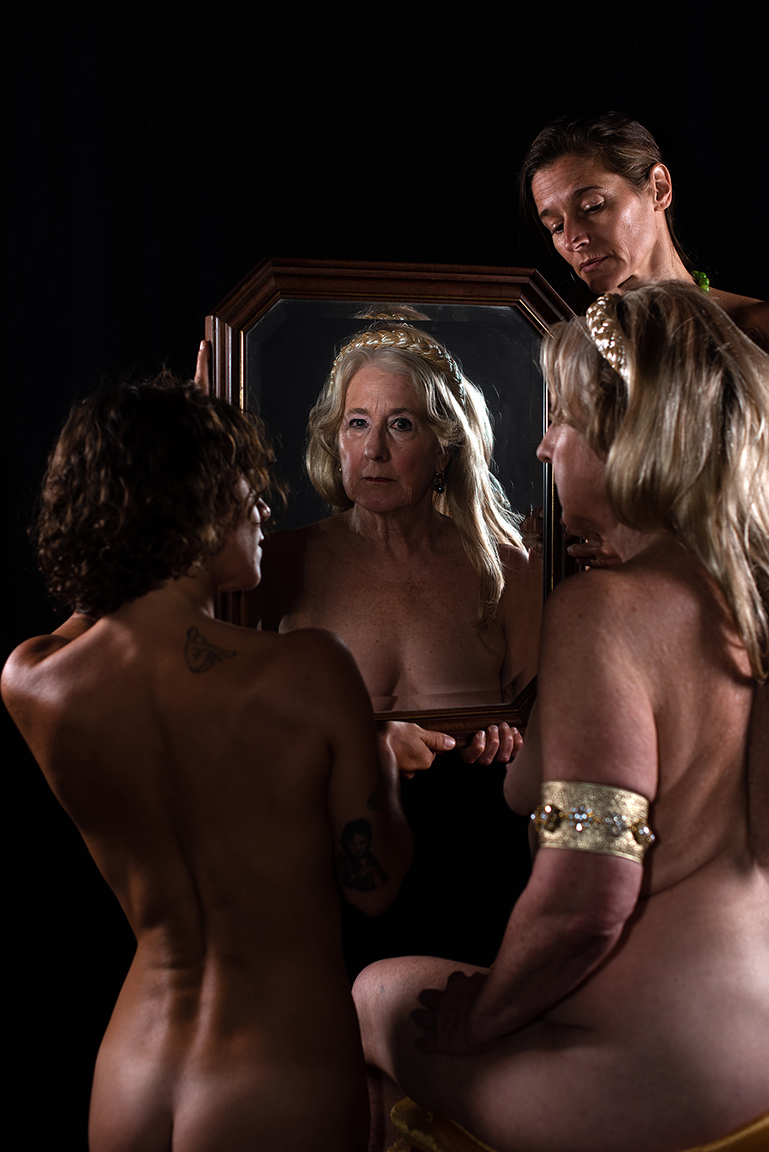
I both love and question Rubens’s “Venus in Front of the Mirror,” as it relates to the HEROINES project and my work in general. For months before leaving for Portugal, I had envisioned myself embodying this same Venus in a performative photograph. I bought a blond wig, and I arranged to have my friends / models / goddesses from the Cortiço Artist Residency come work with Luís and me at OBRAS to create this image. When I first arrived at OBRAS several weeks ago, I ventured to the Saturday market in Estremoz and found an almost-perfect antique mirror. I imagined myself looking out of the mirror of Venus, my late-sixty-something-year-old body (and face) exposed. In so doing, I am reflecting upon the ways in which women’s sexuality has been represented (and misrepresented) over time and how my own sexuality and body consciousness are expressed. Making this image was and is empowering. It’s also a little scary to expose myself in all these nude images. My friends and models, Marta and Marta, my beautiful (younger) goddesses, support me in my vulnerability. This is both a technical image and a poetic image. Luís did a beautiful job with the lighting and the composition.
WIP – Venus in Front of the Mirror, color digital image, Sherry Wiggins and Luís Branco, October 2024.
I am back at home now and posting this after the election. I have been writing and thinking about these goddesses and female power and our bodies and ALL of our rights that are now in great peril. F__K THE PATRIARCHY. We must mobilize, be warriors for the rights of ALL people.










 sherrywigginsblog