WIP—Inanna / Ishtar series, color digital image, Sherry Wiggins and Luís Branco, October 2024.
I almost retitled this blog post “F__K THE PATRIARCHY: Part I: Inanna and Ishtar and Part II: Aprhodite and Venus”. I am posting this after the election… but I decided to go with my original title “Naked and Adorned Parts I and II. I’ve been home from Portugal for more than a week and I have been looking over the images Luís Branco and I produced during our residency at OBRAS. No final edits—just a quick look through and a consideration of my most recent heroines, Inanna and Ishtar, and my long-term heroine, Aphrodite, and her reincarnation as Venus (they are considered in Part II).
For the HEROINES project I have researched and embodied several ancient goddesses and made performative photographs with Luís over the last four years. These goddesses include the Greek goddess / enchantress / sorceress Circe, from Homer’s The Odyssey, with her tamed lions and the men she transformed into swine; Isis, the great Egyptian goddess of motherhood, fertility and magic; and Aphrodite, Greek goddess of love and sexuality and more …, who morphs into the Roman goddess Venus. These goddesses fascinate me for their special powers and independence and agency. They are all sexy, badass goddesses.
These goddesses of ancient times were also syncretic: They merged into one another and through one another across time, cultures, wars, land and water. Aphrodite, my original favorite goddess, has pointed me backward in time to her early predecessor / sister goddesses of love and sexuality (and much more …) in ancient Mesopotamia—Inanna and Ishtar.
My preparation for embodying all of these goddesses includes an exploration of thousands of years of representations, descriptions and depictions of them. I am not a historian, an academic or an archeologist, but I do my own intuitive investigations and excavations of these archetypal heroines.
In this current inquiry and recent embodiments, I have ventured to the East (in my mind and in my research) to the lands and cultures of ancient Mesopotamia, the Fertile Crescent, to find ancient Sumerian goddess Inanna and Akkadian / Babylonian goddess Ishtar. These two goddesses merged over a period of a few thousand years (ca. 4000 BCE to 500 BCE) and are, at times, indistinguishable. Artifacts, texts and poems represent these amazing and powerful goddesses of love, sexuality, war (and much more …). Studying these ancient goddesses has been a revelation. Patriarchal Western European history has largely ignored them.
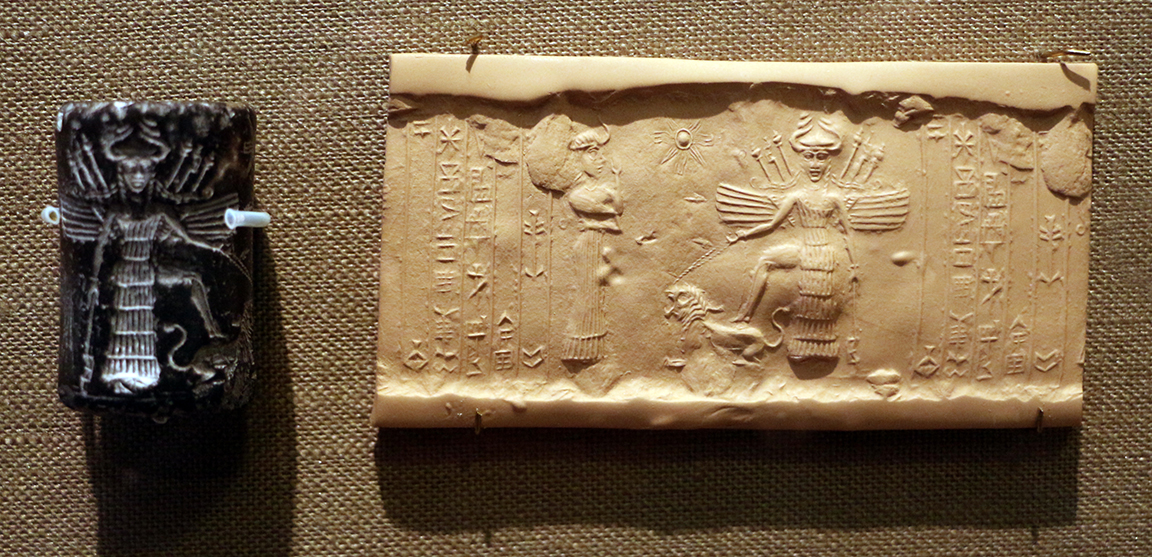
Radiant Inanna, cylinder seal, Mesopotamia, Akkadian period, ca. 2334 – 2154 BCE, h. 4 cm, d. 2 cm. The Oriental Institute Museum, University of Chicago.
In the two images of the ancient cylinder seal terracotta plate above, Inanna / Ishtar stands triumphantly in full regalia with one foot upon the back of her roaring lion. She wears a headdress of multiple horns. Weapons issue from her shoulders, while enormous wings appear from behind her back, suggesting both her martial and supernatural nature. An eight-pointed star, emblem of her manifestation as Venus, the morning and evening star, appears in the sky beside her.
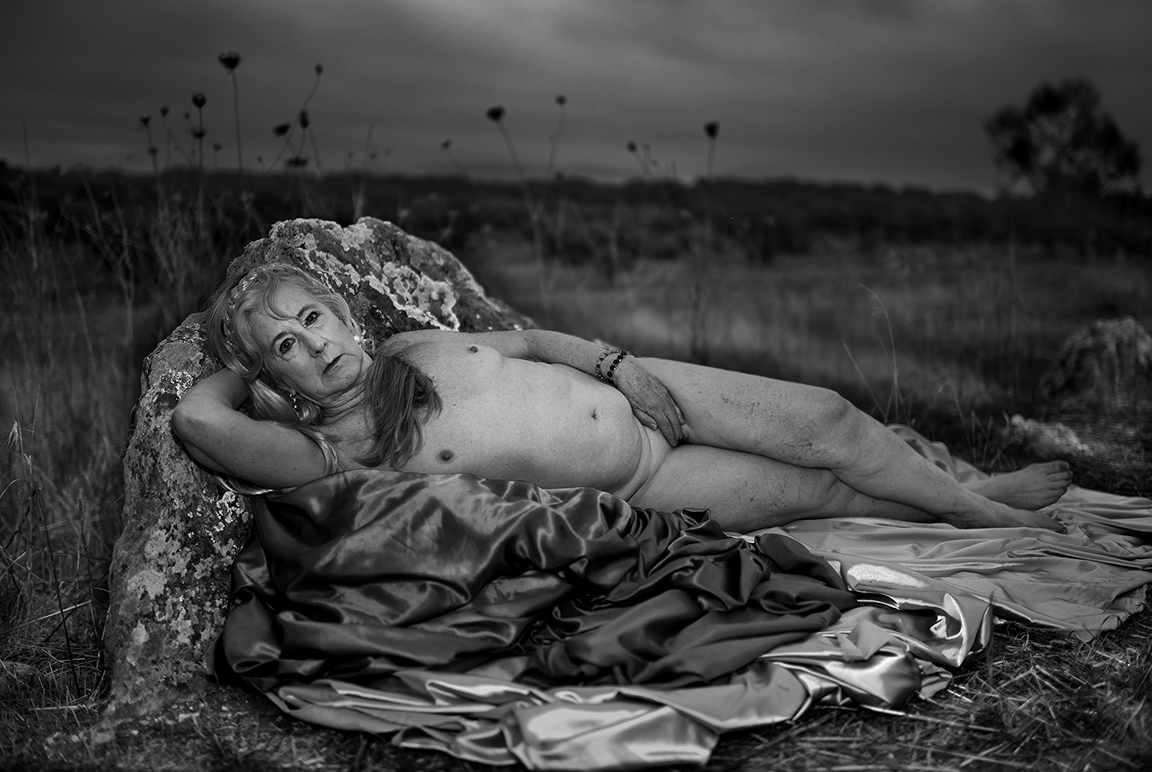
WIP—Inanna / Ishtar series, black-and-white digital image, Sherry Wiggins and Luís Branco, October 2024.
Known as the “Queen of Heaven and Earth,” Inanna is the goddess of love, war, fertility, political power, sex (and much more …). She was worshipped as early as 4000 BCE in Sumer in southern Mesopotamia. In later Babylonian culture (2000 BCE to 500 BCE), Inanna becomes Ishtar and represents many of the same attributes and mythoi and is represented in many poems and hymns.
Terracotta plaque showing the goddess Ishtar (Inanna), 19th – 17th century BCE, from Iraq. Pergamon Museum, Berlin, Germany.
On the terracotta plaque above, Ishtar / Inanna stands on the back of a lion. She holds a bow in her left hand and a crook or a sickle in her right. The symbol of the god Shamash (Utu) appears in the upper right corner. The scene seems to take place in mountainous terrain.
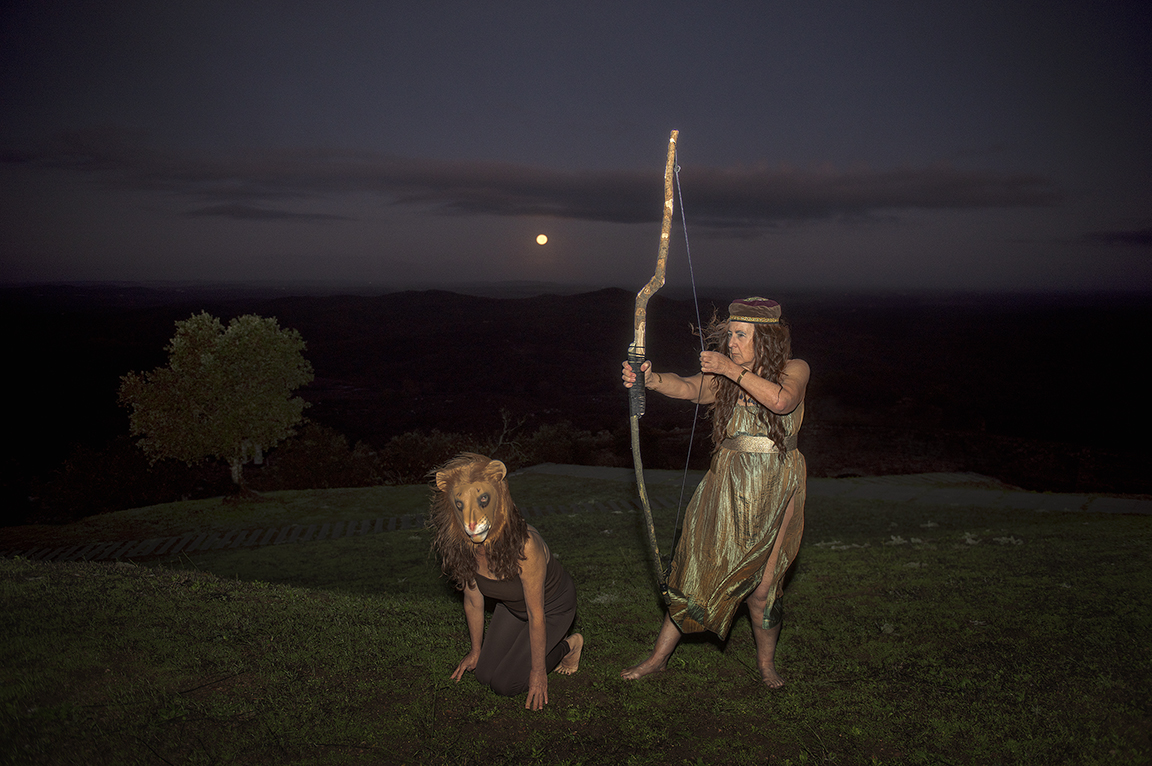
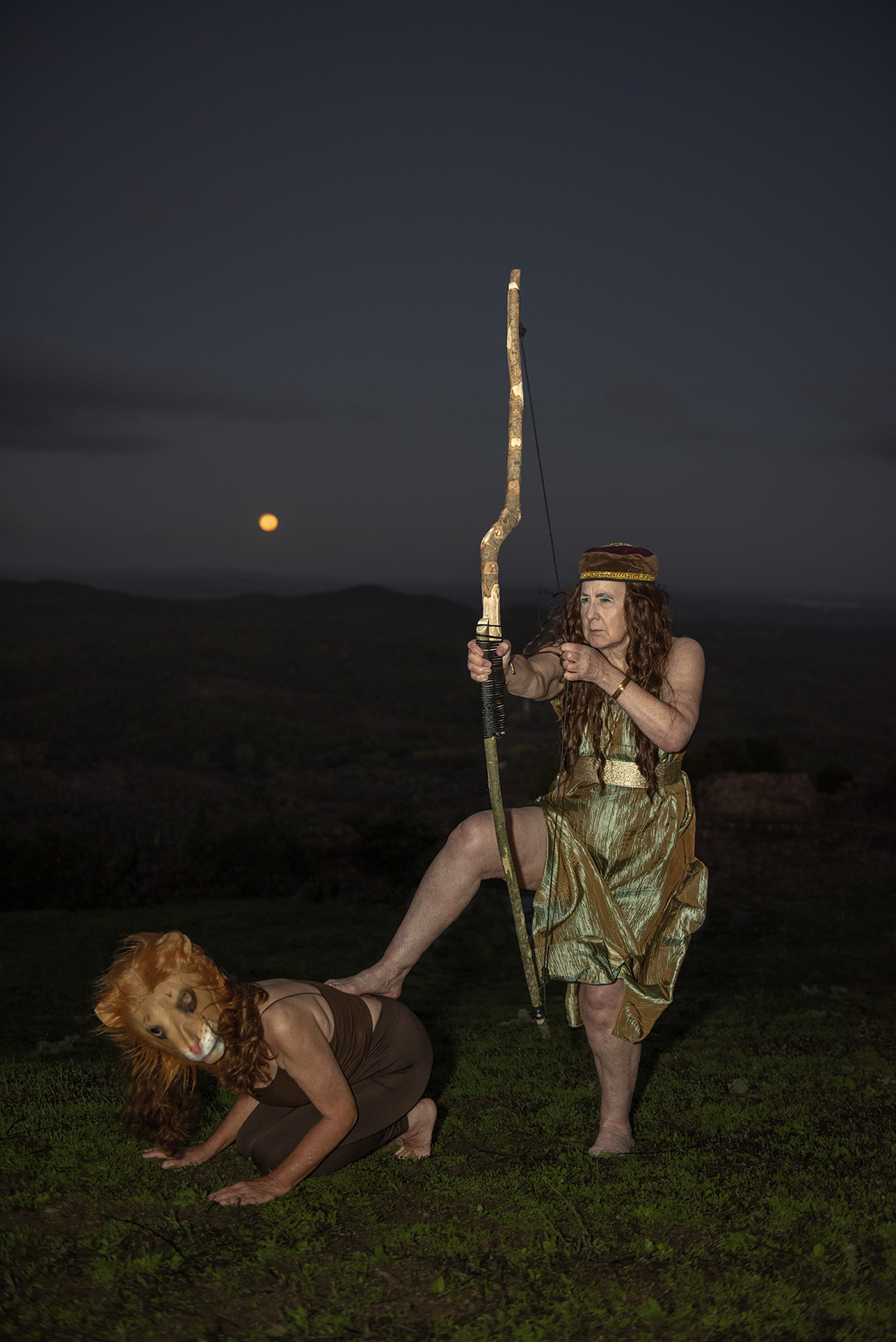
I constructed her gown and collected golden horns, a lapis necklace and a golden girdle for my embodiment of Inanna / Ishtar. My friend Antonio made a wooden bow for us. My lioness, Jacinta, accompanied Luís and me to the top of Evoramonte near dawn, just as the moon was setting.
WIP—Inanna / Ishtar series, color digital image, Sherry Wiggins and Luís Branco, October 2024.
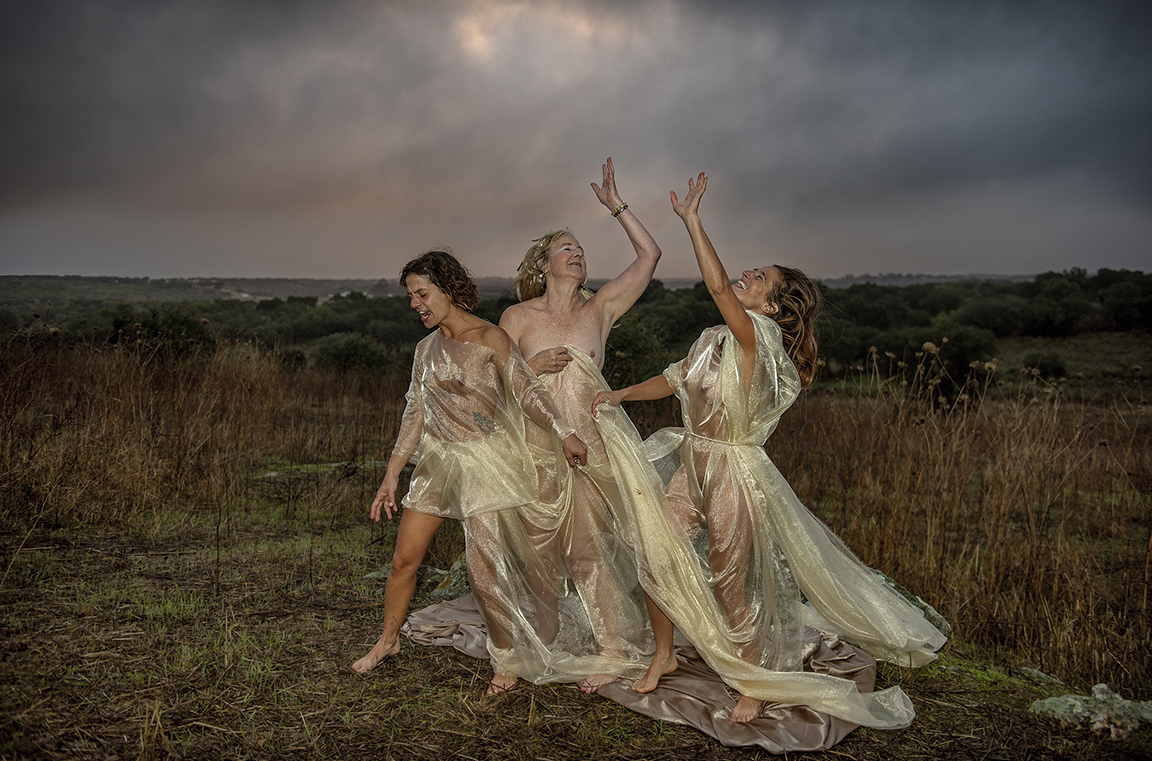
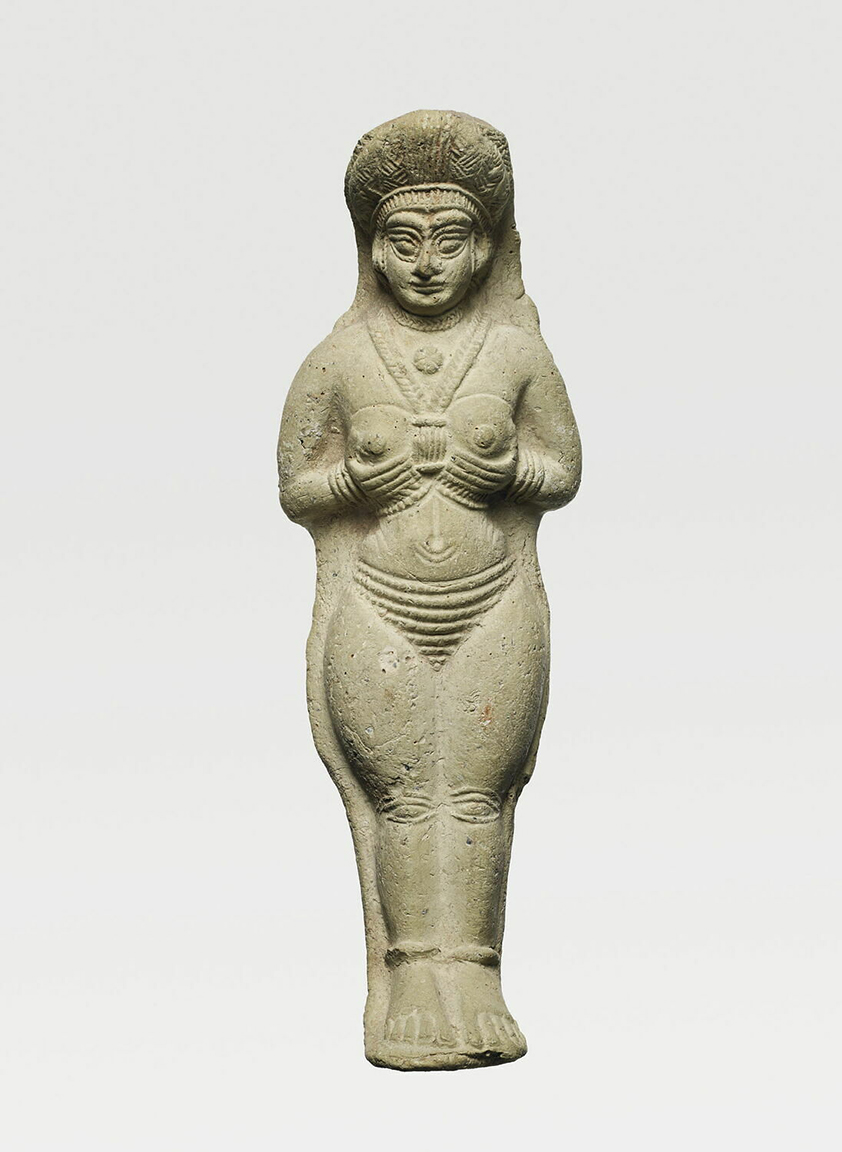
Both Inanna and Ishtar have been portrayed in various states of nakedness and adornment, all of which evoke their power and their sexuality. They are invincible goddesses and sexy, graced with elaborate crowns and jewels, often portrayed full-frontal in sculpture or other artifacts, whether nude or adorned. Their states of dress and undress reflect cultural ideas about female sexuality and female power, essentially equating the two. Which of course I love! Many Mesopotamian sculptures depict Inanna / Ishtar, as well as other women, holding their breasts—not as a statement of modesty, but, rather, referring to their potent and powerful sexuality.
Ishtar from Susa, 1500 – 1100 BCE. Louvre Museum, Paris, France.
WIP – Inanna / Ishtar series, color digital image, Sherry Wiggins and Luís Branco, October 2024.
In addition to sculptures and plaques, Inanna / Ishtar is depicted in texts and poems. I have been reading translations of these texts in Inanna, Queen of Heaven and Earth: Her Stories and Hymns from Sumer by Diane Wolkstein and Samuel Noah Kramer. “The Descent of Inanna” is the most famous text. Here, Inanna descends into the underworld through seven gates. At each gate, she must give up an article of clothing or an object that signifies one of her various powers—her horned crown, her scepter, her lapis jewelry, her robe. Finally, she is naked in the colorless underworld alongside her sister, Ereshkigal, who is the goddess of death and the underworld. Ultimately, Ereshkigal and the seven judges of the underworld kill Inanna. Her corpse is hung on a hook on the wall and left to decompose. Yet Inanna contrives a way to return to the living world: She consigns her husband, Dumuzi, the shepherd /king, and her faithful servant to spending half of every year in the underworld for eternity. Inanna is definitely a badass, but she has other sides as well; her sexual powers are prodigious.
Perhaps my favorite text about Inanna is the very sexy “The Courtship of Inanna and Dumuzi”:
Inanna spoke:
“What I tell you,
Let the singer weave into song.
What I tell you,
Let it flow from the ear to mouth,
Let it pass from old to young:
My vulva, the horn,
The Boat of Heaven,
Is full of eagerness like the young moon.
My untilled land lies fallow.
As for me, Inanna,
Who will plow my vulva?
Who will plow my high field?
Who will plow my wet ground?
As for me, the young woman,
Who will plow my vulva?
Who will station the ox there?
Who will plow my vulva?”
Dumuzi replied:
“Great Lady, the king will plow your vulva.
I, Dumuzi the King, will plow your vulva.”
Inanna:
“Then plow my vulva, man of my heart!
Plow my vulva!”
(From Inanna, Queen of Heaven and Earth: Her Stories and Hymns from Sumer, Diane Wolkstein and Samuel Noah Kramer, 1983, Harper Perennial: New York, NY, pp. 36 – 37.)
Terracotta Couple from Susa, 1500 – 1100 BCE. Louvre Museum, Paris, France.
Please read my blog post “Naked and Adorned Part II: Aphrodite and Venus” about our work made during the same time period at OBRAS, also part of the F__K the Patriarchy series…











 sherrywigginsblog