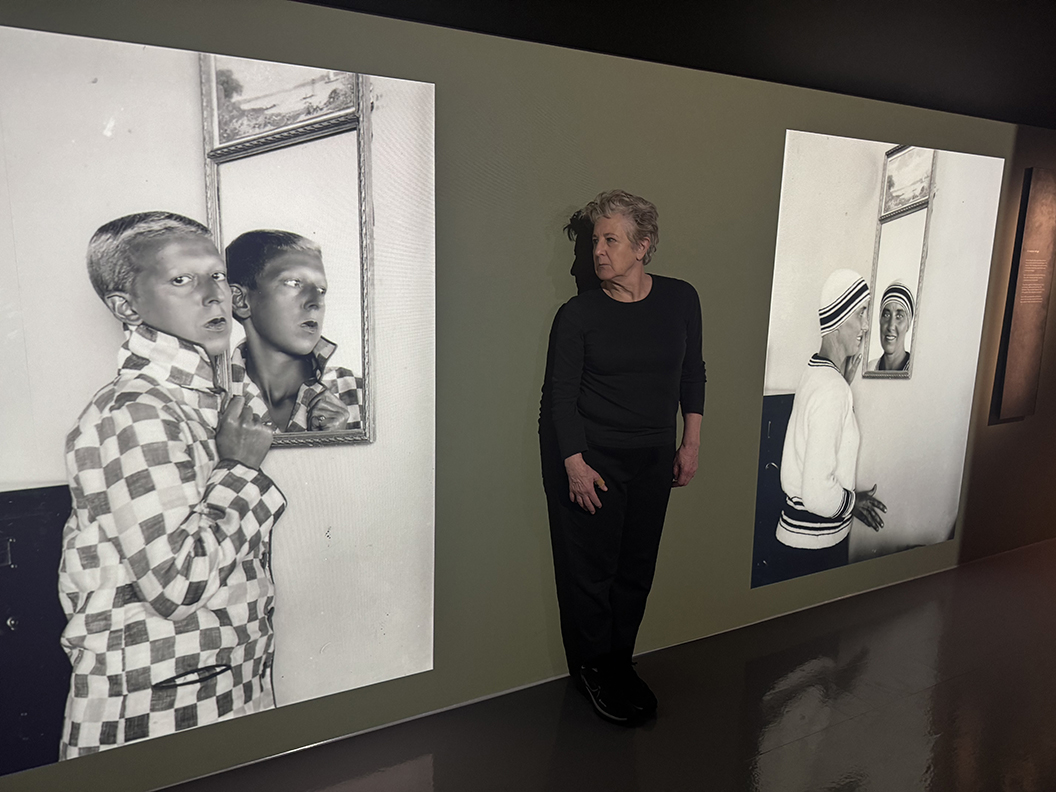
In the Jersey Museum with Claude Cahun and Marcel Moore’s dual projected images, made in 1928. Photograph by Luís Branco.
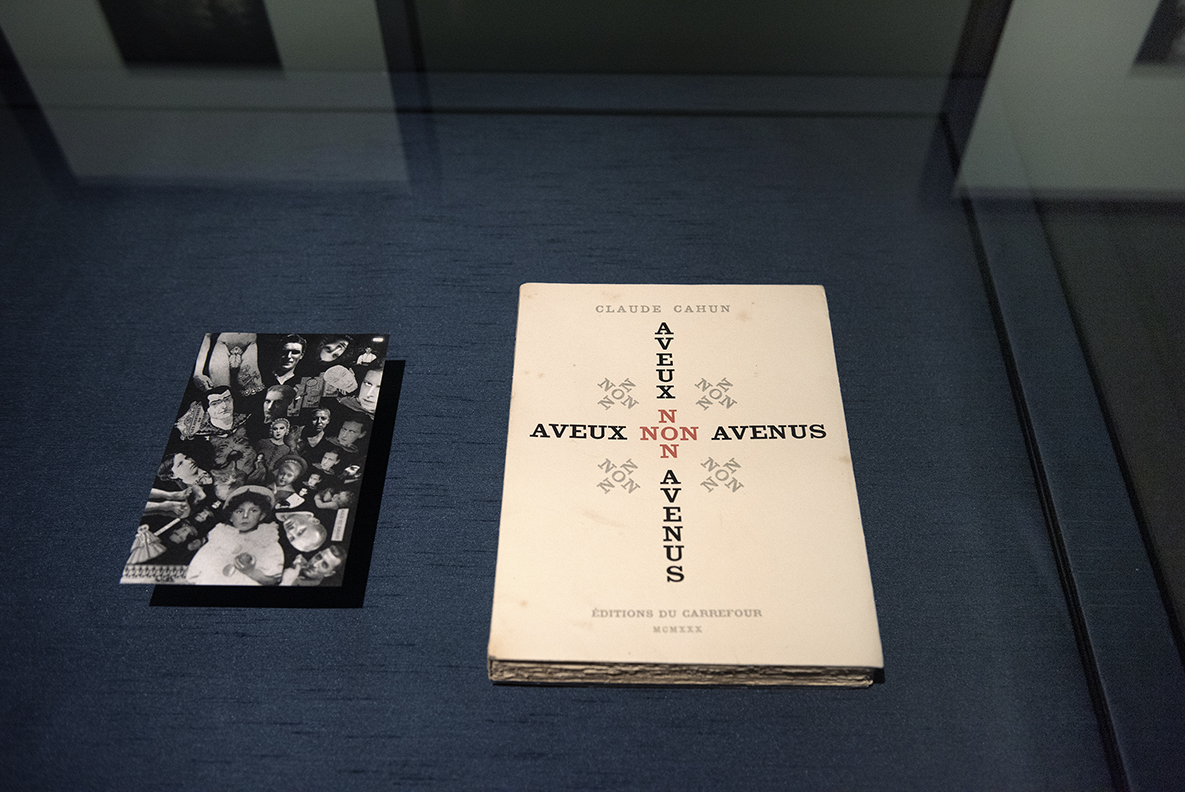
Seeing Claude Cahun and Marcel Moore’s images projected on the walls of the Jersey Museum on Jersey Island was a revelation. Several of their original small gelatin silver prints are displayed in the museum alongside Cahun’s original manuscripts and several of Cahun and Moore’s original anti-Nazi tracts made during the occupation of Jersey.
During my recent stay on Jersey Island, I was able to spend time in both the Jersey Museum and the Jersey Archive. Jersey Heritage, a nonprofit organization dedicated to protecting the island’s culture, heritage and records, oversees the museum and archive, as well as many other sites on the island. The museum and archive are both located in downtown St. Helier, Jersey’s capital city. The museum houses an exhibition of ancient artifacts from the neolithic period through to the twentieth century. The archive holds artworks, artifacts, records and documents from ancient to modern times.
Most relevant for me, the museum and archive hold the most important collection anywhere of Cahun and Moore’s works, including photographs, negatives, paintings, texts, letters, diaries, manuscripts and an assortment of anti-Nazi tracts. The museum displays a selection of Cahun and Moore’s original prints, manuscripts and texts on a revolving basis—they are rotated every few months to preserve and protect them. Large projected images appear on the walls of the museum every few minutes (much to my delight). The complete collection of Cahun and Moore’s works is held in the Jersey Archive and has been catalogued and documented in high-resolution digital images (and is available online at low resolution).
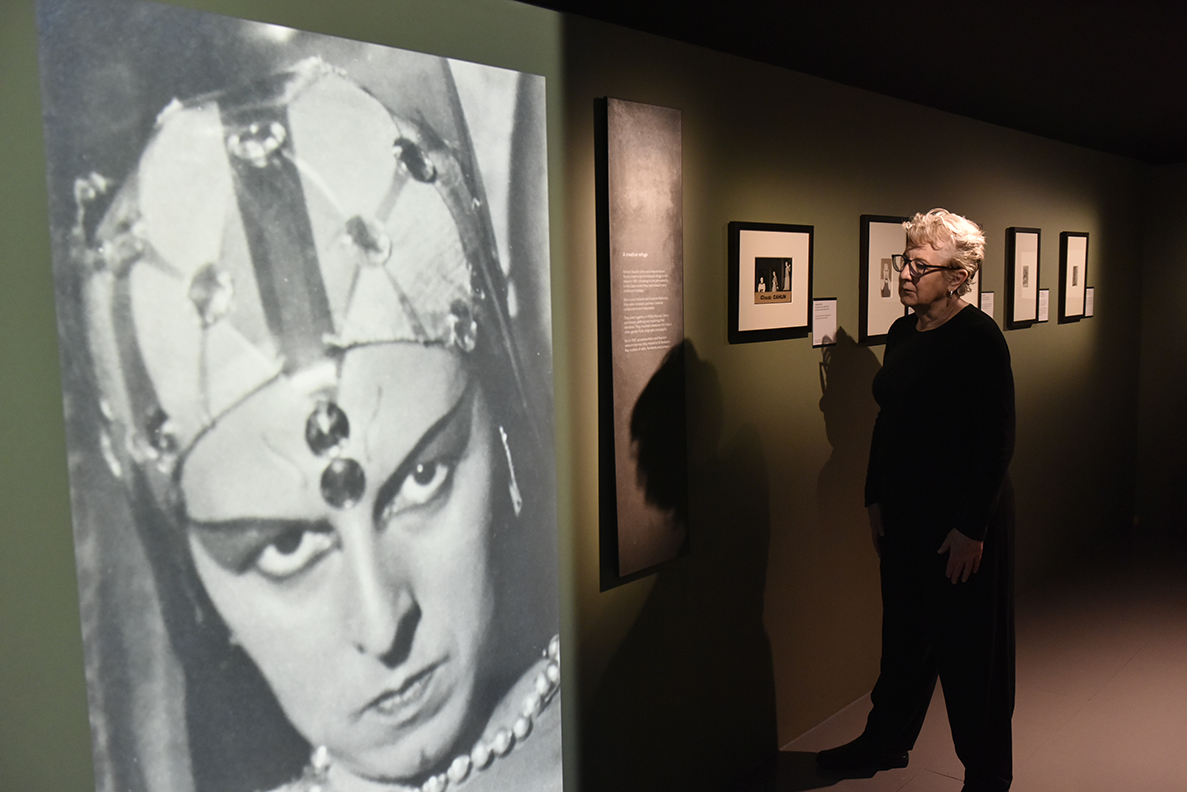
In the Jersey Museum with the projected image of Cahun (as the Devil, a character she performed in the play Le Mystère d’Adam in Paris in 1929). Photograph by Luís Branco.
In the Jersey Museum with the projected image of Cahun (as the Devil, a character she performed in the play Le Mystère d’Adam in Paris in 1929). Photograph by Luís Branco.
Before arriving on Jersey, I contacted Jersey Heritage Curation and Experience Director Louise Downie, an art historian and curator who has worked there since 1995. She supervised the purchase and collection of Claude Cahun and Marcel Moore’s archive in the 90s and early 2000s.
Cahun died in 1954 and Moore in 1972, both in Jersey. Their works and lives virtually disappeared from the annals of art history, literary history and WWII history for decades. After Moore’s death, their possessions were auctioned off in lots. John Wakeman, a collector of surrealist books and photographs, bought their possessions for twenty-one British pounds. The collection was haphazardly stored in an assortment of cartons. Some of their more valuable artworks (drawings by Henri Michaux, a bust of Cahun by Chana Orloff) and books (by Hans Bellmer and Andre Breton) were sold off by Wakeman during the 70s and 80s.
In 1995, Jersey Heritage Trust acquired the remainder of the Wakeman collection, a disorganized jumble of photographs, negatives, manuscripts, bills of sale, postcards, letters and all sorts of written materials in French, English and German, all stored in a large tea chest. Louise Downie enlisted Claire Follain to sort through the materials. Follain is a Jersey native who was studying French history and the resistance during World War II in England at the time. Follain told me that going through this potpourri of materials was a fascinating puzzle and a major project.
Claude Cahun was named in the collection, as were Lucy Schwob, Suzanne Malherbe and Marcel Moore. At first, they were thought to be four distinct people; in fact, Claude and Lucy were one and the same, as were Marcel and Suzanne. As the puzzle was solved, Downie and Follain realized what a treasure trove they held in their hands. Downie (and other scholars and curators) began exhibiting Cahun and Moore’s photographic work. Other scholars and translators started pouring through the manuscripts. Follain wrote her thesis on Cahun and Moore’s resistance during the occupation of Jersey. In 2002, Jersey Heritage Trust purchased another smaller collection of Cahun and Moore’s photographs and some of Moore’s drawings and paintings.
At a similar period, in France during the late 80s and early 90s, while studying the surrealists, French art historian Françios Leperlier discovered a piece of Cahun’s writing from 1934—Les Paris sont ouverts—and one of her signed photographs. He has subsequently devoted much of his life’s work to Cahun’s writing and art practice, doing extensive research and curating exhibitions. He published the first biography of Cahun in 1992, L’Ecart et la Metamorphose, and compiled the most complete compendium of her writing in Les écrits de Cahun in 2002. Unfortunately, these two important works of Leperlier’s have yet to be translated into English.
All who are interested in Cahun and Moore have benefited from the scholarship and analysis of other curators, art historians, translators and scholars, such as Gen Doy, Tirza True Latimer, Susan de Muth, Norman MacAfee, Shelley Rice, Jennifer Shaw and many others. Cahun and Moore’s photographs, artworks, written works and life history are now, thankfully, well accounted for.
It was thrilling for me to meet Louise Downie (for coffee in the Jersey Museum café) and Claire Follain (for lunch) and to hear about their personal experiences and histories with Cahun and Moore’s works. Years later, they are still excited and inspired by these two women and their courageous lives, love and creative endeavors.
I spent two days in the Jersey Archive perusing its large collection of digital files of Cahun and Moore’s artwork, diaries, letters and texts. It was kind of overwhelming, but now I understand how to gain access to the materials in the archive. I hope to obtain high-resolution digital files of Cahun and Moore’s photographic work for a book and exhibition I am planning. The book and exhibition will interweave Cahun and Moore’s photographic work with my and Luís Branco’s performative photographic work.
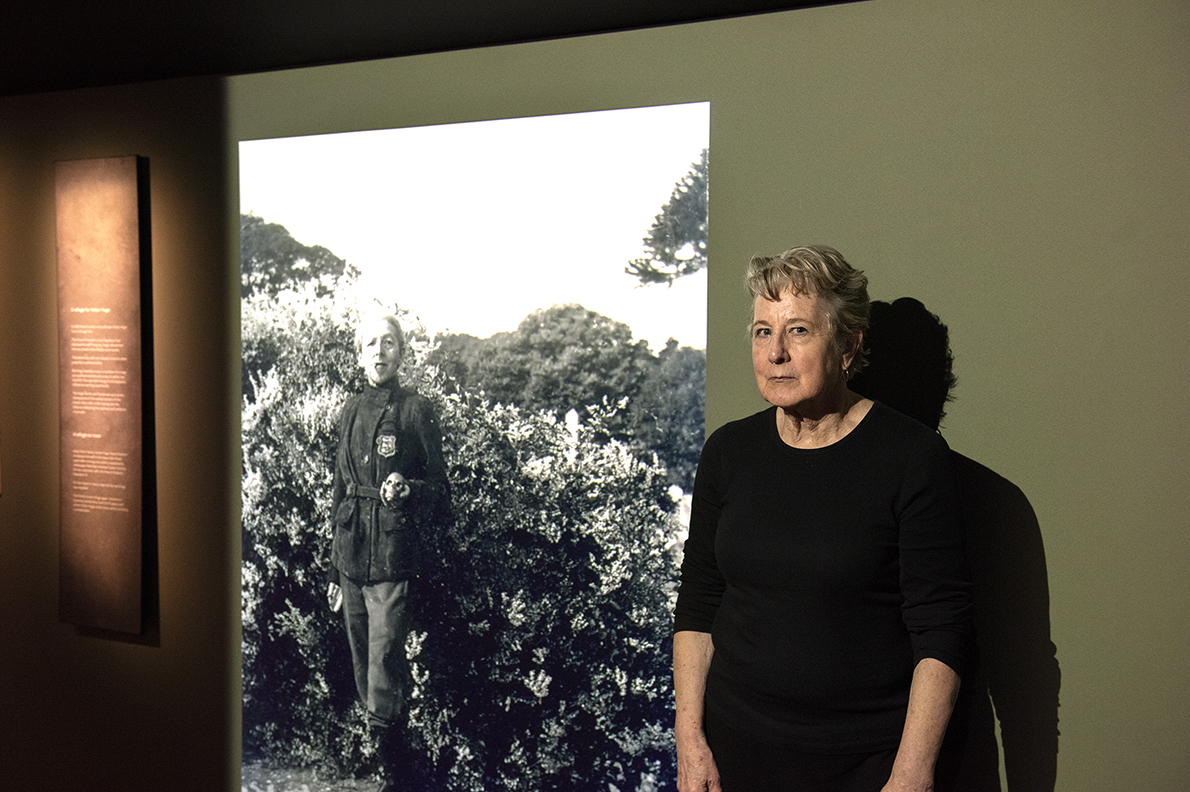
In the Jersey Museum with the projected image of Cahun dressed as ‘The Soldier with no Name’ (the dissident German Soldier, the character Cahun and Moore invented during the occupation of Jersey during WWII). This image was taken by Marcel Moore in 1947. Photograph by Luís Branco.
Most of the texts, letters, diaries and manuscripts in the archive are in French. The anti-Nazi tracts are all in German. I don’t speak or read either language. I am fascinated by the tracts, the letters they wrote during their time in jail and Cahun’s writings after the war. My translations here are from Google translate.
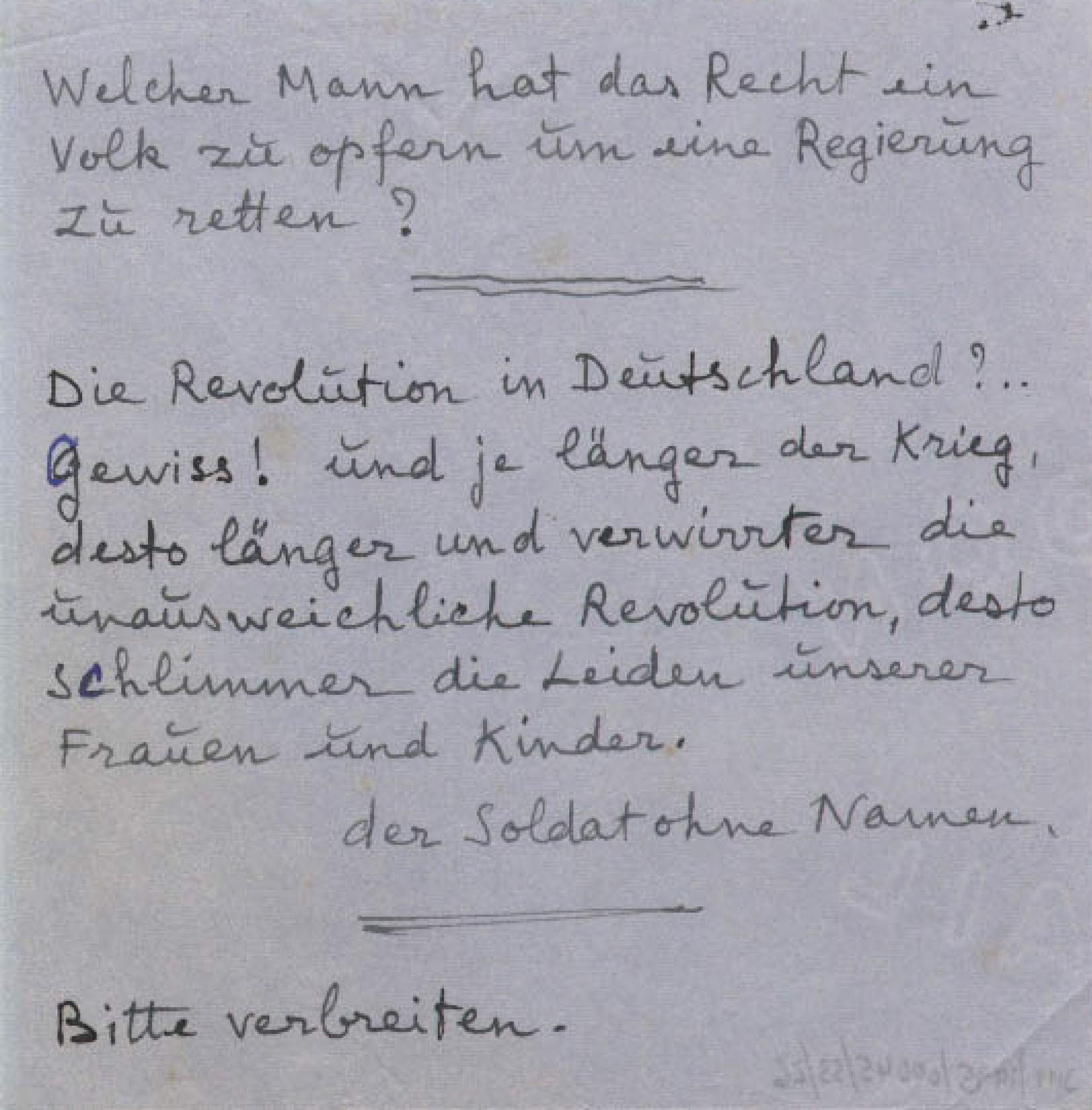
One (#27) of Cahun and Moore’s tracts written during the occupation of Jersey between 1940 and 1944. A digital image held in the Jersey Archive.Translation below.
Which Man has the Right to sacrifice a people to save a Government?
The Revolution in Germany? … Indeed! And the longer the war lasts, the
longer and more chaotic the inevitable Revolution will be and the worse
the suffering of our women and children.
the Nameless Soldier
Please circulate
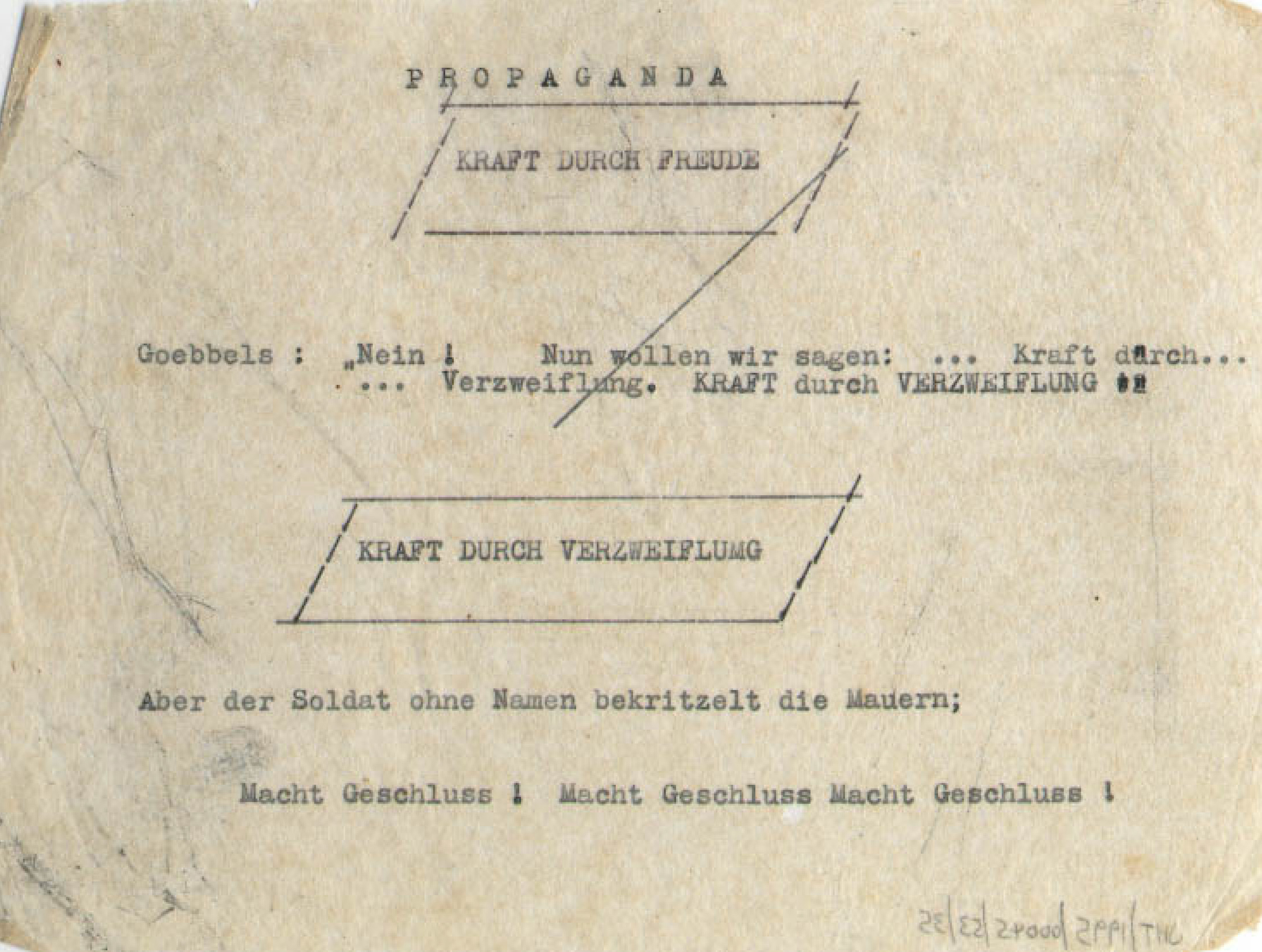
One (#36) of Cahun and Moore’s tracts written during the occupation of Jersey between 1940 and 1944. A digital image held in the Jersey Archive. Translation below.
PROPAGANDA
STRENGTH THROUGH JOY
Goebbels: No! Now let us say: … Strength through …
… Despair. STRENGTH through DESPAIR
STRENGTH THROUGH DESPAIR
But the Nameless Soldier scribbles on the Walls;
Make an End of it! Make an End of it! Make an End of it!
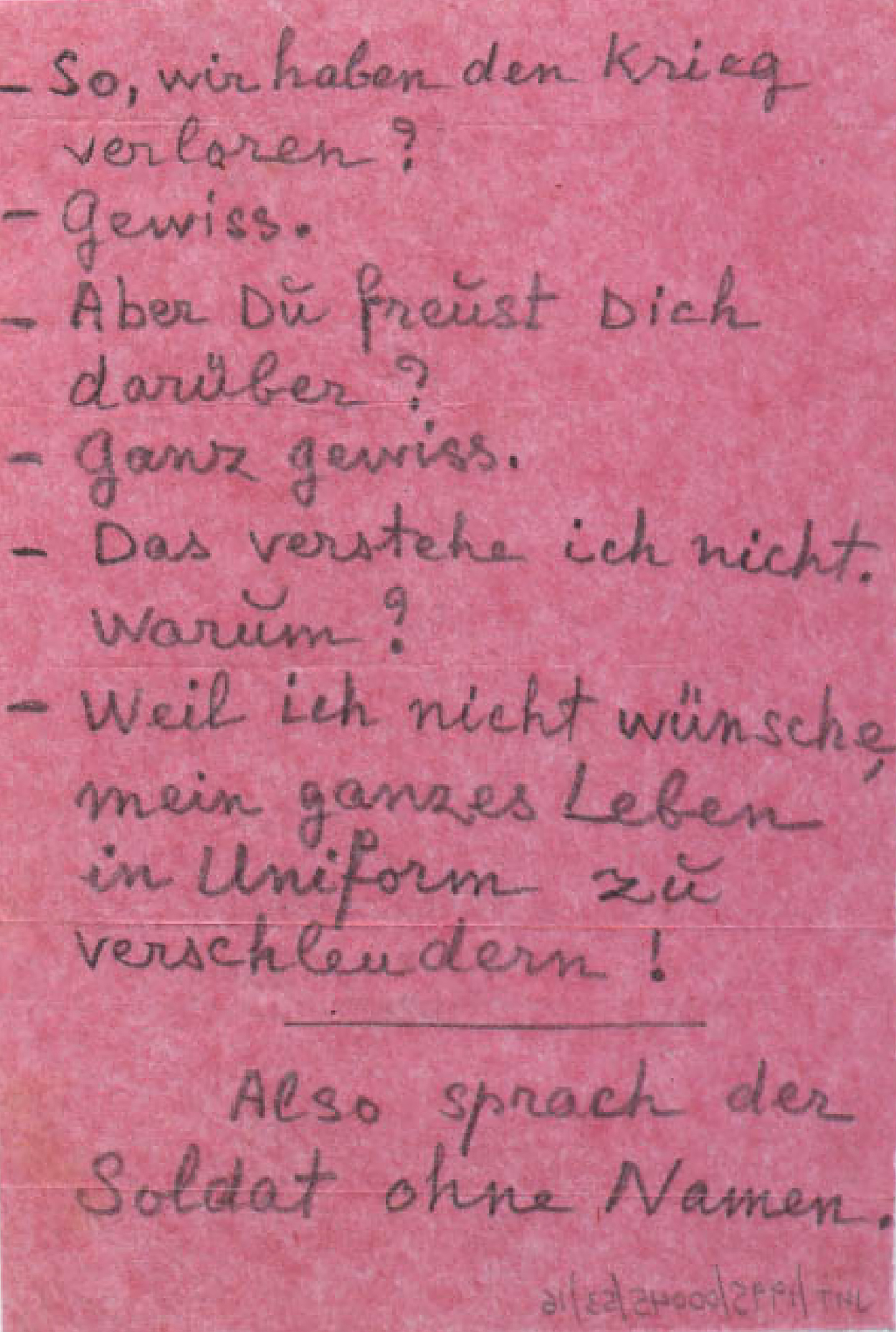
One (#17) of Cahun and Moore’s tracts written during the occupation of Jersey between 1940 and 1944. A digital image held in the Jersey Archive. Translation below.
—So, sir have you lost the war?
—Certainly.
—But you are happy about it?
—Quite certainly.
—I don’t understand that. Why?
—Because I don’t want to squander my entire life in uniform!
————
Thus spoke the Nameless Soldier.
As you can discern from these tracts attributed to the Nameless Soldier (the dissident German soldier invented by Cahun and Moore), Cahun and Moore wrote in different forms and voices to project their anti-war, anti-Nazi sentiments. They produced thousands of these tracts and distributed them widely on the island between 1940 and 1944. The Feldgendarmerie (German Field Police) had collected these tracts and were perplexed by them, assuming they were produced by a group of resistant German soldiers or islanders. They would never have suspected two middle-aged French ladies. However, Cahun and Moore were eventually discovered (it is not clear how), jailed and tried by a military court. They were subsequently sentenced to death for “propaganda undermining the morale of the German forces.” As I have noted before, the war ended before their death sentence could be carried out.
Once Cahun and Moore were discovered and arrested for their resistance work, they were jailed in Gloucester Street Prison in St. Helier. There, they were isolated in separate cells. They had never been separated for any length of time during their adult lives. The archive contains sixty-two digitally preserved letters, originally written on toilet paper, that they exchanged while in jail. These pages are all in the same handwriting; I’m not sure whether they were written by Cahun or Moore. The Google translation below offers details of their daily lives while incarcerated.
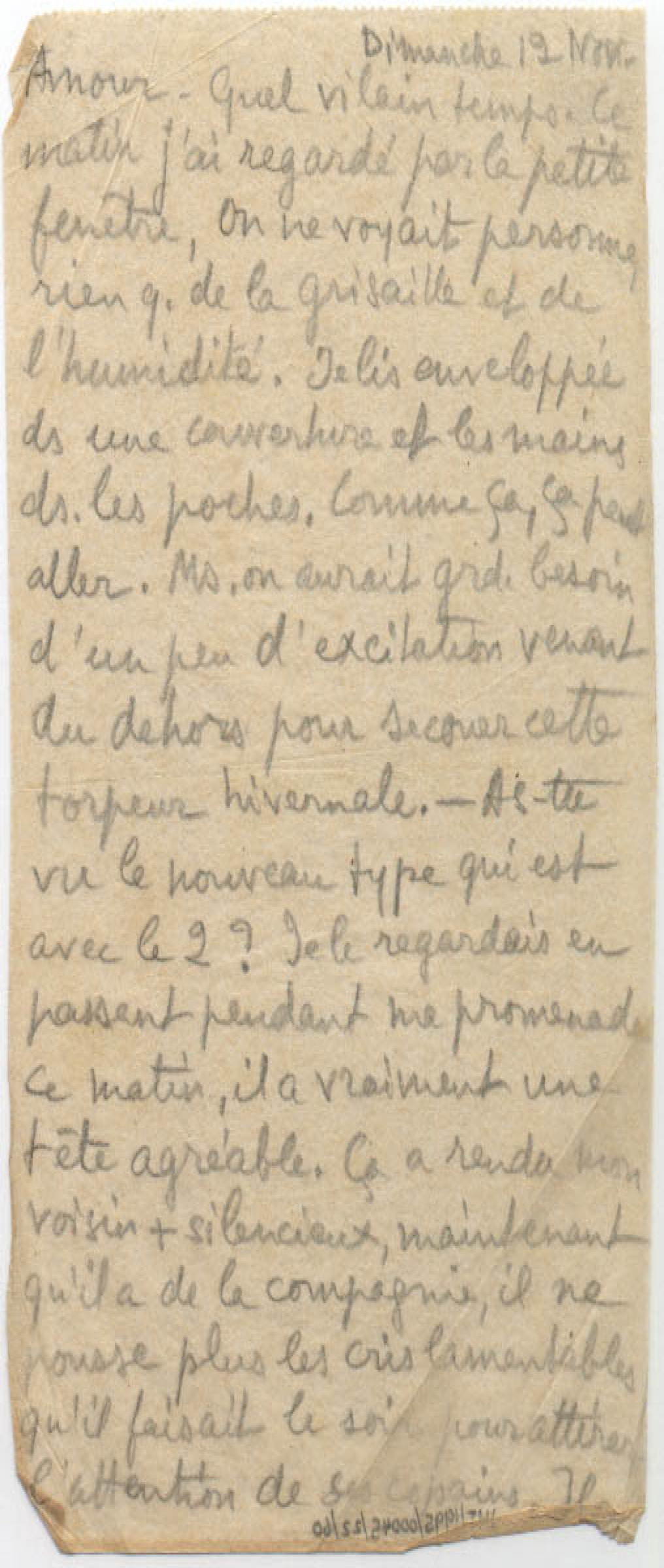
One (#60) of Cahun and Moore’s letters to each other when both were in solitary cells in Gloucester Street Prison, written on Sunday, November 12, 1944. They wrote these letters on toilet paper. Digital images of these many letters are held in the Jersey Archive. Translation below.
Sunday 12 of November
My Love—what wretched weather.
This morning I looked out through the little
window, there wasn’t a soul in sight—
nothing but greyness and dampness.
I’m reading wrapped
in a blanket, with my hands
stuffed in my pockets.
That makes it bearable, at least.
But we could really use
a little excitement coming
from the outside world to shake off
this wintry torpor. — Did you
see the new guy who’s
staying with Number 2?
I glanced at him in passing
during my walk this morning,
he really has a pleasant face.
It has made our neighbor
much quieter; now that
he has company, he no longer
lets out those mournful cries
he used to make in the evenings
to get his buddies’ attention.
Cahun and Moore communicated with each other (and with the other prisoners) with notes passed through a secret ‘postal service’ that was established through the ventilation ducts; in this way, they established relationships with the other political prisoners. While searching through the archive I found images of the ‘Prisoners’ Autograph Book’ that Cahun and Moore had put together, which includes short epigrams and signatures by other prisoners. Even under great duress they mustered activities with the other prisoners with some humor and fun.
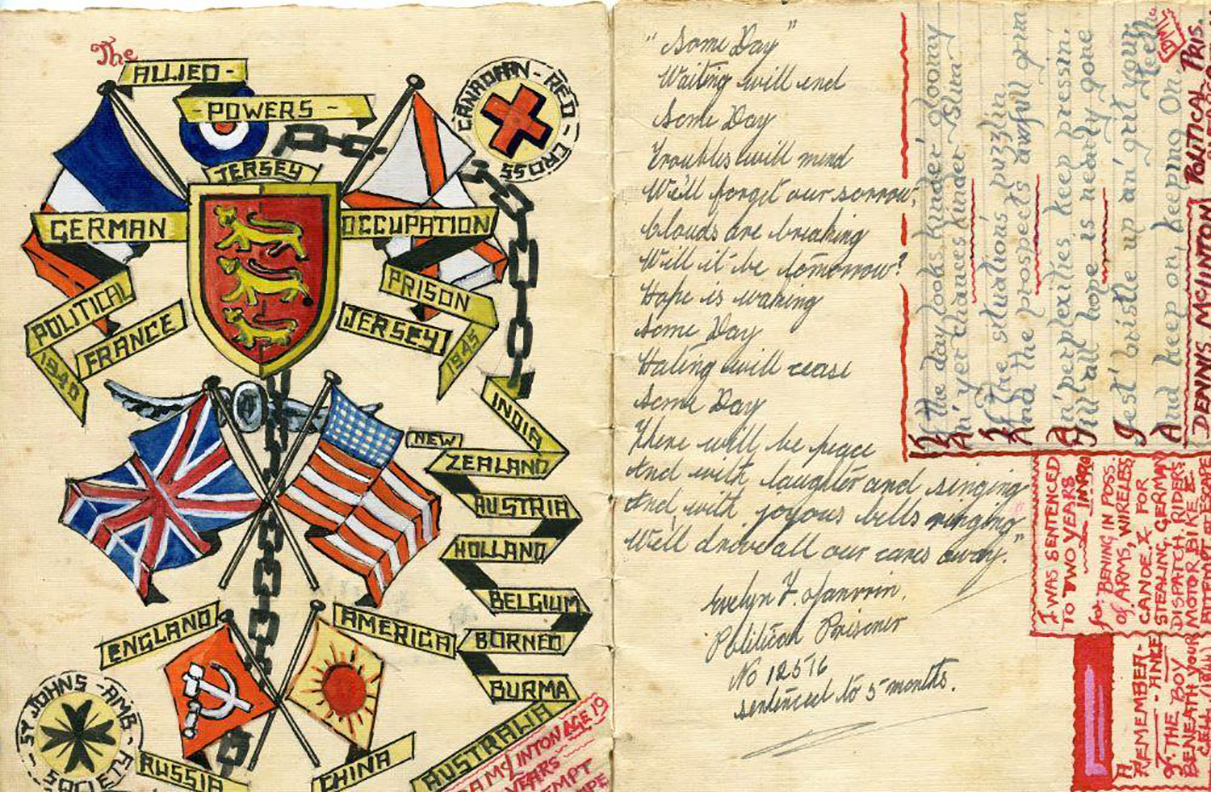
One of the pages from the ‘Prisoners’ Autograph Book’ put together by Cahun and Moore while in prison. In the Jersey Archive.
Viewing these documents and images in the Jersey Museum and the Jersey Archive gave me a whole new sense of the depth of Cahun and Moore’s resistance work, the creativity behind it and their dedication and persistence against all odds.
Below is one of my favorite images of Marcel Moore (standing) and Claude Cahun (seated) together in the doorway of their home, La Rocquaise, on St. Brelade’s Bay sometime after their release from jail in 1945. They are hardly ever pictured together, though they were inseparable in art and life.
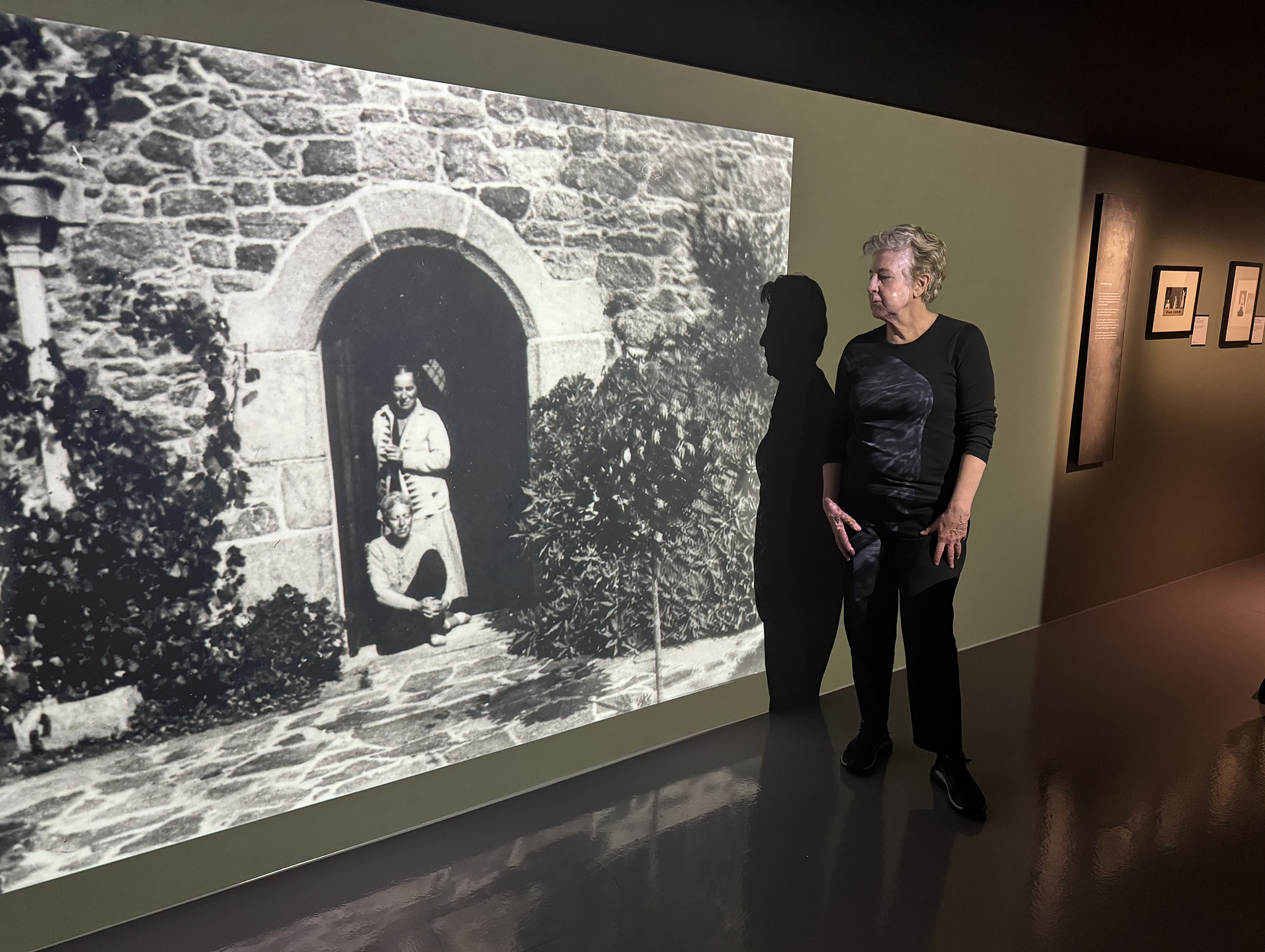
In the Jersey Museum with the projected image of Moore (standing) and Cahun (seated) in front of their home La Rocquaise. Taken in 1945 after their release from jail. Photograph by Luís Branco.
After their release from jail, they gradually put their lives back together. The Germans had stripped the house bare, confiscating most of their art works, books, furniture, and other household items. Cahun’s health was very fragile—the time in jail had taxed her physically and emotionally. She continued to write about their resistance work and their time in jail. They thought about moving back to Paris; in 1953 they visited friends and looked for a place to live. Cahun became ill and they had to return to Jersey. She died in the St. Helier hospital on December 8, 1954. Moore eventually sold La Rocquaise and moved to the nearby village of Beaumont. Moore took her own life in 1972.
I have written another blog post “Double Take – Chasing the Specter of Claude Cahun” – about the photographic work Luís Branco and I made in Jersey. Here is the link:https://sherrywigginsblog.com/2026/04/12/double-take-chasing-the-specter-of-claude-cahun-posted-on-april-11-2026-in-boulder-colorado/
Discover more from sherrywigginsblog
Subscribe to get the latest posts sent to your email.
 sherrywigginsblog
One thought on “Projections and Revelations: In the Jersey Museum and the Jersey Archive – posted April 11, 2026 in Boulder, Colorado”